
 Worksheets
Atomic Bonding
Total questions: 55
Worksheet time: 46mins
Name
Class
Date
1.

How many protons are in Beryllium?
a)
4
b)
9
c)
5
d)
2
2.

What's a valence electron?
a)
electrons in the second energy level
b)
electrons in the outermost energy level
c)
the atomic number
d)
electrons in the first level
3.
How many valence electrons does Beryllium have?
a)
1
b)
2
c)
3
d)
4
4.
How many valence electrons does carbon have?
a)
1
b)
3
c)
4
d)
5
5.

These elements have ____ valence electrons
a)
Full Shell
b)
3
c)
2
d)
1
6.

The circled elements have _____ electrons in their outer shell:
a)
8
b)
1
c)
a full set
d)
7
7.
When two or more atoms join together, the following can be formed
a)
elements
b)
molecules only
c)
molecules and/or compounds
d)
compounds only
8.
Electrons have the following charge
a)
positive
b)
negative
c)
neutral
d)
radioactive
9.
Protons have the following charge
a)
negative
b)
positive
c)
neutral
d)
radioactive
10.
Cations are
a)
positive
b)
negative
c)
on the right side of the periodi table.
d)
nonmetals
11.
Ions are:
a)
atoms with a positive or negative charge
b)
atoms with no charge
c)
atoms with ONLY a positive charge
d)
atoms with ONLY a negative charge
12.
When an atom loses a valence electron, it becomes a(n) _____________ ion.
a)
positive
b)
negative
c)
neutral
d)
polyatomic
13.
Negative ions form when atoms _________ valence electrons.
a)
lose
b)
gain
c)
share
14.
A chemical symbol that is surrounded by dots that represent elements is a....
a)
electron dot diagram
b)
valence electrons
c)
Bohr Model
15.
Atoms are most stable when their outer shell is filled with electrons.
a)
true
b)
false
16.
Covalent bonds are between...
a)
Metal and Non-metal
b)
Non-metal and Non-metal
c)
Metal and Metal
17.
Ionic bonds are between...
a)
Metal and Non-metal
b)
Non-metal and Non-metal
c)
Metal and Metal
18.
How are covalent bonds formed?
a)
Sharing of electrons
b)
Transfer of electrons
19.
How are ionic bonds formed?
a)
Transfer of electrons
b)
Sharing of electrons
20.
The compound 02 would be classified as a
a)
Covalent Bond
b)
Ionic Bond
c)
Element
d)
Metallic Bond
21.
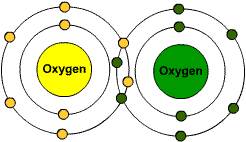
Is this image an example of covalent bonding?
a)
Yes
b)
No
22.

Outer shell electrons are called
a)
outer electrons
b)
valence electrons
c)
negatives
23.

Atoms want
a)
A full outer shell of electrons
b)
One electron short of a full shell
c)
kit kats
24.
What two types of atoms make a covalent bond?
a)
2 Nonmetals
b)
1 Nonmetal and 1 Metal
c)
2 Metals
d)
2 Noble Gases
25.

Name the following compound:
CO2
CO2
a)
monocarbon dioxide
b)
carbon oxide
c)
carbon dioxide
d)
oxygen carbonide
26.

How many valence electrons does oxygen have?
a)
2
b)
3
c)
6
d)
4
27.

How many valence electrons does nitrogen have?
a)
3
b)
2
c)
5
d)
1
28.

What is the correct formula for this molecule?
a)
NH
b)
N3H
c)
NH3
d)
NH4
29.

How many valence electrons does hydrogen have?
a)
4
b)
3
c)
2
d)
1
30.
Which of these is not a real bond in chemistry?
a)
James
b)
Ionic
c)
Covalent
31.
Is hydrogen considered a metal or a non-metal?
a)
A metal
b)
Nonmetal
c)
Metalloid
32.
Hydrogen and helium are exceptions to the octet rule because the have a complete energy level with just two valence electrons
a)
true
b)
false
33.
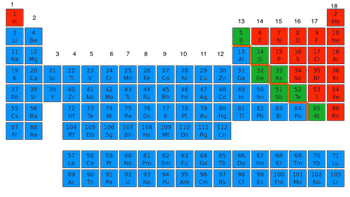
Where are metals located on the periodic table?
a)
Blue
b)
Green
c)
Red
34.
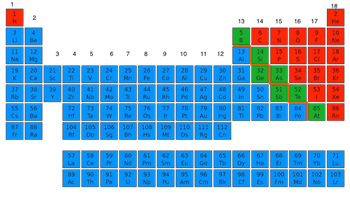
Where are the nonmetals located on the periodic table?
a)
Blue
b)
Red
c)
Green
35.
How many electrons should Helium have around its Lewis dot model?
a)
1
b)
2
c)
7
d)
8
36.
How many electrons should Neon have around its Lewis dot model?
a)
5
b)
6
c)
7
d)
8
37.
The number of _____ is most important in determining how an atoms will bond.
a)
Neutrons
b)
Protons
c)
Valence Electrons
d)
Electron sin the innermost shell
38.

This picture shows a...
a)
Ionic Bond
b)
Covalent Bond
c)
Both bonds
d)
Neither bond
39.

Ammonia (NH3) is found in many household cleaning solutions.
a)
Ionic
b)
Covalent
40.

Cow farts, which release methane (CH4), are a source of global warming.
a)
Ionic
b)
Covalent
41.
What is the name of the electrons that are found on an atom's outer ring and are responsible for bonding with other elements?
a)
Stable electrons
b)
Valence electrons
c)
Unstable electrons
d)
Isotope electrons
42.
The COLUMNS on the periodic table tell us:
a)
# of rings or levels
b)
# of total electrons
c)
# of valence electrons
d)
# of protons & neutrons
43.

What type of bond is shown in the image?
a)
Hydrogen
b)
Ionic
c)
Covalent
44.

Ionic Bonds take place between
a)
nonmetal - nonmetal
b)
metal - nonmetal
c)
metal - metal
45.

Covalent Bonds take place between
a)
nonmetal - nonmetal
b)
metal - nonmetal
c)
metal - metal
46.

What molecule is this?
a)
CO
b)
CO2
c)
C2O
d)
C2O2
47.
What bond is formed between a nonmetal and a nonmetal?
a)
Covalent bond
b)
Ionic bond
48.
What bond is formed between a metal and a nonmetal?
a)
Covalent bond
b)
Ionic bond
49.

Why are ions formed?
a)
To make our lives difficult
b)
Because atoms want 8 valence electrons
c)
Because atoms have the same number of protons and electrons
d)
Because atoms gained neutrons
50.

Cations are...
a)
Positive
b)
Negative
c)
Neutral
d)
Purring
51.

Anions are...
a)
Positive
b)
Negative
c)
Neutral
d)
Crying
52.

An atom becomes _________ when it gains electrons.
a)
Positive
b)
Negative
c)
Neutral
d)
Invinsible
53.

An atom becomes _______ when it loses electrons.
a)
Positive
b)
Negative
c)
Neutral
d)
Invinsible
54.
If an element has 3 valence electrons, what charge will likely form on its ion ?
a)
+3
b)
+5
c)
-3
d)
-5
55.

Elements on the LEFT side of the periodic table will most likely form:
a)
Positive ions
b)
Negative ions
c)
Neutral Ions
d)
None of these
100 %

