
 Worksheets
Test Review- Chemistry Final
Total questions: 84
Worksheet time: 2hrs 1mins
When balancing chemical equations, you CANNOT change the___
element
compound
coefficient
subscript
In the equation 2H2 + O2 --> 2H2O the coefficient of the oxygen (O) reactant is
0
1
2
3
What are the products of the following equation?
N2 + 3H2 --> 2NH3
N2
3H2
2NH3
N2 + 3H2
According to the Law of Conservation of Matter
you can create or destroy matter
you cannot create or destroy matter
matter does not exist
In a chemical equation, how should the mass of the reactants compare to the mass of the products?
The reactants will have a higher mass than the products
The products will have a higher mass than the reactants
The reactants will not have any mass
The mass of the reactants will be the same as the mass of the products
Which of the following is a physical change?
breaking a bone
rust forming on a nail
stomach digesting food
cooking pancakes
In the following equation, what are the reactants?
CH4 + 4Cl2 --> CCL4 + 4HCl
CH4 + 4Cl2
CCl4 + 4HCl
CH4
CCl4
In the following equation, what is the subscript for chlorine on the reactant side?
CH4 + 4Cl2 --> CCl4 + 4HCl
4
2
1
In the following equation, how many total elements are present on the product side?
CH4 + 4Cl2 --> CCl4 + 4HCl
4 total elements
7 total elements
6 total elements
3 total elements
In the following equation, how many total atoms are on the product side?
CH4 + 4Cl2 --> CCl4 + 4HCl
10
13
16
Which of the following is NOT an indicator of a chemical reaction?
evolution of gas
condensation
evolution of heat
precipitate
In lab, two clear liquids are mixed together and a bright yellow, solid substance forms from the solution. Which best describes what happened?
a physical change occurred and a new yellow solution was formed
a chemical change occurred and a new yellow solution was formed
a physical change occurred and a yellow precipitate formed
a chemical change occurred and a yellow precipitate formed
Which of the following is an example of a chemical change?
a sugar cube is crushed
salt dissolves in water
kool-aid freezes
vinegar and baking soda mixed together and forms a gas
Of the following equations, which one is balanced?
2Fe + 3O2 --> Fe2O3
2Na + O2 --> 2NaO
Na + 2HCl --> H2 + 2NaCl
Balance the following equation:
Al + O2 --> Al2O3
2Al + O2 --> Al2O3
Al2 + O3 --> Al2O3
2Al + 3O2 --> Al2O3
4Al + 3O2 --> 2Al2O3
How is the Law of Conservation of Matter shown in a chemical reaction?
The number of atoms in the reactants and the number of atoms in the product have no relationship
The number of atoms in the reactants is equal to the number of atoms in the products
The number of atoms in the products is greater than the number of atoms in the reactants
The number of atoms in the reactants is greater than the number of atoms in the product
During lab, a chemical change occurred and a solid substance was formed in a beaker where two liquids were mixed. What is that solid substance called?
a solute
a solvent
a solution
a precipitate
Which number tells how many molecules are in a chemical formula?
subscript
coefficient
Which number tells how many individual atoms are in a chemical formula
subscript
coefficient
CH4+ __O2 → CO2 + 2H2O
Which is the best description of table salt (NaCl)?
atom
compound
element
________ is a substance that is produced during a chemical reaction
Substance
equation
Chemical equation
Product

Which of the following does this picture represent?
Element
Compound
Mixture of elements & compounds
Mixture of compounds

Which of the following does this picture represent?
Element
Compound
Mixture of elements & compounds
Mixture of compounds
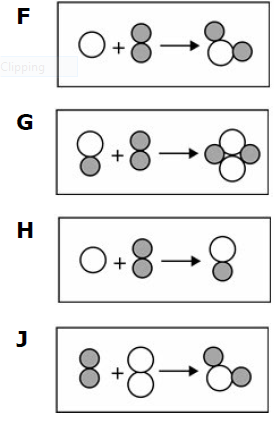
Which one of the following illustrations shows a molecule that is NOT a compound?


A solution of hydrochloric acid (HCl) in an open container is placed on a balance. Magnesium (Mg) metal is added to the acid and the mass is recorded.
The solution is stirred and the mass of the solution is recorded every 10 minutes. The following data is collected (see picture).
Based on this data, which of the following is most likely occurring?
The hydrochloric acid and magnesium metal react to form a gas that is less dense than the surrounding air.
The hydrochloric acid and magnesium metal react and some of the atoms are destroyed, which decreases the overall mass.
The hydrochloric acid and magnesium metal react to form a precipitate
The hydrochloric acid and magnesium metal are not reacting with each other

In this picture: Atoms are represented by circles Molecules are represented by circles that are connected to each other. Different colored circles represent different types of atoms (different elements).
Which of the pictures could represent a chemical reaction?
A
B
C
D
What does it mean for a chemical equation to "support the law of conservation of matter"?
The chemical equation has reactants and products.
The equation includes coefficients that show the same number of atoms of each type before and after a reaction
The equation shows the transfer of energy as a substance is heated or cooled
The equation demonstrates no change in the substances after the reaction occurs

Which of the models of a chemical reaction best represents the Law of Conservation of Mass?
A
B
C
D

How many grams of OXYGEN would be needed to show conservation of mass in the example below?
100 g
93 g
7 g
0 g

Look at the pictures above. A shows the bag before the vinegar and baking soda are mixed together, and B shows it after they are mixed together. In which picture do the contents of the bag have the greater mass?
The mass is greater in A—before they are mixed.
The mass is greater in B—after they are mixed.
The mass is the same in both.
The mass depends on the temperature.

Is it possible for these reactants to become this product?
No, because no new types of atoms were made
No, because none of the atoms were destroyed
Yes, because the type and number of atoms are the same, just rearranged differently
Yes, because new types of atoms were created
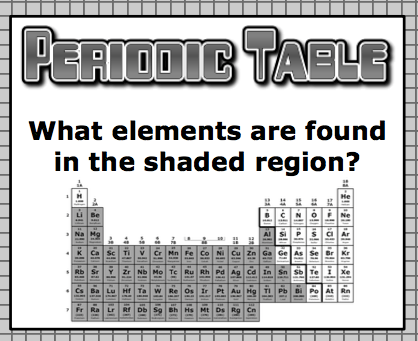
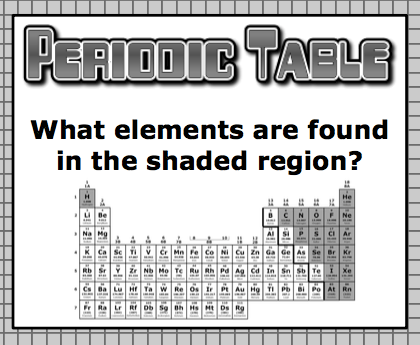
What subatomic particle is found in the nucleus and is neutral?
proton
neutron
electron
What subatomic particle is negative and found outside the nucleus?
proton
neutron
electron
Every element has an unique number of _______________.
protons
neutrons
electrons
symbols
What subatomic particle is positive and found in the nucleus?
electron
proton
neutron
quark
The atomic number of an element increases from left to right across the periodic table.
True
False

What is the atomic mass of Calcium (Ca)?
40.08
20

How many protons does Potassium (K) have?
39
19
20
39.10
Hydrogen and Helium have similar physical and chemical properties.
True
False
The chemical properties of an element are determined by the number of
energy levels
valance electrons
isotopes
ions
The identity of an element on the periodic table is determined by the number of _______.
protons
neutrons
electrons
ions
Subatomic particles with a negative charge
Electrons
Neutrons
Protons
Quarks

How many neutrons does platinum have?
78
117
195
196

How many atoms in all are in a molecule of serotonin?
C10H12N2O
2HgO → 2Hg + O2
Al + O2 → 2Al2O3

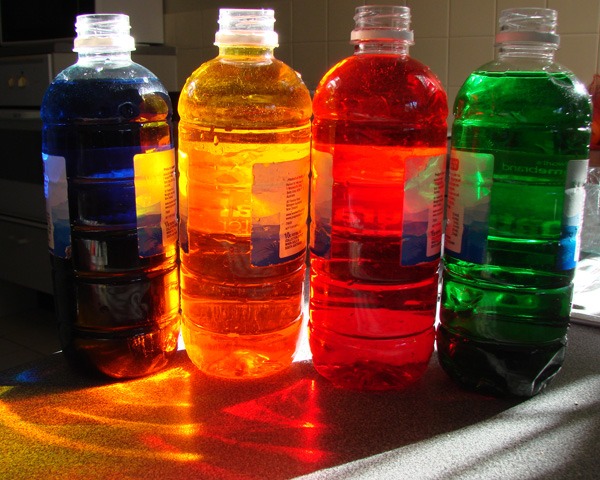


How would you separate a mixture of sand and salt?
Mix them with water and let the water evaporate
Mix them with water, pour the mixture through a screen, then let the water evaporate
Heat the sand and salt mixture for 5 minutes, then let it cool
I would not do any of these because none of these options would work

This picture represents which of the following?
element
compound

