
 Worksheets
ASYS 220 Exam 2 Review
Total questions: 60
Worksheet time: 20mins
Which one is not a form we use oxygen in?
Solid
Liquid
Gas
Plasma
What color are low pressure oxygen bottles?
Green
Yellow
Brown
Black
What color are high pressure oxygen bottles?
Green
Yellow
Brown
Black
Liquid oxygen systems are typically found on what type of aircraft?
Homebuilt
Military
High altitude
Restricted category
How is solid oxygen activated?
Demand from the person inhaling at the mask
Opening a regulator
By a small explosive charge
By mixing with water

Which type of oxygen system uses this type of mask to deliver oxygen to cabin crew and passengers?
Regulated
Pressurized
Continuous flow
Diluter demand
When servicing oxygen, what must be free of grease and oil?
Coverall
Tools
Lines and hoses
All of these
What happens to oxygen bottles when filling?
They heat up - so fill slowly to prevent overheating
They get cold - so fill slowly to prevent freezing
They expand - so loosen mounting clamps first
Nothing, they're designed for this
When servicing oxygen from a cart using the cascade method, which bottle should we use first?
The fullest bottle
The second-fullest bottle, save the full one
The lowest pressure bottle that's higher than the aircraft one
Open all bottles at once and let the regulator regulate the flow
If we're servicing an oxygen system before departing Cancún, the aircraft is much hotter than it usually is, what do we have to consider?
Fill the system higher pressure than it is rated for
Fill the system to what it is rated for
Fill the system to lower pressure than it is rated for
Don't service the system until at standard temperature
What condition does the body experience when we don't get enough oxygen?
Hypoxia
Anoxia
Oxidation
Anemia
What are symptoms of hypoxia?
What can we do to prevent hypoxia?
Pressurize the aircraft
Use latent heat
Everyone brings a portable oxygen bottle
Test for carbon monoxide
What is a disadvantage to pressurization?
Extended range due to less drag at altitude
Higher altitude flight
Subjects the structure to tension stresses
Lower cost to install
Which one is not a source of bleed air for pressurization?
Turbochargers
Superchargers
Combustion air heaters
Bleed air
What section of a turbine engine is bleed air taken from?
Inlet
Compressor
Combustor
Turbine
If we're pumping air in for pressurization, how do we keep from blowing up the fuselage?
Ventilate with windows
Regulating less air coming in
Meter air leaking out with valves
Fretting corrosion lets air out of the rivets.
What are those valves called?
Outlet valve & safety valve
Outflow valve & sentient valve
Outflow valve & safety valve
Outside valve & secure valve
Which valve works most of the time, with a pressure setting, in the isobaric range, normal flight?
Outflow valve
Safety valve
Dump valve
Negative pressure relief valve
Which valve controls the airflow out when we're at the maximum pressure the fuselage can handle?
Outflow valve
Safety valve
Dump valve
Negative pressure relief valve
Which valve is spring-loaded to open inwards?
Outflow valve
Safety valve
Dump valve
Negative pressure relief valve

Which of the following would cause the safety valve to open?
The pilot presses the dump switch
The weight on wheels switch is tripped
The pilot climbs to a very high altitude
All of these
Which of the following can be used for both heat and pressurization?
Combustion heater
Exhaust gas
Bleed air
Supercharger
An Air Cycle Machine ____ temperature and ____ pressure of bleed air.
decreases, decreases
decreases, increases
increases, decreases
increases, increases
The Air Cycle Machine is also called a ____
BACK
PACK
LACK
STACK
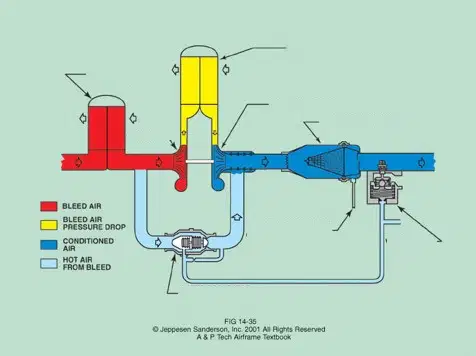
What is the first component bleed air passes through?
Primary heat exchanger
Secondary heat exchanger
Cooling turbine
Vernatherm
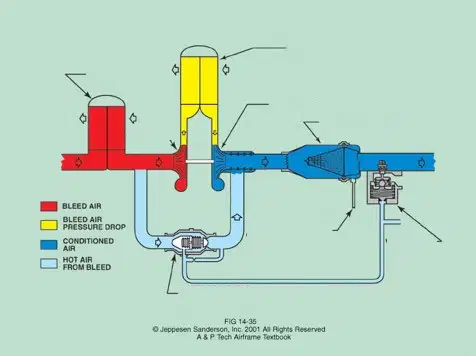
What is the last component bleed air passes through?
Primary heat exchanger
Cooling turbine
Water separator
Vernatherm
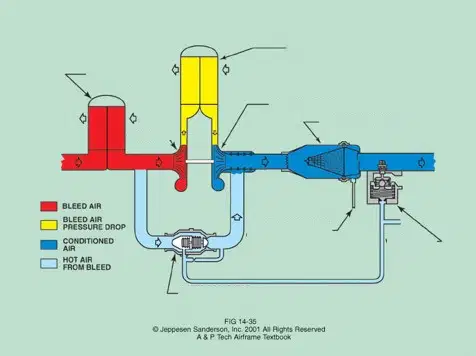
Which component may bleed air pass through only sometimes?
Secondary heat exchanger
Temperature control valve (35* F valve)
Cooling turbine
Water separator

Why would it pass through there?
Prevent water from freezing solid on the water separator
When the compressor can't handle all the inlet air
If the bleed air isn't hot enough
All of these
Instead of using pressure and temperature of air, we can use an air conditioner like our cars. What do we call this system?
ACM
Vapor cycle system
Bleed air circulation
Freon combustion
We change the state of matter from a gas or vapor to a liquid and back, what principle is this?
Layaway heat
Latent heat
BTU capitalization
Phase changes

Coming out of the compressor we have high pressure vapor/gas. What is it when it comes out of the condenser?
High pressure vapor
Low pressure vapor
High pressure liquid
Low pressure liquid

The receiver dryer acts as a filter and a _____
Pressure booster
Reservoir
Accumulator
Secondary expansion valve

The thermal expansion valves meters out fluid in low quantities to drop the pressure. What does the evaporator do afterwards?
Changes state from liquid to gas
Takes the BTUs from the cabin air
Warms up in temperature
All of these
Now that we just looked at it, what order did the vapour cycle system flow in?
(type answer as 12345 in correct order)
1-Compressor
2-Condenser
3-Evaporator
4-Receiver Dryer
5-Thermal Expansion Valve
(a)
Why don't we use water in a vapor cycle cooling system?
It can freeze and clog the system
It's too expensive
It doesn't transfer heat
It doesn't meet a MIL spec
What is a drawback of using bleed air heat?
It's not hot enough
It reduces engine efficiency
Contaminants can enter the cabin air
There's not enough pressure
What do we use most often for small single engine aircraft heat?
Exhaust type heat
Combustion air heater
Bleed air heat
Electrical heat
What do we use most often for small twin engine aircraft heat?
Exhaust type heat
Combustion air heat
Bleed air heat
Electrical heat
What fuel does a combustion air heater use?
Avgas
Jet A
JP-4
whatever fuel the aircraft uses
What is the main concern when using an exhaust heater?
Carbon monoxide
Clogged valves
Excessive backpressure
Reduced engine efficiency
True or False: We can open windows to ventilate the cabin
True
False
True or False: we can ventilate to remove contaminants from the cabin
True
False
What are some contaminants that can be in the cabin?
Ice accumulation will increase
weight
lift
aerodynamics
efficiency
Ice accumulation will reduce
weight
lift
aerodynamics
efficiency
Which kind of icing protection never lets ice build up in the first place?
de-ice
anti-ice
Which kind of icing protection removes ice after it has built up?
de-ice
anti-ice
Which one is NOT a basic method of ice protection?
Mechanical
Thermal
Electrostatic
Chemical
Selecting alternate air to bypass an iced up air filter is an example of
Thermal
Mechanical
Chemical
Using electric boots to heat propeller blades is an example of
Thermal
Mechanical
Chemical
Boots inflating and cracking ice off the wing & tail leading edges is an example of
Thermal
Mechanical
Chemical
Bleed air heating of the wings & tail on an airliner is an example of
Thermal
Mechanical
Chemical
Bleed air heating aircraft brakes is an example of
Thermal
Mechanical
Chemical
What area does NOT use in-flight chemical de-ice/anti-ice?
Propeller
Wing & tail leading edges
Engine inlets
Windshields
True or False: We use exhaust heat to help prevent carburetor icing.
True
False
True or False: We use exhaust heat to help reduce engine inlet air filter ice.
True
False
Windshields are usually heated for the entire flight to help with visibility and reduce damage from
lightning strikes
delamination
bird strikes
improper rain repellent use
Never test rain protection systems
on a dry window
on a wet window
on a hot window
without something to catch the fluid
What is the biggest advantage of electro-thermal ice protection (Boeing 787)?
Much more efficient than using bleed air
Heating blankets can be moved around to areas that need it
Incorporates geothermal heat
High velocity bleed air increases lift over the wings

