
 Worksheets
CHAPTER 3 DC CIRCUITS
Total questions: 35
Worksheet time: 3hrs 55mins
What is the scientific formula for ohm's law?
V=IR
I=VR
R=IV
None of the above
Which one of the following graphs correctly represents Ohm’s law, where V is the voltage and I is the current?


Which of the formula represent effective resistcance in parellel?
1/Reff = 1/R1 + 1/R2 + ...
Reff = R1 + R2 + ...
1/Reff = 1/R1 = 1/R2 = ...
Reff = R1 = R2 = ...
What is the resistance if the voltage is 10V and the current is 2A?
20 Ω
5 Ω
12 Ω
8 Ω

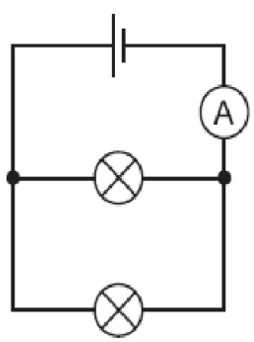
This is an example of a _______ circuit
open
series
parallel
square

This is an example of a ______ circuit
Series
Parallel
Open
Dihexihedral

A current flows in two resistors connected in series as shown in the diagram. A1 and A2 are the readings on the ammeters. V1 and V2 are the readings on the voltmeters.
Which of the following correctly describes the ammeter and voltmeter readings?
A1 is less than A2 V1 is less than V2
A1 is less than A2 V1 is greater than V2
A1 is equal to A2 V1 is less than V2
A1 is equal to A2 V1 is equal to V2

Which two resistor combinations have the same resistance between X and Y?
P and Q
P and S
Q and R
R and S
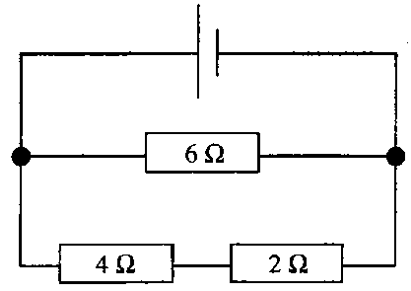
What is the effective resistance of the three resistors in the circuit shown below?
0.3 Ω
1.1 Ω
3 Ω
12 Ω
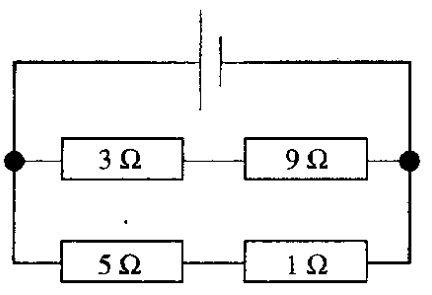
What is the effective resistance of the four resistors in the circuit shown below?
0.25 Ω
4 Ω
6 Ω
18 Ω
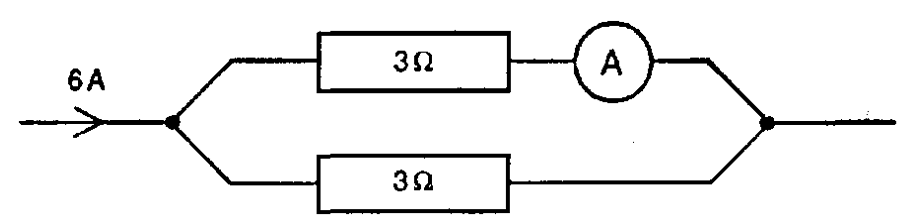
The current of 6 A flows in the circuit shown. It splits up when it enters parallel branches of resistors.
What is the reading on the ammeter?
2 A
3 A
6 A
12 A
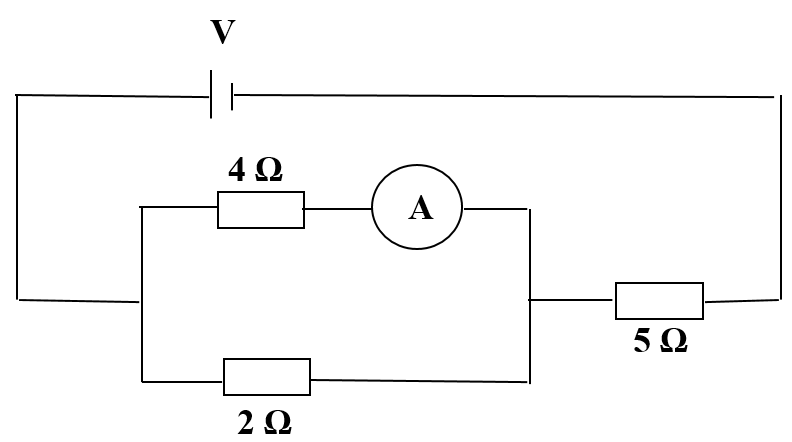
As shown in the diagram below, the ammeter reads 1A.
What is the voltage of the cell?
14 V
19 V
20 V
22 V
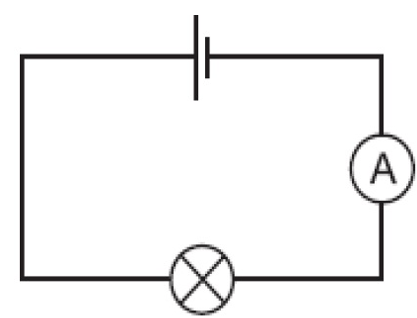
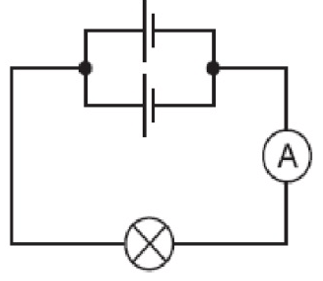
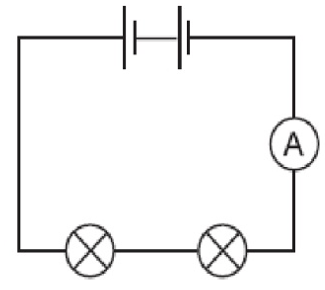
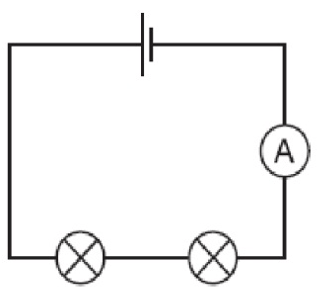
A cell is connected in series with an ammeter and a lamp. The current is 1.0 A.
In which circuit, using identical cells, lamps and ammeters, is the current reading 2.0 A?

Increase
Decrease
Stay the same
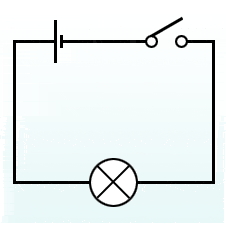
open
parallel
closed

What is the total resistance in the circuit?
10 ohms
6 ohms
4 ohms
2.4 ohms
What is the current through the 2 ohm resistor?
0.75 A
1.5 A
3 A
0.33 A
What is the current through the 4 ohm resistor?
1.5 A
3 A
2 A
0.75 A

The ammeter the picture shown reads 0.2 A. State the current at Z.
0.2 A
0.4 A
0.6 A
0.8 A

A Series circuit is shown in the picture. The resistors have values of 3Ω and 6 Ω. The ammeter reading is 0.20 A. Calculate the potential difference across the 6 Ω resistor.
0.8 V
1.2 V
1.8 V
2.4 V

The diagram shows two resistors, P and Q, in series. The ammeter reads 0.20 A. Voltmeter X reads 1.2 V and voltmeter Y reads 2.0 V.
Calculate the potential difference across resistor P.
0.8 V
1.2 V
1.5 V
3.0 V

The diagram shows two resistors, P and Q, in series. The ammeter reads 0.20 A. Voltmeter X reads 1.2 V and voltmeter Y reads 2.0 V.
Calculate the resistance of resistor Q.
3 ohm
6 ohm
9 ohm
12 ohm
A 220 Ω resistor has a voltage of 3.3 V across it. Calculate the power dissipated by the resistor.
730 mW
495 W
49.5 mW
3.3 W
Kirchhoff's current law is applicable to only
Junction in a network
Closed loops in a network
Electric circuits
Electronic circuits

What is the current I flowing through the circuit?
2 A
3 A
4 A
5 A

What is the reading V1 on the voltmeter?
2 V
3 V
4 V
6 V

What is the reading V2 on the voltmeter?
2 V
3 V
4 V
6 V

Based on the circuit, acording to the Kirchoff Current Law, we can conclude that
I1 = I2 + I3 = I6 = I4 + I5
I1 = I2 + I3 + I6 + I4 + I5
I6 = I1 + I2 + I3 + I4 + I5
I1 = I6 + I2 + I3 + I4 + I5

If R1 = 20 ohm, R2 = 30 ohm, R3 = 50 ohm,
ε₁= 10 V and ε₂= 40 V
calculate:
a) the current flow throughout the circuit
b) the voltage at R2
0.5 A , 15 V
0.5 A , 10 V
2 A , 15 V
2 A , 10 V

By using Kirchoff Current Law, find I3 if I2 = 1/4 I1
150 mA
300 mA
450 m A
600 m A

Referring to the circuit, find
a) the total current
b) voltage at R3
0.2 , 1 V
0.2 , 2 V
0.4 , 2 V
0.4 , 1 V

