
Font size
 Worksheets
Properties of Matter Unit Test Review
Total questions: 65
Worksheet time: 37mins
Nina and her mother both have cell phones. Nina thinks her cell phone is lighter than her mother's. If Nina wants to compare the masses of the cell phones, what is the best tool for her to use?
graduated cylinder
beaker
thermometer
balance
What is the best way to find the volume of an irregular shaped solid object?
triple beam balance
water displacement
L x W x H
1/2 (L x W x H)
Which physical property of matter depends on the pull of gravity?
mass
volume
weight
density
The SI base unit for mass is the gram
True
False
What does volume measure?
the amount of space something takes up
the amount of weight of something
the amount of mass of something
Temperature is a measure of the _____________ energy of the particles of a substance.
average potential
average kinetic
total kinetic
total potential

Which letter represents particles in solid form?
A
B
C
D
E
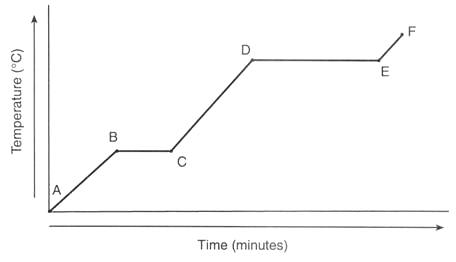
Between which points is the temperature of the substance remaining constant? (Diagram F)
A-B only.
A-B, C-D, E-F
B-C only.
B-C, D-E
True or false: melting and freezing occur at the same temperature
True
False

A substance's heating curve is shown in the graph. What is its boiling point? (Diagram B)
100 C
60 C
80 C
20 C
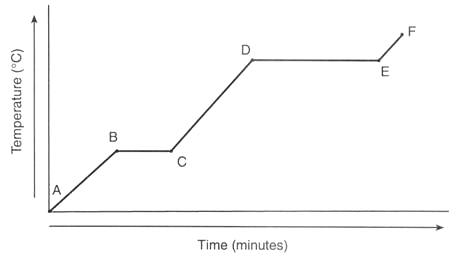
Moving left to right across the diagram, are the particles moving faster or slower as time goes on? (Diagram F)
Faster
Slower

If a substance is freezing, what is happening to it?
It is changing from a liquid to a solid
It is losing thermal energy to its surroundings
the particles of the substance are making bonds
all of the above
What is happening at absolute zero
A liquid is changing to a solid
All particle motion stops.
water can no longer change into a solid
solids are permanently in their form
Which of the following is a characteristic physical property of matter?
Density
Mass
Weight
Basicity
Which of the following are characteristic physical properties of matter?
Combustibility
Solubility
Melting point
Acidity
Which of the following are characteristic physical properties of matter?
Boiling point
Combustibility
Basicity
Electrical conductivity

Which object has the greatest mass?
a
c
f
e

Which object has the largest volume?
a
c
e
f

Which two objects have the same volume?
a -b
c-d
e-f
b-c

Which two object have the same mass?
b-c
a-f
c-f
d-b

Which object has the greatest density?
a
f
c
e

Which two objects would you expect to be made of the same material?
a-b
b-d
a-f
e-c

triple beam balance
ruler
thermometer
graduated cylinder


20 m = ___km
2000 km
200 km
.2 km
.020 km
The total energy of all the particles in a substance is called
temperature
thermal energy
degrees
mass
Heat is transferred through vibrations from one particle of matter to another
conduction
convection
radiation
insulation
The transfer of energy by electromagnetic waves is called
conduction
convection
radiation
insulation
A material that does NOT conduct heat well is called a(n)
insulator
conductor
metal
radiator
Heated air moves from baseboard heaters to the rest of a room in a process called
conduction
convection
radiation
insulation

When temperature decreases, distance between molecules ____________.
increases
decreases
stays the same
Convection occurs in
Solids only
Solids, liquids, gases
Liquids and gases only
Gases only

The handle of a metal spoon warms up when it is placed in a hot bowl of soup because of ________.
convection
conduction
radiation

Near the ceiling of a room the air is warmer. The warm air rises because of ________.
conduction
convection
radiation
Which type of transfer occurs at the speed of light and in a straight line?
Condution
Convection
Radiation
Conduction occurs more easily between solids and liquids. This is because the particles in gases are
farther apart and move faster.
closer together and move faster.
further apart and move more slowly.
closer together and move more slowly.

Analyze the graph.
Between which points is heat energy released?
E to F
B to C
E to D
D to E

Analyze the picture.
In which state do molecules have the highest kinetic energy?
ion
solid
gas
liquid

A substance in solid-state has just reached its phase change temperature. Based on the graph, what effect does additional thermal energy have on this substance?
Additional thermal energy increases the kinetic energy of the substance's particles.
Additional thermal energy breaks bonds holding substance's particles together.
Additional thermal energy changes the substance's phase with characteristic temperature increase.
Additional thermal energy does not affect the substance.
Endothermic reactions
absorb heat
release heat
Exothermic reactions
absorb heat
release heat
In the phase change of melting, is this endothermic or exothermic?
Endothermic
Exothermic
Endothermic reactions
absorb heat
release heat
Condensation is an example of
Particles moving faster/endothermic change
particles moving slower/endothermic change
particles moving faster/exothermic change
particles moving slower/exothermic change
Boiling is an example of
Particles moving faster/endothermic change
particles moving slower/endothermic change
particles moving faster/exothermic change
particles moving slower/exothermic change
If particles end up moving slower it is an example of a
Exothermic Change
Endothermic Change
Kinetic energy is what type of energy?
chemical
electric
motion
sound

During the Investigation "Ready, Set, Collide" on p.13, why did the particles diffuse quicker in hot water.
The particles in the hot water diffused quicker because the water molecules were moving faster, colliding, and moving further apart.
The particles in the hot water diffused slower because the water molecules were moving slower and not colliding as much.

Which of the following statements are true about temperature? Choose all the true statements
It is the measure of average kinetic energy
Temperature is measuring the speed of the particles
Temperature increases when kinetic energy increases
Temperature decreases when kinetic energy decreases
None of the statements are true

