wayground logo

Free Printable Worksheets

Font size

S
M
L
XL
Worksheets

Computer Science Bi-Weekly 02/09/23

Total questions: 71

Worksheet time: 45mins

Name
Class
Date
1.

a verb that means to write instructions for a computer

a)

code

b)

debugging

c)

event

d)

algorithm

2.

An algorithm that has been coded into something that can be run by a machine is called a...

a)

program

b)

bug

c)

loop

d)

command

3.

A list of steps to finish a task. A set of instructions that can be performed with or without a computer.

a)

program

b)

algorithm

c)

command

d)

condition

4.

Putting commands in correct order so computers can read the commands

a)

loop

b)

repeat

c)

debugging

d)

sequencing

5.

The action of doing something over and over again

a)

conditionals

b)

until

c)

loop

d)

constant

6.

A placeholder for a piece of information that can change.

a)

constant

b)

variable

c)

until

d)

function

7.

Breaking big problems in to smaller, more manageable problems

a)

decomposition

b)

debugging

c)

algorithm

d)

abstraction

8.

Analyzing and identifying repeated sequences

a)

debugging

b)

abstraction

c)

sequencing

d)

pattern recognition

9.

Removing parts of a problem that are unnecessary and making one solution to work for multiple problems.

a)

debugging

b)

abstraction

c)

sequencing

d)

decomposition

10.

The goal of Computational Thinking is to help you:

a)

Fix Computers

b)

Understand Code

c)

Solve Complex Problems

d)

Collect Data

11.

Which of the following is an example of a Computational Thinking strategy?

a)

Decomposition

b)

Pattern Recognition / Pattern Matching

c)

Abstraction

d)

Algorithm Design

12.

Which Computational Thinking strategies are required to be used in EVERY problem?

a)

Decomposition and Abstraction

b)

Pattern Recognition and Algorithm Design

c)

All Strategies Must Be Used in Every Problem

d)

No One Strategy Must Be Used in Every Problem

13.

Each iteration of a problem should______ the previous iteration.

a)

Copy

b)

Ignore

c)

Build On

d)

Complicate

14.

Data can help you determine:

a)

Which strategies to use.

b)

The order to use the strategies.

c)

How often to repeat the strategies.

d)

All of the Above.

15.

Breaking down a year's worth of daily temperature data by monthly average is an example of:

a)

Decomposition

b)

Pattern Recognition

c)

Abstraction

d)

Algorithm Design

16.

Noticing that your candy supply decreases every time a certain friend comes over is an example of:

a)

Decomposition

b)

Pattern Recognition

c)

Abstraction

d)

Algorithm Design

17.

What is an Algorithm?

a)

A list of steps to complete a task.

b)

What is used to make a computer work.

c)

When you look for similarities between different parts of a problem.

d)

Breaking a problem down into smaller, more manageable pieces.

18.

Designing an algorithm is most similar to:

a)

Filling a Toolbox

b)

Writing and Instruction Manual

c)

Conducting an Interview

d)

Cleaning Your Room

19.

Which of the following is an example of thinking computationally?

a)

Planning the route to meet your friend.

b)

Wandering around until you meet your friend.

c)

Asking a parent to plan your route for you in order to find your friend.

20.

Which of the following is NOT an example of thinking computationally?

a)

Planning what to collect and where to exit in a video game level.

b)

Planning how to beat your enemies in a video game.

c)

Accidentally completing a video game level.

21.
What is Code?
a)
Rules of conduct.
b)
A pack between friends.
c)
One or more commands designed to be carried out by a computer.
d)
Edoc spelled backwords.
22.
What can you make with programming?
a)
Games
b)
Websites
c)
Apps
d)
All of these
23.
A user does this to tell the computer start the commands you have written into the program.
a)
event
b)
run program
c)
function
d)
abstraction
24.
Coding is a series of commands that tells the computer what to do. 
a)
True
b)
False
25.
What is a sequence?
a)
A super fun game
b)
The tiny shiny things sewn onto clothes for fancy effect
c)
A popular dance move
d)
The order of events that the computer will execute - exactly in the order that they are written
26.

Which block makes a sprite talk?

a)
b)
c)
27.

Programming is when humans write computer instructions

a)

true

b)

false

28.
What is an Algorithm?
a)
A set of instructions in order
b)
A task for the computer
29.
What is the purpose of a flowchart?
a)
To plan the program before it is made
b)
Because it is easier
30.
Why do we use flowcharts?
a)
To represent algorithms in an easy way
b)
To use different maths shapes
31.
What does this symbol represent?
a)
Start
b)
Sub
c)
Decision
d)
Process
32.
What is this symbol used for in a flowchart?
a)
A decision/question
b)
A task to carry out
33.
What symbol do flowcharts begin with?
a)
oval
b)
parallelogram
c)
rectangle
d)
diamond
34.
What is the name of this symbol in a flowchart?
a)
Input
b)
Output
c)
Decision/Question
d)
Process
35.
What does this shape represent?
a)
Input/Output
b)
Decision
c)
Process
d)
Start/Stop
36.
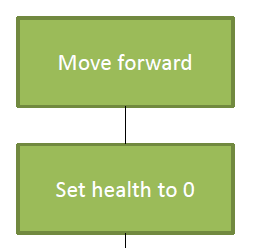
What's missing from this part of a flowchart?
a)
An Arrow
b)
A Line
c)
A Square
d)
A Diamond
37.
What is the purpose of an arrow in a flowchart?
a)
Shows the relationships between shapes/ the flow of information
b)
They look nice when we use them
c)
We don't use arrows
d)
Shows the way the arrow is directed
38.
Can this shape be used for both Start and Stop?
a)
Yes
b)
No
39.
What is the Output if the temperature is:
19
a)
Below Freezing
b)
Above Freezing
40.

What is missing on the following flowchart?

a)

Arrows

b)

Flow lines

c)

Terminators

d)

Process symbols

41.

In this flowchart the diamond shape helps with...

a)

Deciding whether the student should pass or fail

b)

Adding up the student's marks

c)

Making sure the student gets good marks

d)

Checking the student's general behaviour

42.

This flowchart is made to ...

a)

Check whether a number is odd or even

b)

Decide if we like a number or not

c)

Calculate the remainder of a number + 2

d)

Help people with Maths

43.

What kind of device is this?

a)

Input

b)

Output

c)

Input and output

44.

What kind of device is this?

a)

Input

b)

Output

c)

Input and output

45.

What kind of device is this?

a)

Input

b)

Output

c)

Input and output

46.

What kind of device is this?

a)

Input

b)

Output

c)

Input and output

47.

What kind of device is this?

a)

Input

b)

Output

c)

Input and output

48.

What kind of device is this? (Tip - similar to the ones in the computer room)

a)

Input

b)

Output

c)

Input and output

49.

What kind of device is this?

a)

Input

b)

Output

c)

Input and output

50.

What kind of device is this?

a)

Input

b)

Output

c)

Input and output

51.
If you are confronted by a difficult situation online and you do not know exactly how to handle it, what should you do?
a)
Ask an online friend for help
b)
tell an adult you trust
c)
turn off the computer
d)
make an educated guess
52.
If you are confronted by a difficult situation online and you do not know exactly how to handle it, what should you do?
a)
Ask an online friend for help
b)
tell an adult you trust
c)
turn off the computer
d)
make an educated guess
53.
Why do you need to be more cautious with friends you meet online than friends you meet in school?
a)
Most people on the Internet are not trustworthy as people in the real world
b)
Friendships that begin online are not real
c)
Online, it is more difficult to tell if a person is who he/she says
d)
websites have very strict rules about online friends
54.
What kind of personal information is it okay to reveal online?
a)
your phone number
b)
the name of your school
c)
your home address
d)
your favorite color
55.
If you are friendly to people you meet online, chances are your behavior will be reciprocated.  In other words:
a)
making an effort online to be nice is usually a waste of time
b)
If you are friendly, your internet service might be suspended
c)
If you are nice to people, they will probably be nice to you as well.
d)
if you are friendly, online crooks will take advantage of you.
56.
Molly is a 12-year old girl from Long Island.  Which of the following screen names is safest for her?
a)
mollygirl1999
b)
longisland_girl
c)
blackcat
d)
tweenchick99
57.
How are real life bullies and cyberbullies the same?
a)
they both use computers
b)
they beat you up
c)
they give you a virus
d)
in the end, they both hurt you
58.
Someone I chat with online asks me to email a picture of myself to them.  I do not really know this person.
a)
SAFE
b)
NOT SAFE
59.
While at my friends house, I do not have to follow my parents' rules about using the computer.
a)
SAFE
b)
NOT SAFE
60.
I tell my parents if an online friend wants to meet me in person.
a)
SAFE
b)
NOT SAFE
61.
Kids from schools sent me an email that made me uncomfortable, so I wrote a mean message back to them.
a)
SAFE
b)
NOT SAFE
62.
Imagine a car as a computer, and its engine as a program. Which of the following is an input for the engine program?
a)
gas pedal
b)
driver's seat
c)
steering wheel
d)
windshield wipers
63.
What is wrong with the following "code" for opening a bottle?
1. Grip cap with index finger and thumb
2. Remove cap
3. Twist counter-clock-wise until seal is broken
a)
to many steps
b)
not specific 
c)
function doesn't apply to every bottle 
d)
instructions are out of sequence
64.
How can the following instruction be made more specific? "Meet Joe at the corner of Main Street and First Avenue."
a)
describe how you first met Joe
b)
list all the streets that intersect with First Avenue
c)
describe current weather conditions 
d)
set an exact time for the meeting
65.
What is the variable when setting a thermometer? 
a)
How many people are in the room
b)
The room you are in
c)
The temperature
d)
None
66.
Which terms best describes each step in a computer program?
a)
Vague
b)
Confusing
c)
Random
d)
Specfic
67.

Which tools used to plan computer programs is a pictorial representation of program steps?

a)

assembly

b)

debugging

c)

flowchart

d)

psuedocode

68.

Why do we decompose a complex problem?

a)

To make it more difficult to solve

b)

To change the problem we have

c)

To make it easier to solve

69.

Which of these is an example of decomposition?

a)

Watching a mechanic repair a bicycle

b)

Looking at different bicycles for similarities between them

c)

Finding out how a bicycle works by looking in detail at the different parts that make up the bicycle

70.

Which of these is an example of decomposition?

a)

Breaking the problem of organising a cake sale into smaller parts, such as who will bake the cakes and when to hold the cake sale

b)

Taking the problem of baking a cake and thinking about how we can make it the best cake possible

c)

Looking at what different kinds of cake can be made

71.

Mr. Fronek was trying to organize a schedule for a half day of school. Instead of thinking of all the students in Mr. Hillegonds' 5th hour, he thought of the whole class as 5th hour. What part of Computational Thinking was she using?

a)

Abstraction

b)

Decomposition

c)

Algorithm

d)

Pattern Matching