Wayground logo

Free Printable Worksheets

Font size

S
M
L
XL
Worksheets

DNA, RNA, Transcription, Translation, and Mutations Quiz Review

Total questions: 50

Worksheet time: 55mins

Name
Class
Date
1.

What is the largest in size?

a)

Chromosome

b)

Gene

c)

DNA

2.

What base joins with A?

a)

C

b)

G

c)

T

3.

What base joins with G

a)

A

b)

T

c)

C

4.

Amino acids make up..

a)

proteins

b)

carbohydrates

c)

sugars

5.

DNA is an acronym for _____

a)

Diphosphorus Nucleic Acid

b)

Ribose Nucleic Acid

c)

Deoxyribonucleic Acid

d)

Deoxyribonucleic Acetate

6.

A nucleotide is composed of

a)

A phosphate, sugar and nitrogenous base

b)

A protein, protein and Guanine

c)

A phosphate, Adenine, and nitrogenous base

d)

A protein, Adenine and nitrogenous base

7.

Which of the following is a base pair?

a)

Adenine - Cytosine

b)

Cytosine - Thymine

c)

Deoxyribose - Cytosine

d)

Cytosine - Guanine

8.
Which of the following best describes a DNA molecule?
a)
double helix
b)
contains ribose
c)
made of amino acids
d)
contains Uracil
9.

Which of the following are purines?

a)

adenine

b)

cytosine

c)

guanine

d)

thymine

e)

uracil

10.
Adenine bonds with ______________.
a)
Guanine
b)
Thymine
c)
Cytosine
d)
Adenine
11.
Guanine bonds with ______________.
a)
Adenine
b)
Guanine
c)
Cytosine
d)
Thymine
12.
What are the 4 nitrogen bases?
a)
adenine, thymine, cytoplasm, and guanine
b)
adenine, thymine cytosine, and guanine
c)
adenine, thymine, cytosine, and gylcerol
d)
adenine, thymine, cytosine, and glucose
13.
Why is DNA important?
a)
it is very small and very complicated
b)
it's in everything
c)
it serves as the blueprint for traits of all living things
d)
because we eat it every day for energy
14.

Which of the following are pyrimidines?

a)

adenine

b)

cytosine

c)

guanine

d)

thymine

15.
Which 2 molecules forms the sides (backbone) of the DNA ladder?
a)
deoxyribose and adenine
b)
deoxyribose and a hydrogen bond
c)
sugar and the nucleus
d)
deoxyribose (sugar) and phosphate
16.
Which organelle is DNA usually found in?
a)
cell membrane
b)
vacuole
c)
chloroplast
d)
nucleus
17.
Which sequence of DNA bases would pair with this partial strand
ATG TGA CAG
a)
ATG TGA CAG
b)
TAC ACT GTC
c)
GTA AGT GAC
d)
CAT TCA CTG
18.

Which of the following describes the difference between a purine and a pyrimidine?

a)

Purines are single ring structures while pyrimidines are double ring structures.

b)

Pyrimidines are single ring structures while purines are double ring structures.

c)

Purines are composed of single bonds while pyrimidines are composed of double bonds.

d)

Pyrimidines are composed of single bonds while purines are composed of double bonds.

19.
Which shows the correct complementary base pairing for DNA?
a)
C-A, T-G
b)
A-G, C-T
c)
C-G, U-A
d)
T-A, G-C
20.
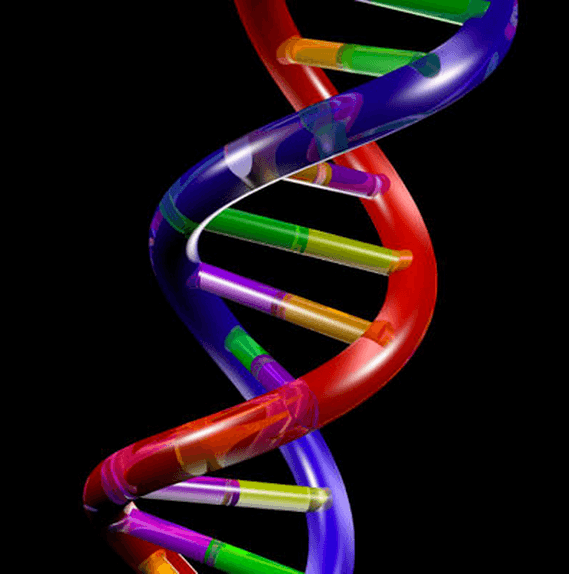
The drawing shows the structure of what molecule?
a)
A DNA molecule
b)
A lipid molecule
c)
A carbohydrate molecule
d)
A protein molecule
21.
How does RNA differ from DNA?
a)
RNA contains uracil and deoxyribose
b)
RNA contains ribose and thymine
c)
RNA contains uracil and ribose
d)
RNA contains adenine and ribose
22.
How would the DNA sequence GCTATA be transcribed to mRNA?
a)
GCUAUA
b)
CGATAT
c)
CGAUAU
d)
GCUTUT
23.
The process by which the genetic code of DNA is copied into a strand of RNA is called
a)
translation
b)
transcription
c)
transformation
d)
replication
24.
Which of the following describes RNA?
a)
RNA is usually double-stranded and contains the base thymine
b)
RNA is usually single-stranded and contains the base uracil
c)
RNA is longer than DNA and uses five bases to encode information
d)
RNA is made in the nucleus of eukaryotic cells and stays there to carry out its functions
25.
In messenger RNA, each codon specifies a particular
a)
nucleotide
b)
enzyme
c)
amino acid
d)
promoter
26.
The process of making proteins on the ribosome based on instructions from messenger RNA is called
a)
transcription
b)
transformation
c)
translation
d)
molecular biology
27.
Changes is DNA sequences that affect genetic information are known as
a)
replications
b)
mutations
c)
transformations
d)
translations
28.
What is the difference between the sugars found in DNA and RNA?
a)
RNA contains glucose
b)
RNA contains sucrose
c)
RNA contains deoxyribose
d)
RNA contains Ribose
29.
What is the difference between DNA and RNA in terms of bases?
a)
RNA contains uracil in place of thymine
b)
RNA contains uracil in place of adenine
c)
RNA contains uracil in place of guanine
d)
RNA contains uracil in place of  cytosine
30.
RNA has how many strands?
a)
one
b)
two
31.

RNA stands for

a)

robot nucleic acid

b)

root nucleic acid

c)

ribonucleic acid

d)

nucleic acid

32.

The nitrogen base pairs for RNA are

a)

A-T C-G

b)

A-U C-G

c)

A-C T-G

d)

T -U G-C

33.

The sugar in the backbone of ribonucleic acid is

a)

deoxyribose

b)

ribose

c)

dextrose

d)

sucrose

34.

RNA carries a copy of the DNA blueprint (instructions) from the nucleus to the ___

a)

nucleus

b)

cell membrane

c)

vacuole

d)

ribosome

35.

Give the correct base pairing for this strand of RNA

AAUUGGCCUU

a)

AAUUGGCCUU

b)

TTAACCGGAA

c)

UUAACCGGAA

d)

UAUACGCGAT

36.
Which of these bases does not exist in RNA?
a)
C
b)
T
c)
U
d)
A
37.
Which of the following units are repeatedly joined together to form a strand of DNA?
a)
amino acids
b)
nucleotides
c)
fatty acids
d)
polysaccharides
38.
What determines the code, or information, of a DNA molecule?
a)
the shape (structure) of the nitrogen bases
b)
the order (sequence) of the nitrogen bases
c)
the color of the nitrogen bases
d)
the frequency (number) of nitrogen bases
39.
Which two scientists are accredited with correctly deducing the double helix model of DNA?
a)
Watson and Crick
b)
Wilkins and Franklin
c)
Wilkins and Crick
d)
Watson and Franklin
40.

Which type of RNA transfers amino acids?

a)

mRNA

b)

rRNA

c)

tRNA

41.

Which type of RNA is a copy of the DNA “code” instructions for building proteins?

a)

mRNA

b)

rRNA

c)

tRNA

42.

DNA contains the template to make RNA

a)

True

b)

False

43.
Where does transcription take place?
a)
nucleus
b)
cytoplasm
c)
ribosome
44.

True or False: RNA uses deoxyribose sugar.

a)

True

b)

False

45.
What are the building blocks of proteins called?
a)
DNA
b)
RNA
c)
Ribosomes
d)
Amino Acids
46.
DNA molecule segment is : TTACGCAAG
The mutated DNA segment is TTCGCAAG. This is an example of ___ mutation.
a)
Substitution
b)
Deletion
c)
Insertion
d)
Inversion
47.
Normal-
GAG-CTC-GAC-AGA
Mutant
GAG CTC-CAC-AGA
a)
no mutation
b)
substitution
c)
insertion
d)
deletion
48.

Why are insertion and deletion (frameshift) mutations so harmful?

a)

They change all of the codons from the mutation on down the line, which changes the amino acid sequence

b)

They insert things that an organism doesn't need.

c)

They often delete things that organisms need.

d)

Insertion and deletions are not any more harmful than substitution mutations.

49.

ATTTGAGCC- Original

ATTGAGCC - Mutated

The example above is an example of a

a)

Insertion- Frameshift

b)

Deletion- Substitution

c)

Deletion -Frameshift

d)

All of the above

50.

A mutation is defined as:

a)

A change in the cell's structure

b)

Anything that changes in an embryo

c)

Any change in the physical features of a human

d)

A change in the DNA sequence