wayground logo

Free Printable Worksheets

Font size

S
M
L
XL
Worksheets

Atmosphere Unit Review

Total questions: 112

Worksheet time: 1hrs 25mins

Name
Class
Date
1.

Which of the following best describes temperature?

a)

Number of molecules

b)

Motion of molecules

c)

Size of molecules

d)

Type of molecules

2.

When you heat a pot on a stove, the handle gets warm. Which type of heat transfer is responsible?

a)

Conduction

b)

Radiation

c)

Convection

d)

All of the above

3.

Heat from the Sun reaches Earth through which type of heat transfer?

a)

Conduction

b)

Radiation

c)

Convection

d)

All of the above

4.

Convection currents occur:

a)

Only in liquids

b)

When a dense substance is warmer than a less dense substance

c)

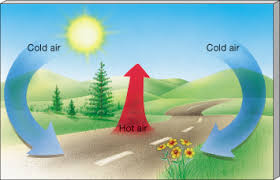
In both liquids and gases

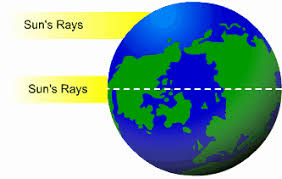
d)

Weakly in solids

5.

All of the following are examples of convection currents, excerpt:

a)

Warm air rising in a house

b)

Cold water sinking to the bottom of the lake

c)

Water flowing through pipes

d)

Steam from hot soup rising into the air

6.

A cat is hanging out several feet from a fire in a fireplace. This causes the kitty cat to get warm. The kitty cat is warm because of...

a)

Convection

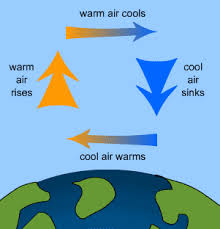
b)

Conduction

c)

Radiation

d)

The fur sweater he's wearing!

7.

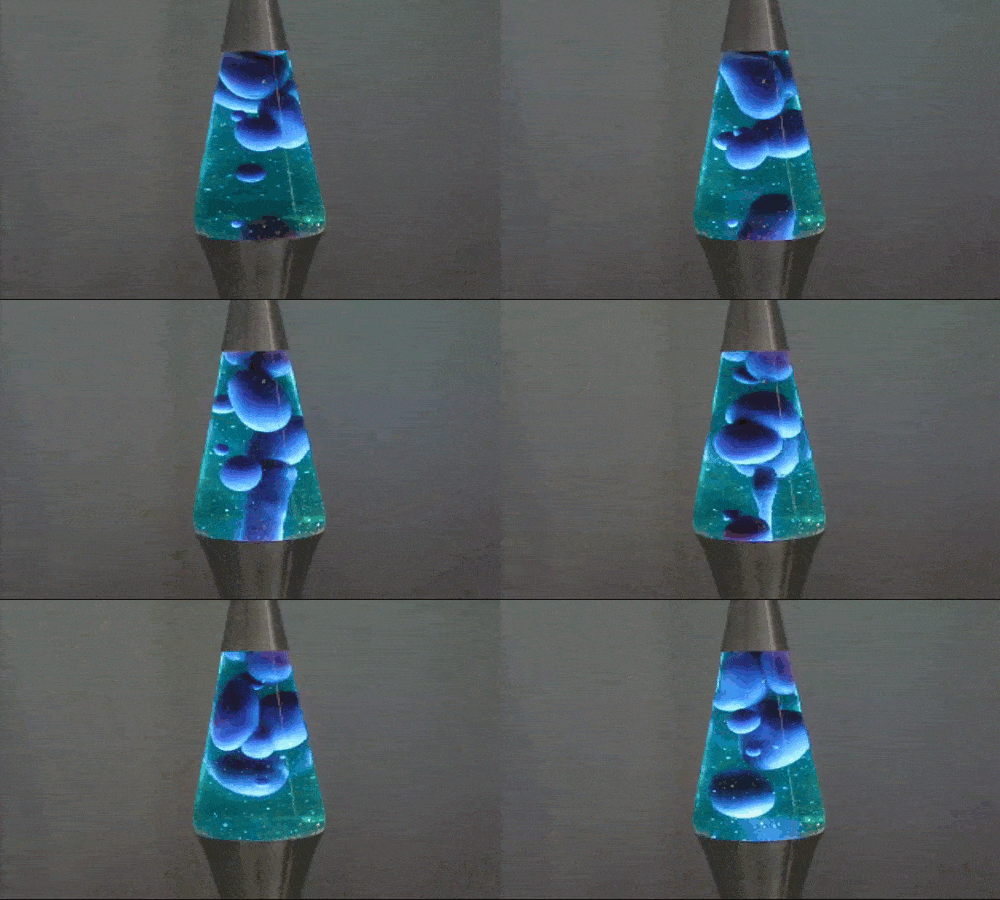
A certain type of decorative lamp contains colored liquids. These liquids form globs that break off and rise to the top of the liquid. The globs rise due to

a)

Convection

b)

Conduction

c)

Radiation

d)

Globulation

8.

Near the ceiling of a room, the air is warmer. The warmer air is rising because of

a)

Convection

b)

Conduction

c)

Radiation

d)

It was told to by this crazy fool!

9.

In a swimming pool, the water near the surface is slightly warmer. The temperature of the water near the top rises because of

a)

Convection

b)

Conduction

c)

Radiation

d)

Too many dogs being in the pool!

10.

A fireman that is at a building that is on fire feels a door and it is hot. Why does his hand feel hot?

a)

Convection

b)

Conduction

c)

Radiation

d)

The Human Torch was on the other side!
11.

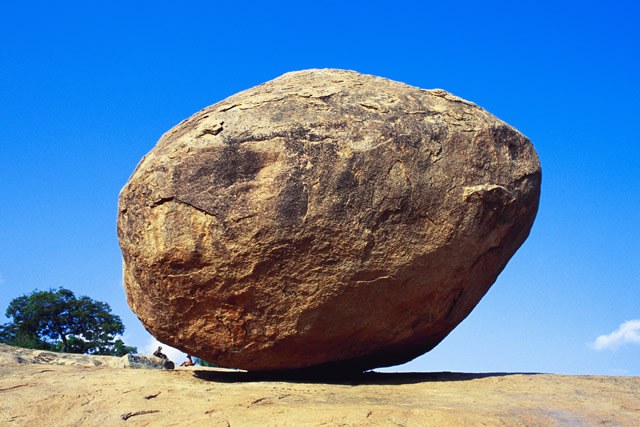
A huge boulder at the state park in Arizona gets so hot during a mid summer's day. This is due to...

a)

Convection

b)

Conduction

c)

Radiation

d)

Boogie Fever

12.

A house burns down. On the house next to it, the vinyl siding is twisted and warped by the heat. The heat was transferred across to the other house by

a)

Convection

b)

Conduction

c)

Radiation

d)

Marvin the Martian

13.

As you hold a piece of ice, it begins to melt from the warmth of you hand on it. This is because of

a)

Convection

b)

Conduction

c)

Radiation

d)

the fact that you are the Human Torch from the Fantastic Four.

14.

In heat transfer, heat always flows from the _______________ object to the _______________ object.

a)

hotter / colder

b)

colder / hotter

c)

hotter / hotter

d)

colder / colder

15.
Heat is the movement of ______.
a)
radiation
b)
thermal energy
c)
cold
d)
fire
16.
Which gas in our atmosphere is most abundant?
a)
Argon
b)
Oxygen
c)
Nitrogen
d)
Carbon Dioxide
17.
The air in the troposphere has a greater density than the air in any other layer of the atmosphere,
a)
True
b)
False
18.
Temperature in the stratosphere warms as altitude increases.
a)
True
b)
False
19.
What is the percentage of oxygen in Earth's atmosphere?
a)
1%
b)
21%
c)
78%
d)
90%
20.
Which layer of the atmosphere contains the greatest amount of water vapor?
a)
Thermosphere
b)
Troposphere
c)
Mesosphere
d)
Stratosphere
21.
In which layer of the atmosphere does weather occur?
a)
Mesosphere
b)
Thermosphere
c)
Stratosphere
d)
Troposphere
22.
What decreases as you go up in the atmosphere?
a)
Altitude
b)
Atmosphere
c)
Meteors
d)
Air Pressure
23.
The layers of the atmosphere are classified according to changes in _________.
a)
altitude
b)
density
c)
composition
d)
temperature
24.
James plans to climb to the top of Mount Everest.  Which of the following statements about his climb will be the most accurate?
a)
Air pressure will rise and the temperature on a thermometer will increase.
b)
Air pressure will fall and the temperature on a thermometer will decrease.
c)
Air pressure will rise and the temperature on a thermometer will decrease.
d)
Air pressure and thermometer will not change.
25.
Which of the following is NOT a reason why the atmosphere is important?
a)
It is made of many layers.
b)
It provides gases living things need.
c)
It provides warm temperatures.
d)
It protects us from UV rays and meteors.
26.
Which layer is the coldest?
a)
Troposphere
b)
Stratosphere
c)
Mesosphere
d)
Thermosphere
27.
Describe how the ozone layer protects the earth.
a)
Absorbs solar radiation, Protects Earth from UV Rays,  and emits heat
b)
Ozone in the lower atmosphere is a pollutant
28.
Water vapor is a greenhouse gas
a)
True
b)
False
29.
The warming of the atmosphere by the trapping of heat being radiated to space is called
a)
evaporation
b)
condensation
c)
the greenhouse effect
d)
radiation
30.

Which layer of the atmosphere has weather?

a)

troposphere

b)

stratosphere

c)

mesosphere

d)

thermosphere

31.

Which layer of the atmosphere contains the ozone?

a)

troposphere

b)

stratosphere

c)

mesosphere

d)

thermosphere

32.

What is the term for the day to day conditions of the atmosphere?

a)

weather

b)

climate

c)

hurrican

d)

global wind

33.

What do you call the part of the atmosphere where molecules escape into space?

a)

doldrums

b)

ionosphere

c)

exosphere

d)

dead zone

34.

Which type of cloud is this?

a)

cirrus

b)

stratus

c)

cumulus

35.

Which type of cloud is this?

a)

cirrus

b)

stratus

c)

cumulus

36.

Which type of cloud is this?

a)

cirrus

b)

stratus

c)

cumulus

37.

This molecule is important because it absorbs harmful UV radiation.

a)

methane

b)

ozone

c)

carbon dioxide

d)

nitrogen

38.

How do scientists know when one atmospheric layer ends and the next layer begins?

a)

They look for changes in air pressure.

b)

They look for changes in temperature.

c)

They look for changes in the density of air.

d)

They use specific altitudes to determine the layer.

39.
Heat from the sun travels to Earth by _____.
a)
conduction
b)
convection
c)
insulation
d)
radiation
40.
This type of heat transfer is due to direct contact.
a)
Radiation
b)
Transpiration
c)
Conduction
d)
Convection
41.
This process keeps Earth's temperature suitable for life.
a)
Convection Currents
b)
Greenhouse Effect
c)
Global Warming
d)
Water Cycle
42.
What is being illustrated in the picture?
a)
greenhouse effect
b)
coriolis effect
c)
global warming
d)
air pressure
43.
As altitude increases what happens to the air pressure?
a)
increases
b)
decreases
c)
stays the same
d)
increases then decreases
44.
Which of the following is the correct order of the atmosphere layers from Earth to space?
a)
troposphere, stratosphere, mesosphere, thermosphere, exosphere
b)
troposphere, mesosphere, thermosphere, exosphere, stratosphere
c)
thermosphere, stratosphere, mesosphere, troposphere, exosphere
d)
troposphere, stratosphere, mesosphere, exosphere, thermosphere
45.

A measure of the average (kinetic) energy of motion of particles in a substance.

a)

heat

b)

temperature

c)

conduction

d)

all of these

46.

What do conduction and convection have in common?

a)

they both involve sinking and rising

b)

they both need materials to travel through

c)

they both work through direct contact

d)

they both travel through the vacuum of space

47.

Most of the heating of the troposphere comes from

a)

conduction

b)

condensation

c)

convection

d)

radiation

48.

What causes wind?

a)

differences in air pressure

b)

differences in gravity

c)

difference in oxygen

d)

differences in the thermosphere

49.

What causes differences in air pressure?

a)

even heating of the Earth

b)

Even cooling of the earth

c)

uneven heating of the earth

d)

global warming

50.
Which statement correctly defines wind?
a)
Wind is the movement of air from areas of low pressure to areas of high pressure
b)
Wind is the movement of air to a colder area in the atmosphere.
c)
Wind is the movement of air from areas of high pressure to areas of low pressure.
d)
Wind is the movement of air pushed around and bouncing off Earth's surface.
51.
Why does warm air rise?
a)
Warm air is more dense than cooler air.
b)
Warm air has more pressure than cooler air.
c)
Warm air is less dense than cooler air.
d)
Warm air has a higher dew point than cooler air.
52.

Air is warmer and less dense at the equator because the equator receives more____________________.

a)

wind

b)

solar radiation

c)

air pressure

d)

condensation

53.

In the Northern Hemisphere, winds traveling north appear to curve east because of the:

a)

trade winds

b)

convection currents

c)

Coriolis effect

d)

polar easterlies

54.
The Coriolis effect is the curving of wind across Earth. What causes winds to curve?
a)
Earth's revolution
b)
Earth's magnetic field
c)
Earth's rotation
d)
Earth's gravitational pull
55.
Use the diagram to determine which statement is correct.
a)
The air at location 3 is more dense than the air at location 6.
b)
The air at location 2 is rushing in to take the place of the colder air at location 3.
c)
Location 1 heats up and cools down slower than location 7.
d)
High pressure air at location 2 is taking the place of the low pressure air at location 3.
56.
Wind belts are always named according to...
a)
how strong they are
b)
what temperature they are
c)
where they blow to
d)
where they come from
57.

All wind are caused by differences in ____________.

a)

weather

b)

precipitation

c)

air pressure

d)

climate

58.

Most differences in air pressure are caused by _______________ heating of the atmosphere.

a)

some

b)

equal

c)

unequal

d)

great

59.

Local winds are wind that blow over ______________.

a)

short distances

b)

long distances

c)

the oceans

d)

many continents

60.

Local winds are caused by _____________ heating of Earth's surface within a small area.

a)

typical

b)

unequal

c)

unsusual

d)

some

61.

It takes _________ energy to warm up a body of water than it does to warm up an equal area of land.

a)

some

b)

equal

c)

less

d)

more

62.

A wind that blows from an ocean or lake onto the land is known as a _________.

a)

sea breeze

b)

desert breeze

c)

cold wind

d)

warm wind

63.

The flow of air from land to a body of water is called a ___________________

a)

warm breeze

b)

lake breeze

c)

land breeze

d)

wind breeze

64.

Monsoon winds bring seasonal ____________ to an area.

a)

sunshine

b)

cold

c)

snow

d)

rain

65.

Winds that blow over long distances in predictable patterns are called ____________.

a)

seasonal winds

b)

strong winds

c)

global winds

d)

local winds

66.

Warm air ____________ at the equator.

a)

rises

b)

sinks

c)

mixes

d)

goes down

67.

Cold air ___________ at the poles.

a)

has a lot of moisture

b)

gets warm

c)

rises

d)

sinks

68.

Temperature differences between the equator and the poles produce giant __________________ in the atmosphere.

a)

clouds

b)

global warming

c)

Greenhouse Effect

d)

convection currents

69.

About 10 kilometer above Earth's surface are bands of high speed wind called __________. They blow from west to east at speeds of 200 to 400 kilometer per hour.

a)

jet streams

b)

jet airplane

c)

jet setter

d)

jet propulsion

70.
How do jet streams influence the weather? 
a)
by creating clouds 
b)
by increasing the moisture in the atmosphere 
c)
by moving weather from one area to another very quickly 
d)
by drying out the atmosphere 
71.
What is the name for cooler air blowing from the sea to land?
a)
Sea Breeze
b)
Land Breeze
c)
Mountain Breeze
d)
None of the Above
72.
What is the name for cooler air blowing from the land to the sea?
a)
Sea Breeze
b)
Land Breeze
c)
Mountain Breeze
d)
None of the Above
73.
The Jet Stream is a wind in the upper troposphere that moves from ____.
a)
North to South
b)
East to West
c)
West to South
d)
West to East
74.
Global winds travel over ____.
a)
Short distances
b)
Long distances
c)
The Southern Hemisphere only
d)
The ocean only
75.
What kind of breeze is this and when would it form?
a)
Land breeze - daytime
b)
Land breeze - nighttime
c)
Sea breeze - daytime
d)
Sea breeze - nighttime
76.
Local winds are produced by geographic features. 
a)
True
b)
False
77.

What happens to most solar radiation when it reaches the surface of the earth?

a)

It reflects right back into space

b)

It's collected in solar panels

c)

It's soaked up by land, water, and plants

d)

It disperses throughout the earth's atmosphere

78.

According to the ____________________, energy cannot be created or destroyed.

a)

kinetic

b)

law of conservation of energy

c)

energy transformation

d)

potential

79.

Warm air is ______ dense than cool air. Warm air rises and cool air sinks.

a)

less

b)

more

80.
A front is
a)
where warm air is cooling at earth's surface
b)
a line where hot and cold air are separating
c)
a line where two different air masses meet
d)
where cold air is rising and forming rain clouds
81.
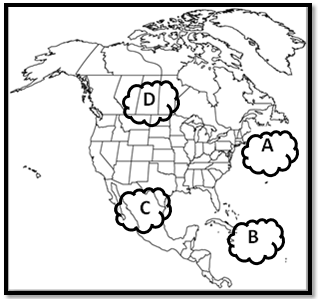
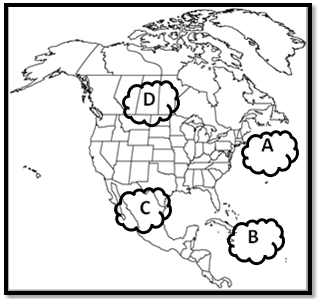
Which type of air would you find at air mass D?
a)
cold, dry
b)
warm, humid
c)
warm, dry
d)
cold, humid
82.
This is the symbol for a... 
a)
Cold Front
b)
Warm Front
c)
Stationary Front
d)
Occluded Front 
83.
This is the symbol for a... 
a)
Stationary Front
b)
Occluded Front
c)
Cold Front
d)
Warm Front
84.
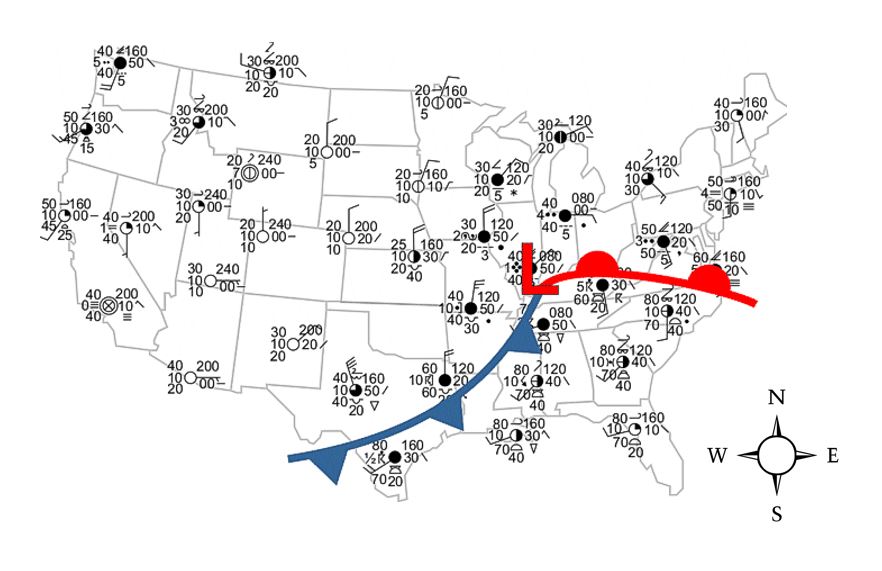
Identify the type of front that is shown in the image.
a)
Occluded Front
b)
Cold Front
c)
Stationary Front
d)
Warm Front
85.

Which type of air would you find at air mass B?

a)

cold, dry

b)

warm, humid

c)

warm, dry

d)

cold, humid

86.
What direction is the cold front moving on the map? 
a)
Southwest
b)
Northwest
c)
Southeast
d)
Northeast
87.

What city will experience decreasing temperatures in the next day?

a)

Denver

b)

El Paso

c)

Memphis

d)

Los Angeles

88.

__________ is a boundary separating two masses of air of different densities, and is the principal cause of meteorological phenomena outside the tropics.

a)

air mass

b)

weather front

c)

trade wind band

d)

westerlies band of wind

89.
Which side of the mountain is driest?
a)
Leeward
b)
Winward
c)
Squidward
d)
Left
90.
Land breezes occur at:
a)
Night
b)
During the day
91.
A land breeze is a local wind that blows:
a)
Only over land
b)
only over water
c)
from land toward water
d)
from water toward land
92.
Which of the following can cause an air mass to become less moist?
a)
oceans
b)
rivers
c)
mountains 
d)
valleys
93.
a)
1
b)
2
c)
3
d)
4
94.
a)
A
b)
B
c)
C
d)
D
95.

___________ is the long term average weather of an area for a period of years (usually 30 years).

a)

Freezing

b)

Transpiration

c)

Climate

d)

Weather

96.

_________ is the measure of the amount of moisture in the atmosphere.

a)

Humidity

b)

Atmospheric Pressure

c)

Temperature

d)

Thermometer

97.

Cool, dry weather is usually accompanied by ______

a)

high air pressure

b)

high relative humidity

c)

lower air pressure

d)

precipitation

98.

A drop in air pressure usually indicates that the

a)

approaching weather is cool and dry

b)

weather will remain unchanged

c)

approaching weather is stormy

d)

air temperature is falling

99.

Climate describes short term changes in the variables of the atmosphere, such as temperature, pressure, wind speed, etc.

a)

True

b)

False

100.

Low pressure systems often bring stormy weather

a)

True

b)

False

101.

A meteorologist is

a)

a space scientist

b)

a weather scientist

c)

a radar scientist

d)

an air scientist

102.

What do meteorologists use to see inside clouds?

a)

Doppler radars

b)

Cameras

c)

Weather radars

d)

Satellites

103.

Day to day state of the atmosphere (temperature, pressure, precipitation, wind speed, etc.)

a)

Weather

b)

Radar

c)

Climate

d)

Meteorology

104.
What are the two main factors that determine the climate of an area?
a)
precipitation and humidity
b)
temperature and air pressure
c)
wind conditions and humidity
d)
temperature and precipitation
105.
What are the 3 major climate zones in order from equator to the poles?
a)
polar, temperate, tropical
b)
tropical, temperate, polar
c)
temperate, polar, tropical
106.
The biggest factor in determining climate is?
a)
elevation
b)
an ocean
c)
latitude
d)
mountain
107.
Which climate zone do we live in?
a)
Temperate
b)
Tropical
c)
Polar
d)
Savannas
108.
A hurricane forms over the Atlantic Ocean. When it hits land and comes ashore, its wind speed decrease significantly.  This happens because the hurricane:
a)
gains more water from the flooded land than the ocean
b)
meets a land breeze
c)
meets a stronger hurricane moving from land
d)
no longer gains energy from warm ocean water
109.
a)

Mountain shadow effect

b)

Raining effect

c)

Precipitation Effect

d)

Rain Shadow Effect

110.

Which side of the mountain is shown with a question mark?

a)

Rainshadow

b)

Windward

c)

Upward

d)

Leeward

111.
What is the greenhouse effect?
a)
The warming of a planet due to trapped radiation.
b)
The cooling of Earth due to air pollution.
c)
The heating of a solid, such as a rock.
112.

Where does the initial source of energy come from that creates winds?

a)

the moon

b)

the sun

c)

the Earth's surface

d)

the rotation of the Earth