
 Worksheets
Solubility
Total questions: 59
Worksheet time: 2hrs 42mins
A homogeneous mixture is the same thing as...
a solution
a heterogeneous mixture
a compound
an element
The prefix hetero means...
same
different
together
awesome
A type of mixture that forms when one substance dissolves in another is known as a
heterogeneous mixture
solution
solute
solvent

Which substance is least soluble at 0 ºC?
KI
KNO3
KClO3
Ce2(SO4)3

How many grams are soluble in 100 g of water at 100 ºC?
300 grams
250 grams
100 grams
50 grams

Which solute is most likely a gas?
NH3
NaNO3
KCl
NaCl

When 40 grams of NaCl is dissolved in 100 grams of water at 90 ºC, the solution can be correctly described as:
supersaturated
saturated
unsaturated


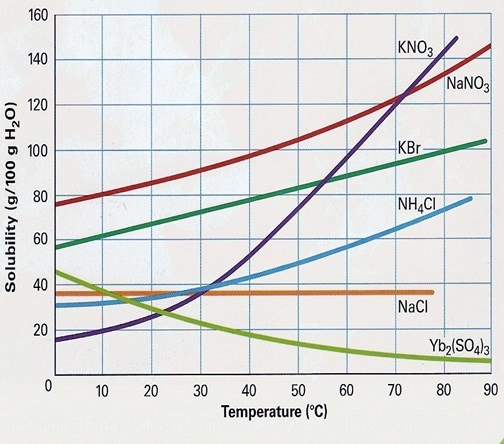
Identify how many grams of KNO3 is required to make a saturated solution at 40'C.
50 g
45 g
55 g
33 g

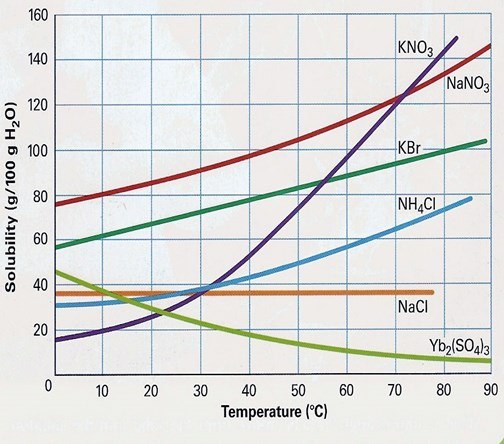
At 30'C, which substance has the lowest solubility?
KNO3
KBr
NaCl
Yb2(SO4)3
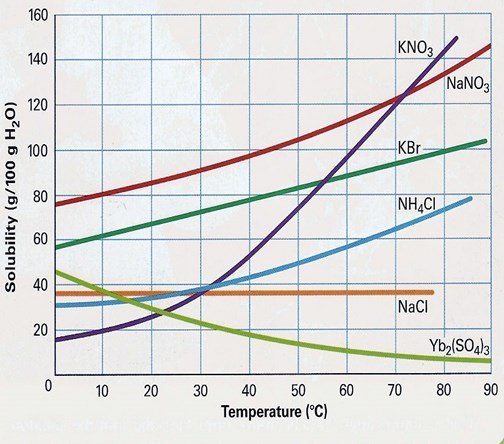
At which temperature do KBr and KNO3 have the same solubility?
60
55
50
Never
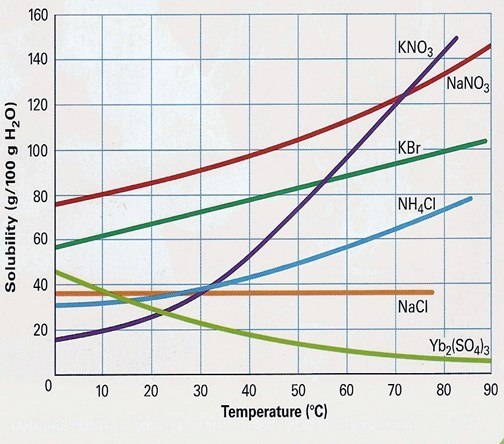
The solubility of Yb2(SO4)3 ________________ with added temperature.
increases
decreases
remains the same
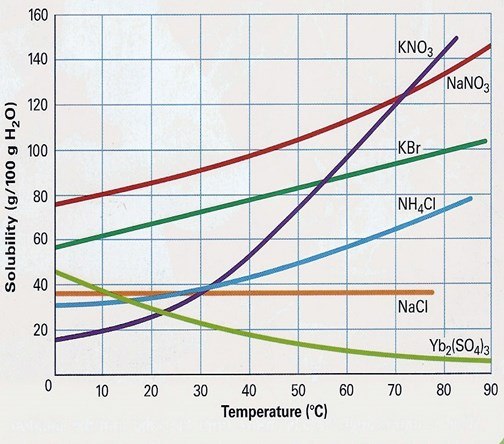
At 80'C, KBr's solubility is:
100
90
80
0
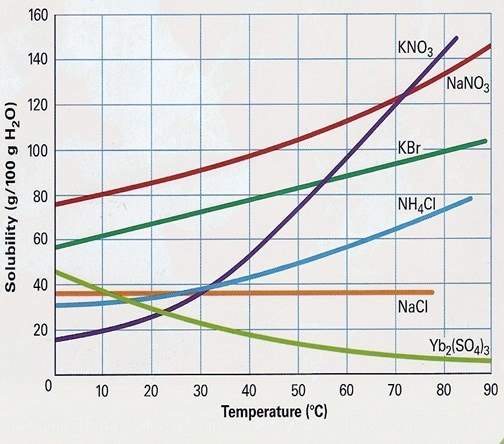
Determine the solubility for the substances at 55'C and arrange them in order from lowest to highest solubility.
NaCl, NH4Cl, KBr, NaNO3
NaCl, NH4Cl, NaNO3, KBr
NH4Cl, NaCl, NaNO3, KBr
NaNO3, KBr, NH4Cl, NaCl
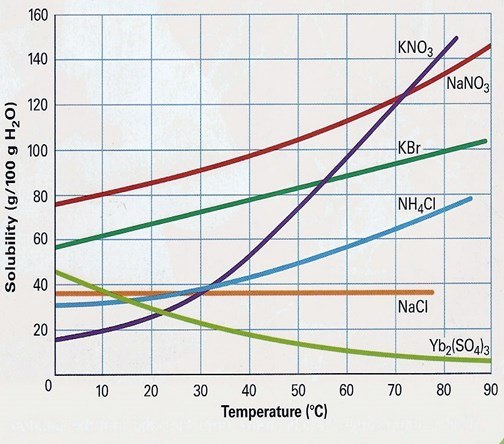
At 10'C, NaNO3's solubility is 80 g/100 g of H2O. Based on this information, what would the solubility be in 50 g of H2O.
40
80
160
16
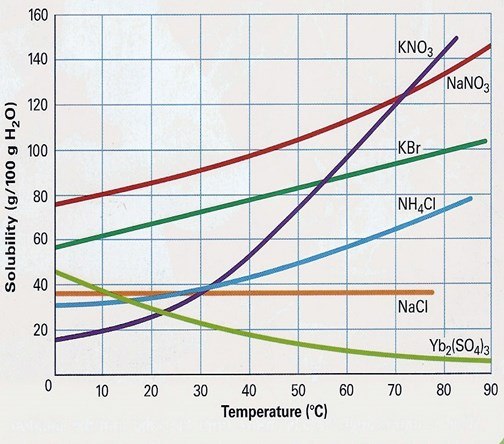
Identify if the following solution would be saturated, unsaturated, or supersaturated: 103 g KBr at 70'C.
Unsaturated
Saturated
Supersaturated
Identify how many grams of KNO3 is required to make a saturated solution at 40'C.
50 g
45 g
60 g
33 g
How could you change a saturated solution to an unsaturated solution?
Add solvent
Add solute
Define the term soluble.
Can dissolve in water
Cannot dissolve in water
Partially dissolves in water


How much Ce2(SO4)3 solute is saturated at 80 degrees?
20
15
30
2

At what temperature can you fully dissolve 140g of NaNO3?
62
73
81
You cannot determine this
What type of a solution is 260g sugar at 50ºC in 100g H2O?
Saturated
Unsaturated
Supersaturated
Which of the following is a solution?
salt (NaCl)
salad
blood
Oxygen gas (O2)
Water is called the ___________ _____________
universal solute
universal solvent
universal solution
___________ and other substances like vitamins and minerals are absorbed in our bodies by dissolving in the water that makes up our cells .
nitrogen
nutrients
pressure
Substances that dissolve in water are _____________, which means " water loving"
hydrophobic
hydrophilic
hyperactive
Substances that do not dissolve in water are called ________, which means " water fearing"
hydrophilic
hydrofearic
hydrophobic
Concentration of a solution can be expressed as a ratio :
C = M / M
C = V / M
C = M / V
Mass of a solute is measured in ________
liters
mL
grams
Volume of a liquid solution can be measured in ________
grams
moles
liters
A containers holds 2 grams of solute and 4 mL of solvent. What is the concentration of the solution ?
.125 g/mL
.25 g/mL
.50 g m/L
What is the concentration of a solution that has 4 g of sugar and 2 mL of water ?
2 g/L
4 g/L
8 g/ L
Solution A has a concentration of .4 g / L and solution B has a concentration of .9 g/L . Which solution has a higher concentration?
solution A
solution B
Solubility is measured in _____ of solute per ________ mL of water
liters, 100
grams, 100
grams, 1
When a solution is _____________ it CAN dissolve more solute
saturated
super saturated
unsaturated
When mixing substances with different densities , substances with _________densities sink to the bottom .
higher
lower
neither they will be equal

The X axis of this solubility graph shows what variable ?
saturation
grams
temperature

The Y axis of this graph shows what variable ?
temperature
celcius
solubility rate

What compound's solubility rate shows to be constant as temperature increases?
BaNo32
Na2So4
NaCl

Type of mixture that has the SAME COMPOSITION in every part.
Homogenous
Heterogeneous


A substance made of only 1 type of atom is called --
an element
a salt
a compound
a mixture

Which of the pictures represents a mixture?
A
B
C

Which picture represents a compound?
A
B
C
Which of the following is a heterogeneous mixture?
salt water
sugar water
soda
beach sand

