
 Worksheets
Chemistry Matter Test Review
Total questions: 50
Worksheet time: 21mins
A physical property that measures mass per unit volume
density
flammability
physical property
element
reactivity
characteristic/trait that can be seen through direct observation of a substance.
mixture
physical property
physical change
chemical property
chemical change
an example of a physical change
flammability
fireworks exploding
rust
melting
has a definite volume but an indefinite shape
solid
liquid
gas
plasma
the ability to burn
physical change
conductivity
elasticity
flammability
reactivity
Anything that has mass and volume.
solid
liquid
gas
matter
mixture
an example of a chemical change
breaking glass
boiling water
stretching copper into wire
rusting
a homogenous mixture
solid
solution
matter
compound
transforms one type of matter into another type of matter
physical change
physical property
chemical change
chemical property
a mixture that has the same composition throughout the entire substance
heterogenous mixture
homogenous mixture
pure substance
matter
What is observed when a substance changes into a new substance?
physical property
chemical property
physical change
chemical change
a change to a substance that does NOT change the identity of the substance
physical change
physical property
chemical change
chemical property
used to observe and describe matter
physical property
physical change
chemical property
chemical change
something that will always have the same composition
matter
pure substance
mixture
solution
Matter that has a definite shape and volume
solid
liquid
gas
plasma
A substance chemically combined from two or more different elements.
matter
mixture
compound
pure substance
solution
matter that has an indefinite volume or shape - it takes the shape and volume of its container
solid
liquid
gas
a substance that cannot be broken down into other substances
matter
mixture
element
solid
solution
a mixture that has a visibly different composition throughout the substance
heterogenous mixture
compound
homogeneous mixture
element
These properties of a substance depend on the amount of matter.
extensive properties
intensive properties
These properties of a substance do not depend on the amount of matter.
extensive properties
intensive properties
Boiling point, freezing point, electrical conductivity, and density are examples of _______________________.
extensive properties
intensive properties
Which of the following are extensive properties? (choose all that apply)
density
heat conductivity
mass
volume
The ability of a substance to be beaten or hammered into a thin sheet is which physical property?
ductility
electrical conductivity
heat conductivity
malleability
Classification of matter. If a substance can be separated and is not uniform, the substance is _____________________
a homogeneous mixture
a heterogeneous mixture
a compound
an element
Classification of matter. If a substance can't be separated and can't be decomposed by ordinary chemical means, the substance is _____________________
a homogeneous mixture
a heterogeneous mixture
a compound
an element
A physical blend of 2 or more kinds of matter is considered a ___________.
element
compound
mixture
Which of the following are pure substances? (multiple answers may apply)
compounds
elements
heterogeneous mixtures
solutions


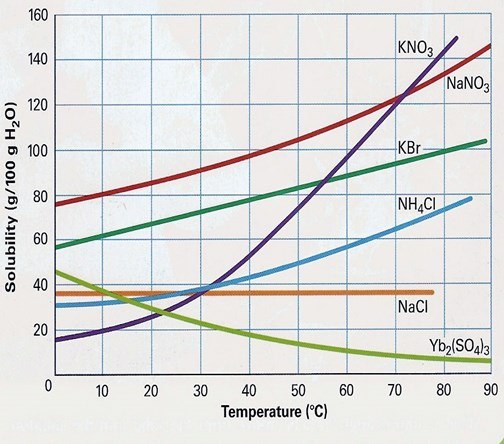
At 30'C, which substance has the lowest solubility?
KNO3
KBr
NaCl
Yb2(SO4)3
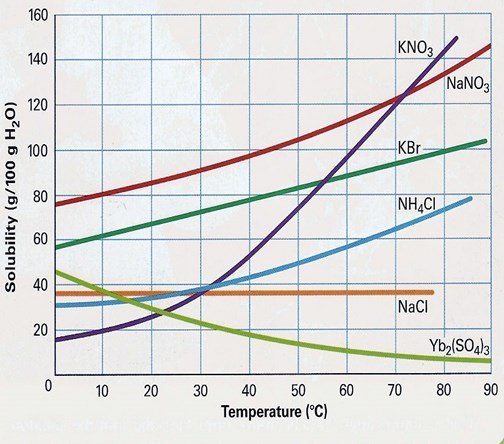
At which temperature do KBr and KNO3 have the same solubility?
60
55
50
Never
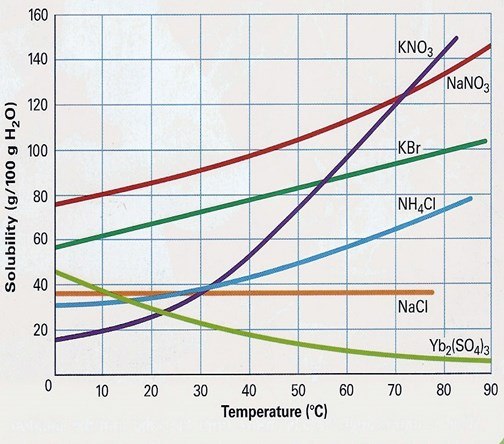
At 80'C, KBr's solubility is:
100
90
80
0
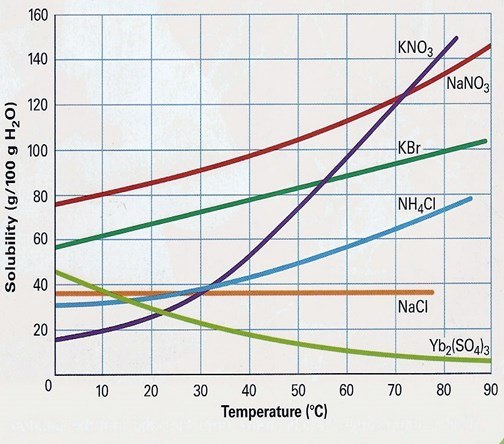
At 10'C, NaNO3's solubility is 80 g/100 g of H2O. Based on this information, what would the solubility be in 50 g of H2O.
40
80
160
16
How could you change a saturated solution to an unsaturated solution?
Add solvent
Add solute
Identify a method to decrease the dissolving rate of a solution:
decrease the temperature
add KE
stir the solution
increase the temperature

