wayground logo

Free Printable Worksheets

Font size

S
M
L
XL
Worksheets

Molecular Shapes, Polarity, and Intermolecular Forces

Total questions: 45

Worksheet time: 26mins
Name
Class
Date
1.
 A lone pair is defined as
a)
A pair of bonding electrons
b)
One non-bonding electron
c)
A pair of non-bonding electrons
d)
A pair of electrons on the central atom
2.
According to VSEPR, molecules adjust their shapes to keep which of the following as far away as possible?
a)
Pairs of valence electrons
b)
Inner shell electrons
c)
Mobile Electrons
d)
Electrons closest to the nucleus
3.
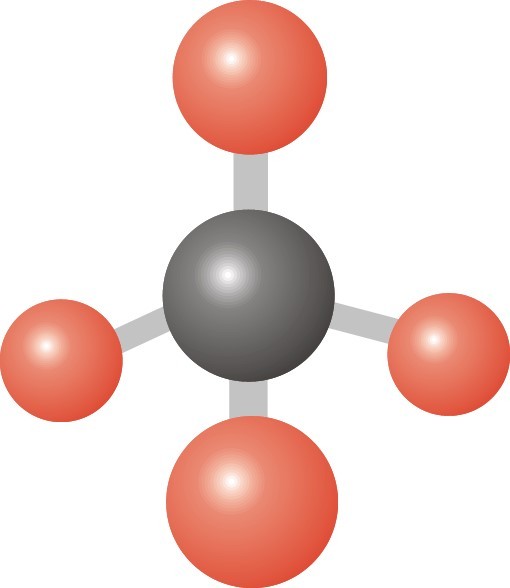
Who could this molecule be?
a)
CH4
b)
CO2
c)
PCl5
d)
BF3
4.
Which molecule below would have this shape?
a)
BF3
b)
CH4
c)
PCl5
d)
CO2
5.
VSEPR stands for ________ theory.
a)
Valence Structure of Electron Pyramids and Regression
b)
Varied Structures of Electrons Paired and Replaced
c)
Varied Shell Energy of Protons and Radiation
d)
Valence Shell Electron Pair Repulsion
6.
T or F: Lone pairs around the oxygen atom of a water molecule play no role in determining its molecular geometry?
a)
True
b)
False
7.

What would be the bond angle between atoms in this molecule?

a)

180

b)

120

c)

90

d)

109.5

8.

What shape would a molecule have if it has 2 bonded pairs and 1 lone pair around its central atom? (It may help if you sketch this out)

a)

Linear

b)

Trigonal planar

c)

Tetrahedral

d)

Bent

9.

What is the name of this molecule's shape?

a)

Bent

b)

Linear

c)

Tetrahedral

d)

Trigonal pyramidal

10.

What is the name of this molecular shape?

a)

trigonal pyramid

b)

tetrahedral

c)

bent

d)

trigonal planar

11.

What 3-D shape would this molecule have?

a)

tetrahedral

b)

trigonal planar

c)

trigonal pyramid

d)

bent

12.

Which Lewis Dot Model drawing correctly shows an O2 molecule?

a)
b)
c)
d)
13.

The word "molecule" applies to substances made of

a)

ionic bonds

b)

covalent bonds

c)

metallic bonds

d)

2 or more different atoms

14.

Which two statments are correctly involved in determining the shape of a molecule.

a)

How many regions of negativity there are around the central atom.

b)

Repulsion between negative regions leads to maximum separation.

c)

Attraction between lone pairs of electrons leads to minimum bond angle.

d)

Double bonds have double the repulsive force leading to greater separation.

15.
In a polar covalent bond, electrons are shared ___________.
a)
equally
b)
unequally
c)
between non-metals with similar electronegativities
d)
between a metal and a non-metal
16.
Electronegativity is a measurement of the ability of a nucleus to...
a)
attract bonding electrons
b)
attract other nuclei
c)
attract elenece in the non-valence energy levels
17.
The most electronegative atom in the periodic table is:
a)
Fluorine
b)
Helium
c)
Neon
d)
Francium
18.
In this Lewis structure, the symbol above F means...
a)
electrons are being transferred to Fluorine
b)
electrons are less attracted to F than H
c)
electrons are more attracted to F than H
d)
Fluorine has formed a cation
19.
Partial charges like the ones shown here are called:
a)
dipoles
b)
deltas
c)
ions
d)
magnetic poles
20.
A diatomic molecule like O2 is always_______ because electrons are shared ________.
a)
nonpolar; equally
b)
polar; equally
c)
nonpolar; unequally
d)
nonpolar; unequally
21.
When you are asked to find bond polarity, compare EN values of each bonding atom to the central atom
a)
true
b)
false
22.
The electronegativity difference in the bonds of CH4 (methane) is:
a)
0.4
b)
5.9
c)
-0.4
d)
1.7
23.
The electronegativity difference in the bonds of CCl4 (carbon tetrachloride) is:
a)
0.4
b)
0.5
c)
9.5
d)
5.5
24.
This molecule is...
a)
polar
b)
unpolar
25.
Which of the following is a polar molecule?
a)
CH4
b)
Xe
c)
H2O
d)
CO2
26.
Which of the following geometries could be nonpolar?
a)
bent
b)
tetrahedral
c)
trigonal pyrimidal
d)
none of the above
27.
Which of the following molecules, based on the elements present, would be most polar?
a)
HF
b)
H2
c)
HCl
d)
HBr
28.

Is this molecule polar or non-polar?

a)

Polar

b)

Non-polar

29.

Is this molecule polar or non-polar?

a)

Non-polar

b)

Polar

30.
Will this molecule be polar or nonpolar? H2S
a)
polar
b)
nonpolar
31.

The electronegativity values for the atoms in the image are shown in blue.

Which of the following is true of CF4?

a)

CF4 has polar bonds and is a polar molecule.

b)

CF4 has polar bonds, but it is a nonpolar molecule.

c)

CF4 has nonpolar bonds and is a nonpolar molecule.

d)

CF4 has nonpolar bonds, but it is a polar molecule.

32.

Is this molecule polar or non-polar?

a)

Non-polar

b)

Polar

33.
Which of the following factors plays an important role in the identification of specific intermolecular forces in a molecule?
a)
bond type
b)
density
c)
solubility
d)
molecular polarity
34.
Which of the following molecules has hydrogen bonding?
a)
HCl
b)
HI
c)
HF
d)
HBr
35.
Which of the following statements correctly explains why hydrogen bonding is such a strong intermolecular force?
a)
There is an attraction between a small, weakly electronegative hydrogen atom and a large, strongly electronegative atom of fluorine, nitrogen, or oxygen
b)
There is an attraction between a small, highly electronegative hydrogen atom and a large, highly electronegative fluorine atom
c)
There is an attraction between the hydrogen and oxygen atoms, only
d)
There is an attraction between the hydrogen and nitrogen atoms, only
36.
Intermolecular force present in HCl?
a)
dipole dipole
b)
dispersion
c)
H-bond
d)
ionic
37.

Intermolecular forces for: CO2

a)

Dispersion Force

b)

Dipole dipole

c)

Hydrogen bonding

38.
Rank these in order of strength:
covalent bond
London forces
hydrogen bond
dipole-dipole attraction
a)
dipole-dipole>covalent bond>hydrogen bond>London
b)
London>dipole-diple>hydrogen bond>covalent bond
c)
covalent bond>hydrogen bond>dipole-dipole>London
d)
hydrogen bond>dipole-dipole>London>covalent bond
39.
Type of intermolecular force present in I2, Br2, and Cl2.
a)
dipole dipole
b)
H-bond
c)
dispersion
d)
metallic
40.
H2S has what kind of intermolecular force?
a)
dipole dipole
b)
dispersion
c)
H-bond
d)
ionic
41.
Intermolecular forces are the forces
a)
within molecules
b)
between molecules
42.

Water has an unusually high boiling point for a molecular compound because it has

a)

hydrogen bonding

b)

ion-ion attractions

c)

a high density

d)

a large gram formula mass

43.
Which of the following factors plays an important role in the identification of specific intermolecular forces in a molecule?
a)
bond type
b)
density
c)
solubility
d)
molecular polarity
44.

Which of the following will NOT have hydrogen bonding?

a)
b)
c)
d)
45.

Which of the following intermolecular forces can all types of matter participate in?

a)

dispersion forces

b)

dipole-dipole forces

c)

hydrogen bonding

d)

none of the above