wayground logo

Free Printable Worksheets

Font size

S
M
L
XL
Worksheets

Evolution Learning Check Review

Total questions: 35

Worksheet time: 19mins

Name
Class
Date
1.

Evolution can be defined as a ____________

a)

change in the frequency of an allele in a population over time

b)

change in the frequency of reproduction in a population

c)

change in the frequency of an allele in an individual

2.

According to Darwin's theory of natural selection, the individuals that tend to survive are those that have ___________ .

a)

the variations best suited to the environment

b)

the most offspring

c)

the variations that are the most colorful

d)

do not have too many predators

3.

A ________ is a group of organisms that can breed and produce fertile offspring.

a)

species

b)

community

c)

biome

d)

herd

4.

What is natural selection?

a)

process in which helpful traits become more common over time

b)

a trait that helps an organism survive better

5.

Differences in traits are called:

a)

natural selection

b)

genetic variations

c)

artificial selection

d)

adaptations

6.
Survival of the Fittest and Evolution were proposed by what scientist?
a)
Charles Darwin
b)
Albert Einstein
c)
Steven Hawking
d)
Isaac Newton
7.
Where the better adapted organisms survive to pass traits along to offspring.
a)
Evolution
b)
Natural Selection
c)
Extinction
d)
Artifical Selection
8.
Why are advantageous traits more likely to be passed onto offspring?
a)
Because they are more likely to survive and reproduce.
b)
Because they come from dominant alleles.
c)
Because they come from recessive alleles.
d)
Because the trait is an acquired phenotype.
9.

What word describes a trait that helps an organism survive in its environment?

a)

natural selection

b)

mutation

c)

camouflage

d)

adaptation

10.
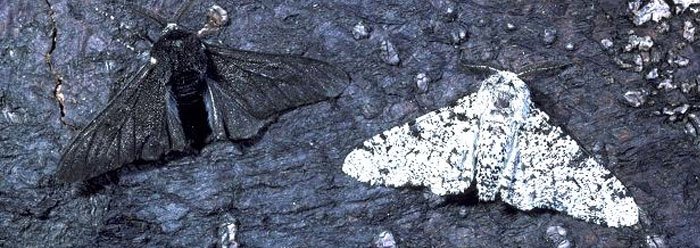
The trees these moths used to live on were white, but have been covered in soot from coal factories. Which moth will be more successful in this environment?
a)
Dark moth
b)
Light moth
c)
Both will be equally successful
d)
Neither will be successful
11.
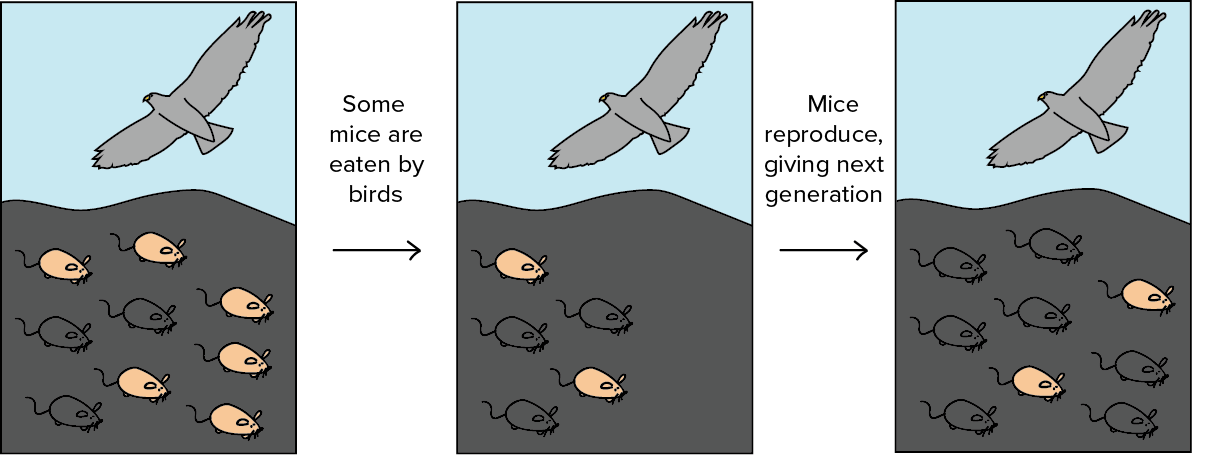
Why is the mouse population changing over time?
a)
The light mice can reproduce more successfully than the dark mice
b)
The hawks eat more dark mice than light mice because the dark mice taste better
c)
The hawks eat more light mice than dark mice because they can see the light mice more easily
d)
The hawks eat more dark mice than light mice because they can see the dark mice more easily
12.
VARIATION
a)
The gradual change of species over time
b)
Differences in traits between members of the same species
c)
Organisms develop in similar ways in the womb
d)
Survival of the fittest
13.
ADAPTATION
a)
Homologous structures that related species have from common
b)
Process by which individuals that are better adapted to their environment are more likely to survive and reproduce
c)
A trait that helps an organism survive and reproduce
d)
Differences in traits between members of the same species
14.
Anything that helps an animal survive in its environment.
a)
counter-shading
b)
mimicry
c)
adaptation
d)
camouflage
15.
This scientist developed the theory of evolution as he studied the finches.
a)
Charles Darwin
b)
Isaac Newton
c)
Albert Einstein
d)
Marie Curie
16.
The most recent ancestral form or species from which two different species evolved is known as ________________________.
a)
a common ancestor.
b)
an embryonic stage.
c)
development.
d)
evolution.
17.
Common ancestry relates to evolution because
a)
evolution only happens when there are common ancestors.
b)
Common ancestors make evolution happen more quickly.
c)
evolution can never take place with common ancestors.
d)
the more two organisms have in common, the more recent is their common ancestor during their evolution.
18.
The similarities of the bones in the diagram provide evidence that---
a)
The organisms shown lived in the same natural envionrment
b)
The organisms shown may have developed from a common ancestor
c)
The organisms shown have the same genetic diseases
d)
All vertebrate species have identical forelimbs
19.
The diagram shows fossils in different rock layers. Which of these statements about the age of these fossils is most likely correct?
a)
Fossil A and C are the same age
b)
Fossil B is older than fossil C
c)
Fossils A is older than fossil B
d)
Fossil D is older than fossil C
20.

Body parts similar in structure and origin

a)

evolution

b)

embryology

c)

homologous

d)

variation

21.

A category of structures that have a similar function, but are structurally different.

a)

Homologous structures

b)

Analogous structures

c)

Vestigial structures

d)

Common core structures

22.

What type of structure does this image illustrate?

a)

Homologous structures

b)

Analogous structures

c)

Vestigial structures

23.

What are the most important characteristics of analogous structures?

a)

Structures that perform the same function

b)

Structurally different

c)

Structurally the same

d)

Structures that perform different functions

24.

A type of structure that is physically present, but does not seem to serve a significant function for an organism.

a)

Homologous structure

b)

Analogous structure

c)

Vestigial structure

d)

Standard structure

25.

The appendix, tailbone, and wisdom teeth are all examples of what type of structure in humans?

a)

Homologous

b)

Analogous

c)

Vestigial

d)

Modern

26.
Mutations are important because they bring about
a)
death of the organism in which they develop
b)
genetic variation needed for a population to evolve
c)
benefits for the individual, not for the population
d)
Hardey-Weinberg equilibrium within a population
27.

The physical features of an organism that help it survive.

a)

Behavioral Adaptations

b)

Structural Adaptations

28.

A giraffe has a long neck to obtain food.

a)

Structural

b)

Reproductive

c)

Behavioral

29.

Some kinds of birds migrate to the warmer places in the winter

a)

Structural

b)

Reproductive

c)

Behavioral

30.

Penguins huddle close together to keep warm.

a)

Structural

b)

Behavioral

c)

Reproductive

31.

Organisms produce more offspring than can survive

a)

Overproduction

b)

Variation

c)

Struggle to Survive

d)

Survival of the Fittest

e)

Inheritance of Traits

32.

There is a competition for available resources.

a)

Overproduction

b)

Variation

c)

Struggle to Survive

d)

Survival of the Fittest

e)

Inheritance of Traits

33.

There are many kittens in a litter.

a)

Overproduction

b)

Variation

c)

Struggle to Survive

d)

Survival of the Fittest

e)

Inheritance of Traits

34.

All of the plants compete for room in the canopy of the forest to get the most sunlight.

a)

Overproduction

b)

Variation

c)

Struggle to Survive

d)

Survival of the Fittest

e)

Inheritance of Traits

35.

All of the antelope are different. Some have longer legs and are faster than others.

a)

Overproduction

b)

Variation

c)

Struggle to Survive

d)

Survival of the Fittest

e)

Inheritance of Traits