
 Worksheets
6th and 7th STAAR Tested Life Science
Total questions: 123
Worksheet time: 1hrs 27mins

F
G
H
J
F
G
H
J

F
G
H
J

F
G
H
J

F
G
H
J

A
B
C
D

F
G
H
J

A
B
C
D

253
200
353
400

F
G
H
J

F
G
H
J

A
B
C
D

A
B
C
D

A
B
C
D

A
B
C
D

A
B
C
D

A
B
C
D

A
B
C
D

F
G
H
J


Watersheds are important because they
prevent surface runoff
increase the soils pore space
prevents floods and provides fresh water
removes salt from ocean water

Most water pollution is the result of __________________.
natural processes
animal waste
human activities
acid rain

Rapid growth of algae in a pond is often the result of...
excess nutrients from fertilizer runoff
loss of habitat due to commercial building
clogged river tributaries entering a lake
flooding that causes water levels to rise

Large nets are used to capture fish. These nets often catch unnecessary species that are not used by humans. What change could lessen the negative effect of using large nets for commercial fishing?
exploring new and uncharted areas of the ocean where the nets can be used
using nets in deeper regions of the oceans where different organisms live
designing nets that release unwanted species without harming them
decreasing the size of the nets, but using more of them

Which human activity most likely affected this body of water between 2000 and 2003?

A scientist made the drawings above to show how the root structures of a plant species changed over time.
Complete the sentece below:
Based on these drawings, the plant species MOST LIKELY lived in an area that changed from a ......
desert into a tundra
rainforest into a tundra
grassland to a desert
mountaintop into a hill
Which of the following is the LEAST affected by seasonal environmental conditions?
the number of crickets that hatch
size and number of pecans on a tree
growth height of sunflowers
length of horns on a steer
Complete the passage below.
Clown fish live in the waving tentacles of sea anemones in the ocean. The sea anemone provides a safe place for the clown fish to escape predators. The sea anemone, although it has poisonous tentacles, does not bother the clown fish and is not harmed by the clown fish. This relationship between organisms can be described as (a)

According to the food web above, which organism(s) prey on suckerfish? (more than one correct answer)
beaver
muskrat
suckerfish
trout

At which temperature range will the least amount of competition take place?
5°C to 10°C
20°C to 25°C
25°C to 30°C


An ____________ are all living and nonliving things that interact with each other in the environment.
organism
population
community
ecosystem
The role of an organism within its environment and community (affecting its survival as a species) is known as its _____
living system
niche
ecosystem

A diagram of a prairie food web is provided. Which organism in this food web gets its energy, indirectly, from prairie grass?
Squirrel
Mountain lion
Robin
Eagle
2. Any level above the base of an energy pyramid can only store roughly (a) percent of the energy contained in the level below it.
1. Which one of the following is another name for producers (plants)?
Heterotrophs
Mesotrophs
Autotrophs
Chemotrophs
Why do you think a food web can recover, even if the population of one of the heterotrophs (consumers) is reduced?
Other organisms may feed on the food the population of heterotrophs would have eaten
It can't recover.
A population decreasing would not affect a food web.
A bird that eats seeds converts the energy stored in the seeds into the energy of its flight muscles. This conversion is from what kind of energy to what other kind of energy?
Mechanical energy to thermal energy
Chemical energy to mechanical energy
Sound energy to radiant energy
Radiant energy to chemical energy
Which ecosystem has the greatest biodiversity?


According to the illustration, which biome has the tropical temperatures (highest) and highest precipitation (rain)
Tundra
Desert
Tropical Rainforest
Grassland
Which of the following would be flora?
Lion
Acacia Tree
Zebra
Savanna Grass
Thorn Bush
Which of the following would be fauna?
Lion
Acacia Tree
Zebra
Savanna Grass
Thorn Bush
Cold/Northern Forest
Conifer Trees (Pine)
Very Little Biodiversity
Temperate Forest
Medium Temperatures
4 Seasons
Deciduous Trees
Taiga (Boreal Forest)
Most Biodiversity
Very HOT/HUMID
Very Rainy
Tropical Rainforest
Very DRY
Lots of NOCTURNAL animals
Low Biodiversity
Desert
Very Cold
No trees
Very little Biodiversity
Tundra
What do you call the first organism to inhabit an area during a succession event?
Pioneer Species
Climax Community
Equilibrium
Shrubs
What is the last stage of succession called?
Pioneer Species
Climax Community
Lichens and Moss
Primary Succession
A state of balance in a system is referred to as...
Equilibrium
Primary Succession
Pioneer Species
Microhabitat
A small area that has a different group of organisms and conditions that the surrounding area is called a(n) ______.
Microhabitat
Ecosystem
Lichen
Catastrophic Event
The type of succession that happens when new land is formed and there is only bare rock on the ground is..
Primary Succession
Secondary Succession
Tertiary Succession
Producer Succession
The type of succession that occurs after a disruption such as a natural disaster wipes out a previously existing ecosystem?
Primary Succession
Secondary Succession
Tertiary Succession
Producer Succession
How is secondary succession different from primary succession?
Primary already has soil
Secondary already has soil
Secondary starts on bare rock
Primary starts after a disturbance
What are the pioneer species for primary succession?
Lichens and Moss
Grasses and weeds
Shrubs
Trees
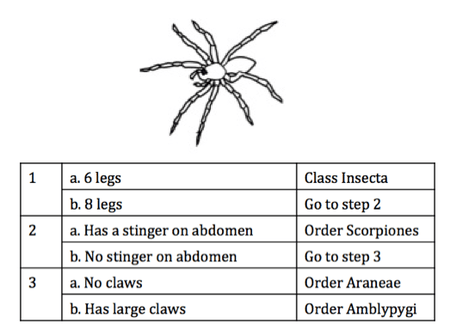
An illustration and a dichotomous key are given. What is the correct classification for this organism?
(a)

arachnids and insects?
(a)
(a)
physical features
weather patterns
environment
diet

A dichotomous key for trees is provided. Hikers found a tree that has large brown cones and single sharp needles. What species of tree have the hikers found?
(a)
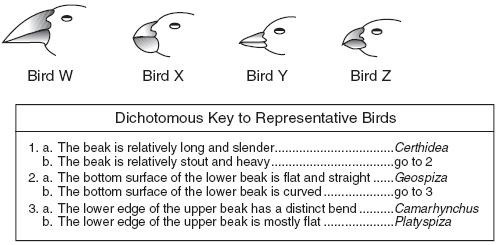
(a)
A characteristic or trait that helps an organism survive in its environment is a/an (a)
Variation in (a) would best help bison survive a harsh winter
The gills have allowed a fish to adapt to living underwater because gills allow the fish to (a)

A giraffe has a long neck in order to better reach leaves to eat. This is an example of _____.
an adaptation
environment
response
stimulus

which is the learned behavior?
shape of beak
monkey riding bicycle
horse eating hay
snake eating mice
Which of the following is an inherited trait?
swimming
eye color
skateboarding
callused fingers

Determine if the traits are structural or behavioral.
Migration
Behavioral because it makes animals move away and find better resources
Hibernation
Behavioral because it allows animals to save energy
Camouflage
Structural because it allows organisms to hide in plain sight
Venom
Structural because it is a chemical defense
Storage of food in bulb
Structural because it allows plants to save energy for later use
Where the better adapted organisms survive to pass traits along to offspring.
Evolution
Natural Selection
Selective breeding
Artifical Selection
Natural selection means that what is changing over time?
The inherited traits of a population.
The acquired traits of a population.
Hair color and eye color
Attractive features.
Why are favorable (advantageous) traits more likely to be passed onto offspring?
Organisms that have them are more likely to survive and reproduce.
Favorable traits come from dominant alleles.
Favorable traits come from recessive alleles.
Because the trait is an acquired phenotype.
Which organisms are most likely to survive?
the best adapted
the fastest
the strongest
the most domesticated
Which of the following is a RANDOM process?
evolution
selective breeding
genetic mutation
natural selection
The group of organs that work together to circulate blood through the body, supply oxygen and nutrients, and remove waste
Digestive System
Organelle
Organ system
Circulatory System
The group of organs that regulate the body by secreting hormones into the bloodstream; also control growth, reproduction, and metabolism
Endocrine System
Muscular System
Digestive System
Integumentary System
A group of organs and tissues specialized for the rapid transmission and processing of information
Photosythesis
Digestive system
Nervous system
Endocrine system
The group of organs that work together to break down food by physical and chemical processes into nutrients that the body can use
Digestive System
Endocrine System
Integumentary System
Respiratory System
A group of organs that function to provide structural support and protect internal organs
Excretory System
Digestive System
Skeletal System
Circulatory System
A collection of body systems that filter and remove excess fluids and waste from the body; includes the digestive, urinary, respiratory, and integumentary systems
Muscular System
Integumentary System
Excretory System
Respiratory System
A system of organs and tissues that protects the body from external damage and water loss
Muscular System
Integumentary System
Endocrine system
Circulatory system

Circulatory system

Respiratory system

skeletal system

Muscular system

Digestive system
Cells
Tissue
Organ
Organ System
Organism
What level of organization is made of organs?
Organ system
organism
cells
tissue
The stomach is made of which to levels of organization?
tissues and organs
cells and tissues
organ systems and organisms
cells and organ
systems
Tissues are made of what?
organs
everything
cells
tissues
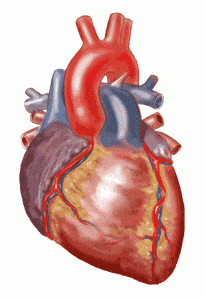
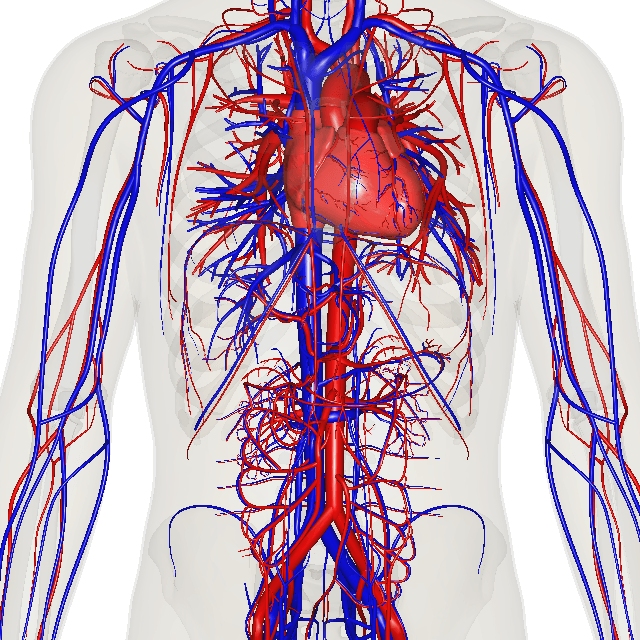
What is a cell?
Groups of similar types of cells that work together to carry out a specific task
Groups of different tissues working together to perform a particular job
Groups of different organs working together to complete a series of tasks
The smallest unit of life

This is an example of....
cell
tissue
organ
organ system
This organelle controls what goes in and out of plant and animal cells.
Cell Wall
Cell Membrane
Chloroplasts
Cytoplasm
The _____________ stores food, water, wastes, and other materials in both plant and animal cells.
Vacuole
Mitochondria
Cytoplasm
Nucleus
Which of the following is NOT an organism?
bee
paramecium
heart
gorilla
If cells make up all living things, are they also considered to be living?
yes
no
Cancer cells are formed when mutated cells divide and rapidly increase in number. Which part of the cell theory is associated with the production of cancer cells?
1. All living things are made of up cells.
2. Cells are the fundamental unit of life.
3. All cells come from preexisting cells.
None of them.

What part of the cell theory does the information in the table relate to?
All living things are made up from cells.
New cells come from existing cells.
Cells contain genetic material in the nucleus.
All cells perform similar necessary functions.
An amoeba is a one-celled organism. The cell theory states that which of the following characteristics of amoebas must be true?
All amoebas have a regular, spherical shape.
All amoebas move rapidly using cilia.
All amoebas have organelles called chloroplasts.
All amoebas come from other amoebas.
1. All the following are examples of asexual reproduction except _____
budding in yeast
binary fission in protists
pollination of a flower
a potato eye developing a bud
Which of the following statements best describe the offspring in sexual reproduction?
Offspring are identical to the parent.
Offspring are identical only to the mother, but not the father.
Offspring are identical only to the father, but not the mother.
Offspring are diverse and look different from the parents.
Which of the following statements best describe an offspring produced by asexual reproduction?
The offspring has the same identical genetic information as the parent.
The offspring contains only the mother's genetic information.
The offspring contains only the father's genetic information.
The offspring has some genetic material from both parents.
Which of the following represents sexual reproduction?


The Appalachian shoestring fern reproduces asexually. What can be concluded about the offspring of this fern? The genetic material of the offspring of the Appalachian shoestring fern _____
is different for each individual offspring.
varies greatly from one generation to the next.
could never be predicted with any reliability.
is identical to that of the parent plant.
1. All the following are examples of asexual reproduction except _____
budding in yeast
binary fission in protists
pollination of a flower
a potato eye developing a bud
Which of the following statements best describe the offspring in sexual reproduction?
Offspring are identical to the parent.
Offspring are identical only to the mother, but not the father.
Offspring are identical only to the father, but not the mother.
Offspring are diverse and look different from the parents.
The genotype for a yellow plant is...

Which type of cells do not possess a nucleus and do not have membrane bound organelles.
eukaryotes
prokaryotes

