
 Worksheets
UPWHM U8
Total questions: 117
Worksheet time: 2hrs 57mins
Which is true of the Cold War?
It was World War 3
It never ended
conflict that was between the US and the Soviet Union
Most casualties in an American war
Policy of providing economic and military aid to any country threatened by communism, mainly helped Greece and Turkey. (Know as)
Truman Doctrine
Marshall Plan
Eisenhower Big 5
Domino Theory
The Iron Curtain cut off
Eastern Europe to the rest of the world
Western Europe to the rest of the world.
The United States to the rest of the world.
Russia to the rest of the world.
The policy of containment meant that
The U.S.S.R. would not let democracy spread.
The U.S. would not let Islam spread.
The U.S.S.R. would not let Communism spread.
The U.S. would not let Communism spread.
The Marshall Plan gave money to
Eastern European countries.
Asian countries.
Latin American countries.
Western European countries.
After World War 2 the Soviet Union set up
Satellite countries in Eastern Europe
Buffer countries in Western Europe
Dinner with friends
Trade agreement between themselves and the United States
Joint effort by the US and Britian to fly food and supplies into W Berlin after the Soviet blocked off all ground routes into the city
East Berlin
Berlin Airlift
Iron Curtain
Berlin Wall
The Truman Doctrine's main goal was to:
Contain communism
Provide weapons to democratic countries
Destroy communism
Provide collective security
How did the United States respond to the Soviet Union’s Berlin blockade?
airlifted supplies to the people of Berlin
withdrew its troops from Germany
sent troops into the Soviet zone of Germany
built a wall between East Berlin and West Berlin
Why is the Cold War called a "cold" war?
The areas affected were in the polar regions of the world
The war was fought during winter months only
Leaders of the superpowers were sick with coughs and fevers
There was never direct fighting between the two superpowers
What does NATO stand for?
North Atlantic Treaty Organization
North American Trade Organization
Northern Alliance Trade Origins
Native American Tribal Organization
What country was the head of the Warsaw Pact?
Germany
Soviet Union
China
North Korea
What was the Iron Curtain?
the boundary between Western Europe and communist Eastern Europe
the boundary between the United States and Mexico
the boundary between the United States and Mexico
the wall dividing East and West Berlin
Sputnik 1 was launched by:
USA
USSR
China
Great Britain
The Cold War was mainly focused on the U.S and their fight against ___.
Socialism
Fascism
Communism
Capitalism
What program aided the rebuilding of Western Europe?
Truman Doctrine
Warsaw Pact
NATO
Marshall Plan
What was the mutual defense alliance of non comminist nations?
NATO
Truman Doctrine
Warsaw Pact
Open Skies
Post World War II tensions increased between these two nations?
United States and United Kingdom
Japan and the Soviet Union
United States and the Soviet Union
Germany and Japan
What was the result of China having a Nationalist government recognized by the world but a Communist party growing in the countryside?
A social realist art campaign was created to uplift Nationalist ideas
Nationalist troops and armed gangs wiped out the Communists
Civil war broke out between the two groups
Communist leaders were forced to work in labor camps
Why did Chinese peasants align themselves with the Communists rather than the Nationalists?
The Communists divided land among the farmers, while the Nationalists ignored their problems
The Nationalists relocated thousands of peasants in the Long March
The Nationalists were forcing China to industrialize through high taxes on farms
The Communists moved peasants to collective farms, where they prospered.
The Nationalist and the Communists fought together against what nation during World War II?
Japan
Thailand
Australia
Mongolia
Which side in China's civil war-the Communist or Nationalists - had more support from the peasants?
Communists
Nationalists
Which side did the U.S. support with financial aid and weapons during the civil war?
Communists
Nationalists
What was the name of the island to which the Nationalist forces retreated at the end of the war?
Japan
Australia
Tawain
Greenland
What is the name of the campaign that was launched by China's leader, Mao, in 1966 with the aim of restoring radical Communist values?
Great Leap Forward
The Cultural Revolution
Mandate of Heaven
communes
Leader of the communist party in China.
Mao Zedong
Jiang Jieshi
Stalin
Mussolini
Leader of the Nationalist party in China.
Mao Zedong
Jiang Jieshi
Stalin
Mussolini
New name for China under Mao Zedong
People's Republic of China
Mao
Soviet Union
Republic of China
How many countries in Africa gained independence from their colonizers?
0
10-25
25-50
50+
Which of the following countries was formerly colonized by Britain?
Ghana
South Africa
Kenya
India
Which tactic was used in both Algeria and Kenya to achieve independence?
Non-violent protests / strikes
Violent resistance / civil war
Apartheid ended in 1994 for which country?
Algeria
Ghana
South Africa
Kenya
Which group was given the most power in the apartheid system?
Native Africans
Europeans
Children of Europeans and native Africans
others
Which of the following religious groups was not involved in the Partition of India?
Muslims
Christians
Sikhs
Hindus
Once it gained independence, India became the world's largest _____?
Dictatorship
Country
Empire
Democracy
Which country has a higher population: China or India?
China
India
Which group was the majority in India before independence?
Chinese
Jews
Muslims
Hindu
Which group was established in 1885 to achieve equal rights for Indians?
Indian National Congress
United Nations
League of Nations
Pan-Africanism
What were Rwandan citizens forced to carry during Belgian rule?
Passports
Driver's Licenses
Mao's Little Red Book
Identification Cards
What was the main reason the Rwandan genocide occurred?
the collapse of the Belgian government
Years of discrimination against the Hutus
Radio station message saying to "cut down the tall trees"
The president telling people to slaughter each other
What is the meaning of apartheid?
Inferior
Apartness
Superior
Closedness
Who fought in the Boer war?
British and the Zulu
British and the Dutch
Soviets and the Nazis
Dutch and Spanish
Who became the first black president in South Africa?
Nelson Mandela
Barack Obama
FW de Klerk
Winnie Mandela
What is civil war?
War between groups in a nation
Wars that occur only in Africa
War between two or more nations
War between brothers
Which term best describes South Africa's National Party?
Colonialist
Unifying
Racist
Liberal
What was the purpose of blood diamonds?
To help save lives
Help rebel groups fund wars against African governments
To scare the enemy into defeat
To act as a piece of fashion
The Revolutionary United Front(RUF) used blood diamonds for
gifts to their family and loved ones.
creating their own country in South America.
child soldiers to fight for them.
funding their fight against the government in Sierra Leone
What was NOT a lasting effect of colonization?
Inexperienced leaders in African countries
Many African countries were undeveloped
Many African economies are based on agriculture
Many African nations thrived after independence
A military take-over through force
Rebellion
Civil War
Coup d'etat
Just War
What was NOT a reason most colonies were given their independence after WWII?
It was hypocritical to have colonies
Most colonists fought alongside their European rulers
Most European countries were in serious debt
European countries were looking to take over new territories
Different ethnic groups were thrown together
Political Challenge
Social Challenge
Environmental Challenge
Economic Challenge
Desertification
Social Challenge
Political Challenge
Economic Challenge
Environmental Challenge
Few industries were established
Social Challenge
Political Challenge
Economic Challenge
Environmental Challenge
African leaders had little experience governing themselves
Social Challenge
Political Challenge
Economic Challenge
Environmental Challenge
Low life expectancy
Social Challenge
Political Challenge
Economic Challenge
Environmental Challenge
Mohandas Gandhi believed in using this to force the British to give up their rule in India.
nonviolent resistance
violent protests
machine guns
apartheid
Gandhi's long march to the Arabian Sea Coast was known as
Salt March
Long March
Bataan Death March
Selma March
Famine can be defined as
the extreme scarcity of non-violent protests
the extreme scarcity of natural resources
the extreme scarcity of food
the extreme scarcity of ideas
Who was the leader of the Chinese Communist Party?
Xia Ping
Deng Xiaoping
Mao Zedong
Emperor Hiroto
Why would the peasants, those living in severe poverty, follow the Communists Party?
They were looking for a new ruler.
They were desperate for any hope to change their situation.
They were told they would get a new job.
They were tired of the old, traditional ways.
The Communist Party's idea of joining small farms into larger farms was known as
collectivization
industrialization
politicizing
ownership
The Chinese Communist's plan of joining farms together to grow more and more food by competition between farms was known as
Cultural Revolution
The Chinese Communal Farm Plan
The Communist's Food Plan
The Great Leap Forward
Was the Great Leap Forward successful?
Yes
No
What program was designed to stop opposition to the Chinese Communist Party?
The Great Leap Forward
The Cultural Revolution
The Chinese Civil War
The Ping Dynasty
What was the name of the army of young people the Communist Party used to enforce the policies in the 1960s?
Red Guard
Red Army
Red Tide
Red Wave
All citizens of China during the Cultural Revolution were required to memorize and carry with them
Mao's Little Instruction Book
Mao's Letter to the People
Mao's Little Red Book
Mao's How to be a Communist Book
Did Communism end with the death of Mao Zedong in 1976?
Yes
No
Deng Xiaoping becomes the new leader of China after Mao Zedong. Choose the reforms, more than one, that he changed to help China increase her economy.
farmers could own their land
private businesses
trade with foreign countries that were not Communist
government no longer controlled the media
Where did thousands of peaceful protesters killed by the Chinese government in 1989?
Red Square
Tienanmen Square
Olympic Square
Singapore Square
This term means to convince others to your way of thinking.
Propaganda
Collectivization
Industrialization
Peroration
What was unique about the Chinese Civil War?
There was no side that won.
There was a break in the Civil War to fight in WW2.
It was a short war.
It was a war without any deaths.
Prior to the Nationalist Party took over China's government, China was ruled by
the people
dictators
presidents
dynasties and emperors
The Berlin Wall was constructed to stop movement of people between East & West Germany. What was the main difference between the two countries?
East Germany was communist and West Germany was democratic and capitalist
East Germany was a free state and West Germany was occupied by Europe
East Germany was democratic and West Germany was a dictatorship
East Germany was Christian and West Germany was Muslim
Which of the following best describes a proxy war?
Two superpowers directly fighting
Two countries fighting without any outside assistance
Supporting sides in another country's war to oppose an enemy
Competing in sports instead of military force
Which of the following is NOT an example of a proxy war?
Vietnam War
Korean War
World War II
Soviet-Afghan War
Which of the following groups/governments did the Soviet Union support during the Cold War era?
the government of South Korea during the Korean War
the mujahideen during the Soviet-Afghan War
the government of South Vietnam during the Vietnam War
the Viet Cong during the Vietnam War
In what way(s) did the United States support South Vietnam's government?
sending American troops to fight the Viet Cong
sending money, supplies, and weapons, but no soldiers
sending diplomats to broker a truce with the Viet Cong
sending money to the Viet Cong during the Vietnam War
In what way(s) did the United States support South Vietnam's government?
sending American troops to fight the Viet Cong
sending money, supplies, and weapons, but no soldiers
sending diplomats to broker a truce with the Viet Cong
sending money to the Viet Cong during the Vietnam War
In what way(s) did the Soviet Union support the Viet Cong?
sending Soviet troops to fight alongside the Viet Cong
sending money, supplies, and weapons, but no soldiers
sending UN peacekeepers
sending diplomats to broker a truce with the Viet Cong
What was the outcome of the Vietnam War?
U.S. troops helped South Vietnam's government successfully defeat the Viet Cong.
The U.S. withdrew its troops and North Vietnam successfully united Vietnam as a communist state.
The U.S. signed an armistice agreement with North Vietnam and Vietnam remained divided.
The U.S. took over Vietnam and made them a territory of the U.S.
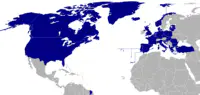
The countries in blue on this map were members of which alliance during the Cold War?
NATO
SEATO
Warsaw Pact
NAFTA
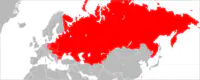
The countries in blue on this map were members of which alliance during the Cold War?
NATO
SEATO
Warsaw Pact
NAFTA
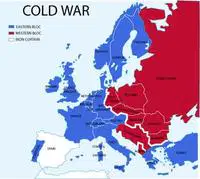
The dividing line between the democracies in blue and the Communist in red was referred to as what?
The line of demarkation
The DeMilitarized Zone
The Iron Curtain
The 38th Parallel
Which of the following was a primary reason for the United States intervention in the Korean War in 1950-1953?
To end apartheid and promote equality in Korea
To rescue Korea from the Japanese Imperialist Army
To stop the spread of Communism and Kim Il Sung
To promote the power of the United States globally
Which of these was integral in beginning a "Space Race" between the United States and the Soviet Union?
Sputnik
the Berlin Wall
the Berlin Blockade
the Cuban Missile Crisis
The United States was involved in all of the following attempts to combat communism EXCEPT....
They supported the South Vietnamese in the Vietnam Conflict
They overthrew the government of Guatemala and set up a pro-US Government
They funded assassinations of communist leaders in Africa and Latin America
They assassinated John F. Kennedy in order to place a more subservient president in office
Which crisis saw the United States emerging as more important diplomatically and internationally as it stopped Great Britain and France from intervening to protect its economic interests.
Hungarian Uprising
Suez Crisis
U-2 Incident
Vietnam Conflict
MAD, or Mutually Assured Destruction, was an acronym coined for the destruction that would be caused world-wide by...
Nuclear Attacks
Intercontinental Ballistic Missiles
Agent Orange
Napalm
What was the strategy adopted that attempted to stop the spread of Communism?
Containment
MAD
Domino Theory
Brinksmanship
Who was the leader who founded the Peoples' Republic of China after the Chinese Revolution?
Chiang Kai-shek
Deng Xiaoping
Mao Zedong
Jiang Zemin
What was the name of the island to which the Nationalist forces retreated at the end of the war between Communist and Nationalist factions in China?
Japan
Australia
Taiwan
Hawaii
Mao Zedong's Great Leap Forward created agricultural communes to...
help the bourgeoisie prosper
"rectify thinking through labor"
make agriculture more efficient
grow extra food for Taiwan
The main purpose of the Cultural Revolution was to...
modernize the Chinese economy through collectivism
strengthen ties with the Soviet Union to strengthen the military
preserve revolutionary Communist values by destroying the past
increase China's technological capabilities for world trade
What led Chinese students to demand democratic reform?
the visit by U.S. president Richard Nixon
economic reforms that allowed Western ideas into China
the breakup of the Soviet Union
the fall of the Berlin Wall and reunification of Germany
The Cuban Missile Crisis occurred when ...
The United States attempted to invade Cuba and create a revolution to overthrow Fidel Castro, but it failed.
the Soviet Union fired missiles at Cuba a long held ally of the United States.
the U.S. learned that the Soviet Union had built missile launching pads in Cuba, very close to the state of Florida.
the Soviet Union fired missiles at the U.S. from Cuba.
The "American War/Vietnam War" began because...
The United States wanted to stop the spread of communism.
The United States wanted to end the enslavement of the Vietnamese population by the Japanese during WWII.
The French had begun to spread capitalism and freedom to communist countries, but ran out of funding to continue in Vietnam.
The occupation after World War II led the nation to be divided in half, much like Berlin and Germany.
Ho Chi Minh fought for a _______ government in Vietnam, while Ngô Đình Diệm led the _________ government.
Communist / Democratic
Democratic / Communist
Socialist / Communist
Fascist / Democratic
The Soviet Union forced much of Eastern Europe to become communist. These nations became under the Soviet's Sphere of influence. What were they called?
Iron Curtains
Comintern States
Satellite States
Deterrents
Apartheid was...
the policy of segregation in South Africa
the government for Indians in South Africa
the language of whites in South Africa.
the policy integration in South Africa
Israeli-controlled territories led to a Palestinian intifada, or
peace treaty
disarmament
uprising
containment
Which has been a major goal of both the Zionists and Palestinian Arabs in the Middle East
to unite all Middle Eastern nations as one
to have their own independent countries
to become leaders in the world economy
to improve their relations with the USSR
Pakistan and Bangladesh are mostly ____ while India is mostly _____.
Muslim, Hindu
Buddhist, Sikh
Hindu, Buddhist
Christian, Muslim
Indira Gandhi is famous because of...
helping the British fight World War II and her role in the Bengali Famine
the removal of British control from the Indian subcontinent through non-violent protest
abolishing caste distinctions and discrimination once in power as the first Sikh president
her controversial time as one of the first democratically elected female heads of state
A negative effect of the partitioning of India in 1947 was that
foreign rule was reestablished in India
Hinduism became the only religion practiced in India
the government policy of nonalignment further divided Indian society
civil unrest, territorial disputes, and religious conflicts continued throughout the region
What was one reason that India was divided into two nations in 1947?
Indian leaders disagreed about India’s role in the United Nations.
Great Britain feared a unified India would be a military threat.
The Soviet Union insisted that India should have a communist government.
Differences between the Hindus and the Muslims created religious conflict.
Which characteristic of South Asian cultures best explains the political divisions of the region after the countries gained independence during the twentieth century?
Climate variations
Language differences
Religious differences
Differences in economic activities
Who created the state of Israel in 1948?
The British
United States
Arabs
United Nations
Which of these African nations experienced a relatively peaceful decolonization process?
Ghana
Algeria
Kenya
Rhodesia
The destruction of the Berlin Wall and the breakup of the Soviet Union signified the:
End of the Cold War
Collapse of Taliban
Strength of the Warsaw Pact
Power of the European Union
Which group of reform-minded revolutionaries overthrew the Nicaraguan government in 1979?
Sandinistas
Ortegas
CIA
Serbs
The term "Pan–Africanism" can best be defined as a movement whose purpose is to
promote African unity
support cultural diversity
encourage European investment in Africa
advocate a return to colonial conditions
A similarity of the goals of Nelson Mandela and Mohandas Gandhi is that both leaders wanted to
secure political power for the majority of the people
encourage a greater degree of industrialization
improve the economy by expanding governmental control
gain independence from the Soviet Union
Which of the following describes Japan after WWII?
Punished with reparations that crippled the economy.
Engaged in an economic and political alliance with the United States after its occupation ended.
Refused to accept defeat and engaged in another, more regionally-based conflict.
Created a constitution with a strong military arm, allowing for its defense against China and North Korea.
Che Guevara was...
an Argentinian who became a communist leader in Cuba before attempting to go global with communism.
a revolutionary hero to all democratic people, and to this day continues to have t-shirts printed with his face on them.
an undercover operative who exposed the Iranian Hostage Crisis and the Iran-Contra Affair to the public.
a religious reformer who created the Rastafari Movement that sought Pan-African Unity.
What African nation gained independence from France after a violent eight year war?
Algeria
South Africa
Egypt
Ethiopia
The boundaries of new African countries were often based upon what?
existing tribal settlement patterns
divisions imposed under European imperialism
Mandates created by the United Nations
Location of natural resources.
What Cold War policy allowed a little bit of capitalism in to the USSR?
Glasnost
Perestroika
Detente
Cheka

