Wayground logo

Free Printable Worksheets

Font size

S
M
L
XL
Worksheets

Oceans

Total questions: 48

Worksheet time: 26mins

Name
Class
Date
1.

Ocean currents are caused by: (choose all that apply)

a)

wind patterns

b)

earthquakes

c)

tsunamies

d)

differences in water density caused by temperature and salinity

2.

Waves are most commonly formed by:

a)

sun

b)

wind

c)

large whales

d)

salt

3.

Which of the following decreases as ocean depth increases ? (Choose all the apply)

a)

pressure

b)

temperature

c)

size of waves

d)

light

4.

Which ocean feature is letter D?

a)

Deep Ocean Trench

b)

Continental Shelf

c)

Mid-Ocean Ridge

d)

Abyssal Plain

5.

Which ocean feature is letter F?

a)

Seamount

b)

Abyssal Plain

c)

Mid-Ocean Ridge

d)

Volcanic Island

6.

Which ocean is letter A?

a)

Atlantic

b)

Pacific

c)

Southern

d)

Arctic

7.

Which ocean is letter B?

a)

Atlantic

b)

Pacific

c)

Arctic

d)

Southern

8.

Which ocean is letter C?

a)

Arctic

b)

Indian

c)

Pacific

d)

Southern

9.

Which ocean is letter D?

a)

Indian

b)

Pacific

c)

Arctic

d)

Southern

10.

Which ocean is letter E?

a)

Atlantic

b)

Arctic

c)

Indian

d)

Southern

11.
Which ocean basin is the largest?
a)
the Atlantic
b)
the Indian
c)
the Pacific
d)
the Arctic
12.

What hemisphere is the United States in?

a)

Southern

b)

Up

c)

Northern

d)

Equador

13.

What is a Tsunami?

a)

A current of water caused by the moon

b)

A huge wave caused by wind

c)

A series of waves caused by an earthquake

d)

A current caused by heat

14.

The amount of dissolved salt in water

a)

Density

b)

Salinity

c)

Temperature

15.

What are submersible vessels or underwater ROVs used for?

a)

To explore land and sea

b)

To explore underwater

c)

To measure the oceans surface

16.

What is a abyssal plain

a)

very flat area of ocean floor

b)

Deep ocean ridge

c)

Underwater canyon

d)

Underwater mountains

17.
Surface currents are caused mainly by 
a)
prevailing winds
b)
tsunamis
c)
earthquakes
d)
upwelling
18.
The Arctic ocean is the ______________ ocean on Earth.
a)
largest
b)
warmest
c)
fishiest
d)
smallest
19.
A factor that affects the density of ocean currents is 
a)
salinity
b)
time
c)
atmosphere
d)
eclipses
20.
A ___________________ is an underwater vehicle built of materials that resist pressure.
a)
gyre
b)
submersible
c)
zone
d)
seamount
21.

The bottom of the ocean is just flat.

a)

true

b)

false

22.

The following are the oceans according to size

a)

Pacific, Atlantic, Indian, Arctic, Southern

b)

Pacific, Indian, Atlantic, Arctic, Southern

c)

Atlantic, Pacific, Indian, Southern, Arctic

d)

Pacific, Atlantic, Indian, Southern, Arctic

23.

the vertical movement of deep water up to the surface

a)

Rip current

b)

Waves

c)

Upwelling

d)

Downwelling

24.

Horizontal distance between two crests or two troughs

a)

Wave current

b)

Wave distance

c)

Wave length

d)

Crest

25.

Lowest point of a wave

a)

Low Valley

b)

Deep Valley

c)

Trough

d)

Sinkhole

26.
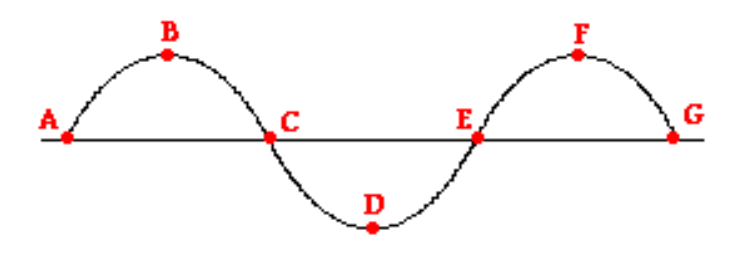
Which letter(s) represent the crest of the wave?
a)
A
b)
B & D
c)
B & F
d)
F
27.
A[n] ___________ tide occurs when the sun, Earth, and the moon are nearly in a line. 
a)
spring
b)
high
c)
low
d)
neap
28.
A neap tide is a tide with the greatest difference between low and high tides
a)
true
b)
false
29.
What type of tides would this arrangement of earth-moon-sun create?
a)
neap tide
b)
spring tide
c)
new moon tide
d)
full moon tide
30.
What type of tide would this arrangement of earth-moon-sun create?
a)
full moon tide
b)
new moon tide
c)
neap tide
d)
spring tide
31.
What causes tides?
a)
gravity
b)
wind
c)
spring
d)
neap
32.
The Coriolis Effect is caused by
a)
Earth rotating around the sun
b)
Earth rotating on its axis
c)
The tides
d)
Gravity
33.

Why is upwelling important?

a)

Upwelling regulates ocean temperature

b)

Upwelling provides nutrient rich water that sustains life

c)

Upwelling controls the tides

d)

Upwelling helps sailors to navigate the seas

34.

What are a circular system of currents in the Earth's major oceans?

a)

ocean current

b)

gyre

c)

upwelling

d)

conveyor belt

35.
Surface currents are mainly caused by
a)
The Coriolis Effect
b)
Cold and Warm Water
c)
Convection
d)
Wind
36.
The deflection of currents due to Earth's rotation is called the
a)
Rotation Effect
b)
Current Effect
c)
Coriolis Effect
d)
Deflection Effect
37.
Warm water is ________ dense and _________ than cold water
a)
More, Heavier
b)
Less, Heavier
c)
Less, Lighter
d)
More, Lighter
38.
What are tides caused by?
a)
Doldrums
b)
Wind
c)
Coriolis effect
d)
Gravitational pull of the moon and sun
39.

Which of the following does NOT make studying the ocean floor difficult?

a)

The ocean consists of salt water rather than fresh.

b)

The deep ocean is in total darkness.

c)

The water in the deep ocean is extremely cold.

d)

There is tremendous pressure in the deep ocean.

40.

Salinity is a measure of which of the following in water?

a)

carbon dioxide

b)

oxygen

c)

dissolved salts

d)

sand

41.

What is Brackish?

a)

A mixture of freshwater and saltwater

b)

Fast moving river and waves

c)

A great place for plants to grow

42.
What is the name of the layer of the ocean that has the most life? 
a)
Oceanic
b)
Twilight
c)
Sunlight
d)
Abyss
43.
Why does most of the ocean life live in or at least visit the ocean surface?  
a)
that is where the majority of the oxygen and sunlight occurs
b)
that is where chemo-synthesis occurs and therefore more life
c)
the water pressure is higher there and is more enjoyable
d)
the temperatures are colder and most animals need cooler temperatures
44.
Animals that can use their bodies to make light are called _______________.
a)
magic
b)
shiny
c)
amazing
d)
bioluminescent
45.
As oceans become deeper, the water pressure ___________________.
a)
increases
b)
decreases
c)
stays the same
46.
Which zone is completely dark and near freezing in temperature?
a)
sunlight
b)
twilight
c)
midnight
47.
The ocean layers are divided by the amount of __________________ in each layer.
a)

animals

b)

ice

c)

light

d)

people

48.
Sunlight allows ________________ to occur in the sunlight zone.
a)
bioluminesence
b)
transpiration
c)
photosynthesis
d)
voting