
NEW
Font size
 Worksheets
IMFs, Properties and Phase Changes.
Total questions: 32
Worksheet time: 27mins
Which property decreases with stronger intermolecular forces?
Surface tension
vapor pressure
melting point
conductivity

What is the main intermolecular force in methanol?
hydrogen bonding
dipole-dipole forces
london dispersion forces
none
Larger molecules will have more of which intermolecular force?
hydrogen bonding
dipole-dipole forces
london dispersion forces
none
What are hydrogen bonds?
Any time hydrogen is bonded to another atom
Any time hydrogen is bonded to N, O, or F
An interaction between molecules with H-N, H-O, or H-F bonds in them
Any attraction to hydrogen atoms
Which of these substances is expected to have the highest boiling point?
NH3
NF3
C2H6
C4H8
What is the relationship between vapor pressure and intermolecular forces?
Vapor pressure does not depend upon intermolecular forces, only the strength of chemical bonds.
Stronger intermolecular forces cause particles to repel each other, raising the vapor pressure.
Stronger IMFs cause particles to stick together, lowering the vapor pressure.
Intermolecular forces cause all liquids to have the same vapor pressure.
Based on the strength of intermolecular forces, which would you expect to have the highest vapor pressure?
NF3
NH3
CH4
C5H12
Select the correct order of molecules from lowest to highest boiling point, based on intermolecular forces.
CH4 < C2H6 < H2O < SO2
H2O < SO2 < C2H6 < CH4
C2H6 < CH4 < H2O < SO2
CH4 < C2H6 < SO2 < H2O
The weaker the intermolecular forces of a substance the _____________ the boiling point
higher
lower

According to the reference table, what is the boiling point of ethanoic acid at 80 kPa?
28 oC
100oC
111oC
125oC

Which liquid has the highest vapor pressure at 75oC?
ethanoic acid
ethanol
propanone
water

Which model represents a LOWER Vapor Pressure?
A
B
Which substance has the weakest intermolecular forces?
Substance A, boiling point of 75 °C
Substance B, boiling point of 105 °C
Substance C, boiling point of 25 °C
Substance d, boiling point of 45 °C
Phase change going from a Liquid to a Gas...
Vaporization
Deposition
Condensation
Melting
Phase change going from a Solid to a Gas...
Deposition
Sublimation
Condensation
Recombination
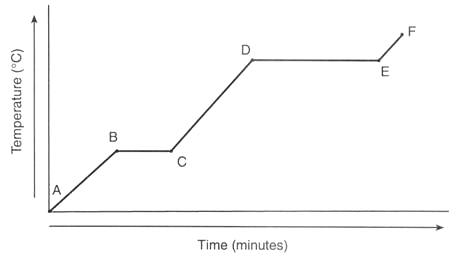
What state/phase is the object likely from points A to B?
Solid
Liquid
Gas
Plasma


Which letter on the diagram represents a gas?
A
B
C
D
Which letter on the diagram represents a liquid?
A
B
C
D

What does point B represent?
Triple point
Critical point
Equilibrium point
Normal melting point
Which letter on the diagram represents a solid?
A
B
C
D
The temperature and pressure conditions at which the solid, liquid, and gas phases of a substance exist at the same time is called the
Critical point
Triple point
Melting point
Boiling point
What is the normal melting point of this substance?
150°C
100°C
-50°C
0°C
Which letter on the diagram represents the triple point?
A
B
C
D

What is true regarding CO2 for temperatures above 31°C?
It does not exist
It decomposes
It cannot be condensed back into a liquid
It is a plasma
What is the normal melting point of this substance?
40°C
60°C
100°C
110°C
What phase change occurs from F to E?
Sublimation
Deposition
Melting
Condensation
What phase change occurs from C to D?
Condensation
Vaporization
Melting
Sublimation
What phase change occurs from E to C?
Sublimation
Freezing
Melting
Vaporization

