wayground logo

Free Printable Worksheets

Font size

S
M
L
XL
Worksheets

Assessment| Recap

Total questions: 100

Worksheet time: 1hrs 15mins

Name
Class
Date
1.

___________ are the smallest unit of an element that maintains the properties of that element.

a)

Atoms

b)

Elements

c)

Compounds

d)

mixtures

2.

A/An _______________ is made up of one or more of the same kind of atom chemically combined.

a)

atom

b)

element

c)

compound

d)

molecule

3.

A/an _____________ contains a variety of elements and compounds that are not chemically combined with each other.

a)

atom

b)

element

c)

compound

d)

mixture

4.

A __________________ is a substance that has definite physical and chemical properties such as appearance, melting point, and reactivity.

a)

mixture

b)

pure substance

c)

compound

d)

element

5.

Elements and compounds are pure substances.

a)

True

b)

False

6.

Elements are broadly classified as metals, nonmetals, and _________________.

a)

compounds

b)

mixtures

c)

metalloids

7.

Coffee, mouthwash, and vinegar are examples of __________________ mixtures.

a)

heterogeneous

b)

homogeneous

8.

The wind that heralds the harmattan season in Nigeria is the

a)

Northeastern wind

b)

Northwestern wind

c)

Southeastern wind

d)

Southwestern wind

9.

Ammonia is a colourless gas with the formula NH3.

Ammonia contains hydrogen and nitrogen and cannot be broken down physically.

Ammonia is a ___________________ .

a)

compound

b)

element

10.

A homogeneous mixture is the same thing as...

a)

a solution

b)

a heterogeneous mixture

c)

a compound

d)

an element

11.

A type of mixture that forms when one substance dissolves in another is known as a

a)

heterogeneous mixture

b)

solution

c)

solute

d)

solvent

12.
What does it mean to dilute a solution?
a)
lower the concentration of solute per solvent
b)
increase the concentration of solute per solvent
13.

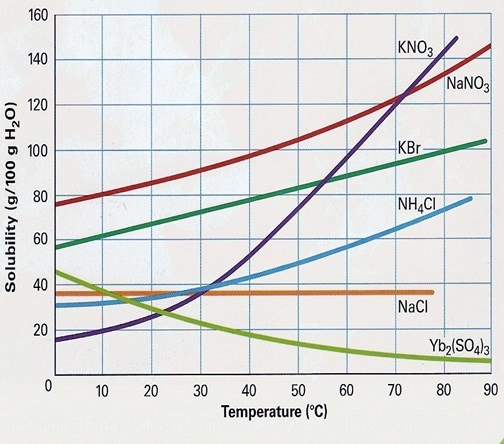
Which substance is least soluble at 0 ºC?

a)

KI

b)

KNO3

c)

KClO3

d)

Ce2(SO4)3

14.

How many grams are soluble in 100 g of water at 100 ºC?

a)

300 grams

b)

250 grams

c)

100 grams

d)

50 grams

15.

Which solute is most likely a gas?

a)

NH3

b)

NaNO3

c)

KCl

d)

NaCl

16.

When 40 grams of NaCl is dissolved in 100 grams of water at 90 ºC, the solution can be correctly described as:

a)

supersaturated

b)

saturated

c)

unsaturated

17.
Which solute does not increase in solubility as temperature rises?
a)
NH3
b)
NaNO3
c)
KNO3
d)
NaCl
18.
Solution where more solute can still be dissolved at the given temperature. 
a)
Saturated
b)
Unsaturated
c)
Supersaturated
d)
Homogeneous solution
19.

Identify how many grams of KNO3 is required to make a saturated solution at 40'C.

a)

50 g

b)

45 g

c)

55 g

d)

33 g

20.
If I dissolve sugar in water, what is the solute?
a)
Water
b)
Hydrogen
c)
Sugar
d)
Carbon
21.
What will allow more solute to be dissolved in a solvent.
a)
adding more solute
b)
stiring
c)
cooling solution
d)
heat
22.
Graph that shows the amount of solute that can be dissolved in 100 g of water at a certain temperature.
a)
Solubility curve
b)
Saturation curve
c)
Concentration curve
d)
Molarity curve
23.

Which factor affecting solubility is shown in the picture?

a)

temperature

b)

height

c)

stirring

d)

particle size

24.

Which factor is shown in the picture?

a)

temperature

b)

particle size

c)

stirring

d)

use of spoon

25.

Why do sugar particles dissolve faster in hot water?

a)

water particles move slow

b)

water particles move fast

c)

water particles settle down

d)

water particles stay on top

26.
Which of the following is the best conclusion that can be made from this graph?
a)
atmospheric carbon dioxide levels have been decreasing since 1960
b)
Hawaii has a lot of carbon dioxide
c)
humans have been working hard to decrease carbon dioxide levels
d)
atmospheric carbon dioxide levels have increased steadily since 1960
27.

The main human activity that releases greenhouse gases is

a)

using public transportation and there by reduce the affects of greenhouse gases.

b)

burning fossil fuels

c)

texting on cellphones

d)

eating meat

28.
 What is the greenhouse effect?
a)
The warming of a planet due to trapped radiation.
b)
The cooling of Earth due to air pollution.
c)
The heating of a solid, such as a rock.
29.
Which is a natural source of greenhouse gases?
a)
aerosols
b)
deforestation
c)
volcanic eruptions
d)
burning fossil fuels
30.

Which of the following gases IS NOT considered a greenhouse gas?

a)

carbon dioxide

b)

nitrogen

c)

water vapor

d)

methane

31.

Which statement best explains the general effect that differences in elevation above sea level have on the average annual temperature?

a)

The higher the elevation above sea level, the lower the average annual temperature.

b)

The lower the elevation above sea level, the lower the average annual temperature.

c)

The higher the elevation above sea level, the higher the average annual temperature.

d)

The lower the elevation above sea level, the higher the average annual temperature.

32.
How does the average annual surface temperature compare from latitude to latitude?
a)
As latitude increases, the average annual surface temperature decreases.
b)
As latitude increases, the average annual surface temperature increases.
c)
As latitude increases, the average annual surface temperature remains the same. 
d)
Well, it's not this one. 
33.
What is the best explanation for these two statements?
1. Some mountains located near the Earth's Equator have snow-covered peaks. 
2. Icecaps exist at the Earth's poles.
a)
High elevation and high latitude have a similar effect on climate. 
b)
Both mountain and polar regions have arid climates.
c)
Mountain and polar regions receive more energy from the Sun than other regions.
d)
An increase in snowfall and an increase in temperature have a similar effect on climate. 
34.
Which graph best shows the general effect that differences in elevation above sea level have on the average annual temperature?
a)

1

b)

2

c)

3

d)

4

35.
Why are temperature variations usually not as great on Long Island as they are in central New York State?
a)
Central New York State has a higher elevation.
b)
Central New York State is more heavily wooded.
c)
Long Island has a more southerly latitude.
d)
Long Island is surrounded by a large body of water. 
36.
What effect does a large body of water usually have on a nearby landmass?
a)
The water causes cooler summers and colder winters. 
b)
The water causes cooler summers and warmer winters. 
c)
The water causes hotter summers and warmer winters. 
d)
The water causes warmer summers and colder winters. 
37.

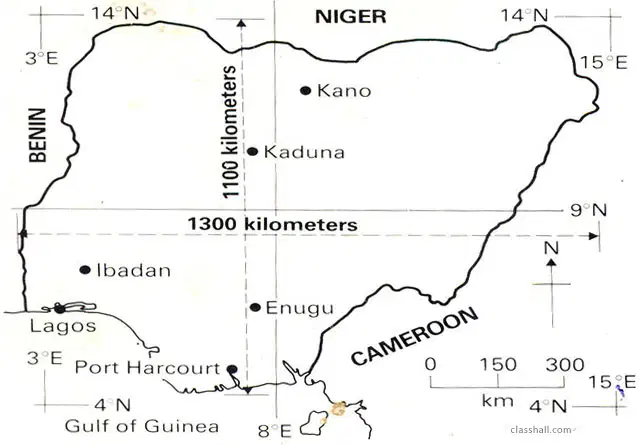
Study the image and select the option that shows the latitudes Nigeria lies between.

a)

9°N and 14°N

b)

4°N and 14°N

c)

4°N and 9°N

d)

0° and 19°N

38.
The planetary winds on Earth are indicated by the curving arrows in the diagram. 
The curved paths of the planetary winds are a result of 
a)
changes in humidity.
b)
changes in temperature.
c)
Earth's rotation on its axis
d)
Earth's gravitational force
39.
What causes winds to form on Earth?
a)
solar energy
b)
ocean currents
c)
elevation differences
d)
uneven heating of the Earth by the sun
40.
A student states the weather is the same as the climate. Which response BEST tells the student the difference between weather and climate?
a)
Weather is about the wind and the rain, but climate is about the clouds.
b)
Weather is the conditions in one day, but climate is the conditions over a long time.
c)
Weather is measured with tools like thermometers, but climate is measured with tools like forecasts.
d)
Weather is recorded on charts, but climate is recorded on world maps.
41.
Which observation describes a change in climate rather than a change in weather?
a)
The thunderstorm dropped about three centimeters of rain today.
b)
The average summer temperatures have increased over the last ten years.
c)
 The snowfall in this area was more this week than it was last week.
d)
The average wind speed in April was less than it was in March.
42.

What is weather?

a)

When it is freezing cold all year round.

b)

The conditions of the atmosphere (air/sky) over a short period of time.

c)

The speed in which the wind travels.

d)

The atmosphere (air/sky) over long periods of time.
43.

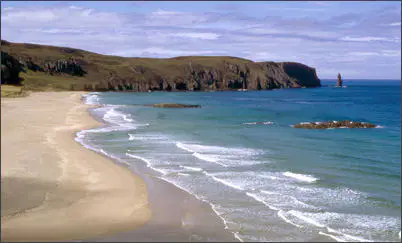
Which of the following is not a coastal area?

a)

Lagos

b)

Delta

c)

Prot-Harcourt

d)

Benue

44.

This changes every four months

a)

Weather

b)

Climate

c)

Seasons

45.

What do you think is a temperate climate?

a)

A mild climate with mild to hot summers and light to low rainfall.

b)

Hot and wet all year round with a humid climate.

c)

Very warm to hot with humid summers and mild to cool winters.

d)

Hot and dry summers and winters.

46.

Ink can be separated by a method of -----------------------------------------------

a)

distillation

b)

filtration

c)

chromatography

d)

sedimentation

47.
chromatography separates the mixture of dyes on the basis of their ----------------------------
a)
density
b)
solubility
c)
gravity
d)
boiling point
48.
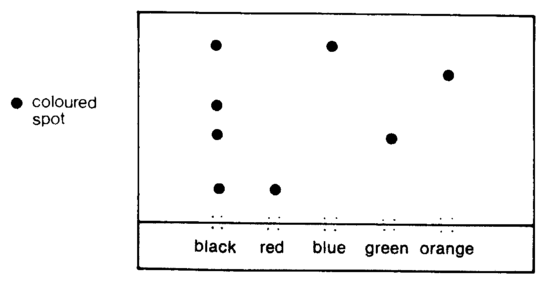
On the chromatogram given -------------- is mixture.
a)
red
b)
orange
c)
green
d)
black
49.

A pure substance shows ------------------ spot on chromatogram

a)

0

b)

1

c)

2

d)

3

50.
a)

identify the molecular bases in DNA

b)

detect chemical toxins in the air

c)

stain specimens before observing them with a microscope

d)

separate a mixture of plant pigments

51.

The pattern formed on the chromatography by the layers of components separated by chromatography is called

a)

distillate

b)

chromatogram

c)

components

d)

compounds

52.

A In paper chromatography, the MOST soluble solute.......

a)

does not move from the start point

b)

stays closest to the start point

c)

travels furthest away from the start point

d)

can be found in the middle of the chromatogram

53.

The diagram shows the paper chromatograms of four substances, W, X, Y, and Z.

Which two substance are pure?

a)

W and X

b)

W and Y

c)

X and Y

d)

Z and X

54.

A student is investigating a colored mixture using chromatography.

Where should he place the coloured mixture?

a)

in the solvent

b)

just above the pencil line

c)

just below the pencil line

d)

on the pencil line

55.

Food colorings contain one or more food dyes. A student used paper colorings (E, F, and G) and one unknown food coloring (H) on the chromatography. The diagram shows the appearance of the paper before and after her experiment. How many food dyes are there in food colouring G?

a)

1

b)

2

c)

5

d)

6

56.

Food colorings contain one or more food dyes. A student used paper colorings (E, F, and G) and one unknown food coloring (H) on the chromatography. The diagram shows the appearance of the paper before and after her experiment. How many food dyes are there in food colouring E?

a)

1

b)

2

c)

5

d)

6

57.
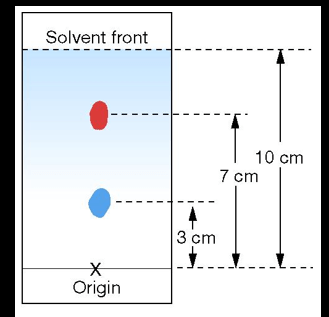
The Rvalue  for the red component is 
a)
0.3
b)
0.7
c)
10
d)
7
58.
The Rvalue  for the blue component is 
a)
0.3
b)
0.7
c)
10
d)
3
59.
At higher temperatures
a)
particles in an object have less energy
b)
particles in an object move faster
c)
a gas contracts
60.
A gas
a)
has a definite shape but no definite volume
b)
has a definite volume but no definite shape
c)
has fast-moving particles
61.

Freezing

a)

Solid to gas

b)

Liquid to solid

c)

Gas to solid

62.
Which of the following tells you that a chemical change may have occurred?
a)
Change Shape
b)
Melting
c)
Vaporizing
d)
Change in color
63.
What happens in ALL chemical changes?
a)
Change in state of matter
b)
A new substance is formed
c)
Bubbles are produced
d)
An explosion
64.
Is Gatorade powder dissolving in water physical or chemical change?
a)
Physical 
b)
Chemical
65.
Photosynthesis is an example of a
a)
physical change
b)
chemical change
66.
Changes in which new substances are formed are called
a)
physical changes
b)
chemical changes
67.
Which of the following describes a precipitate?
a)
a liquid forms when a block of metal is heated
b)
a solid forms when one liquid is poured into another
c)
a gas forms when a solid is placed in a liquid
d)
bubbles form when an acid is poured on a rock
68.
What causes a chemical reaction when you prepare scrambled eggs?
a)
cracking the eggs in a pan
b)
heating the eggs in a pan
c)
putting pepper on the eggs
d)
putting the eggs on a plate
69.
What term describes a solid changing to a gas?
a)
Deposition
b)
Sublimation
c)
Evaporation
d)
Freezing
70.
The milk in the glass has volume and takes the shape of its container. Therefore, it is assumed that milk is a ______________.
a)
solid
b)
liquid
c)
gas
d)
plasma
71.
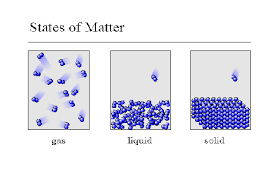
Which state of matter has particles arranged like this?
a)
solid
b)
liquid
c)
gas
72.
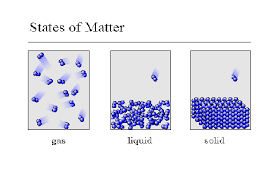
Which state of matter has particles arranged like this?
a)
solid
b)
liquid
c)
gas
73.
Which state of matter has particles arranged like this?
a)
solid
b)
liquid
c)
gas
74.
What does this picture represent? 
a)
solid
b)
liquid 
c)
gas
d)
plasma
75.
This picture represents which of the following?
a)
element
b)
compound
c)
mixture
76.
This picture represents which of the following?
a)
element
b)
compound
c)
mixture
77.
Salt water boils and the water completely evaporates, salt (NaCl) is left in the bottom of the beaker. Which of the following is left in the beaker?
a)
Compound
b)
Element
c)
Mixture
d)
None of the Above
78.

Which statement best explains the effect of the distance from the equator on the average temperature of a particular place?

a)

The higher the distance from the equator, the higher the average temperature.

b)

The higher the distance from the equator, the lower the average temperature.

c)

The lower the distance from the equator, the lower the average temperature.

d)

The lower the distance from the equator, the higher the average temperature.
79.
7.  1.  If a spoonful of salt is mixed in a glass of water, what is the water called?
a)
A. solute
b)
B. solution
c)
C. solvent
d)
D. element
80.
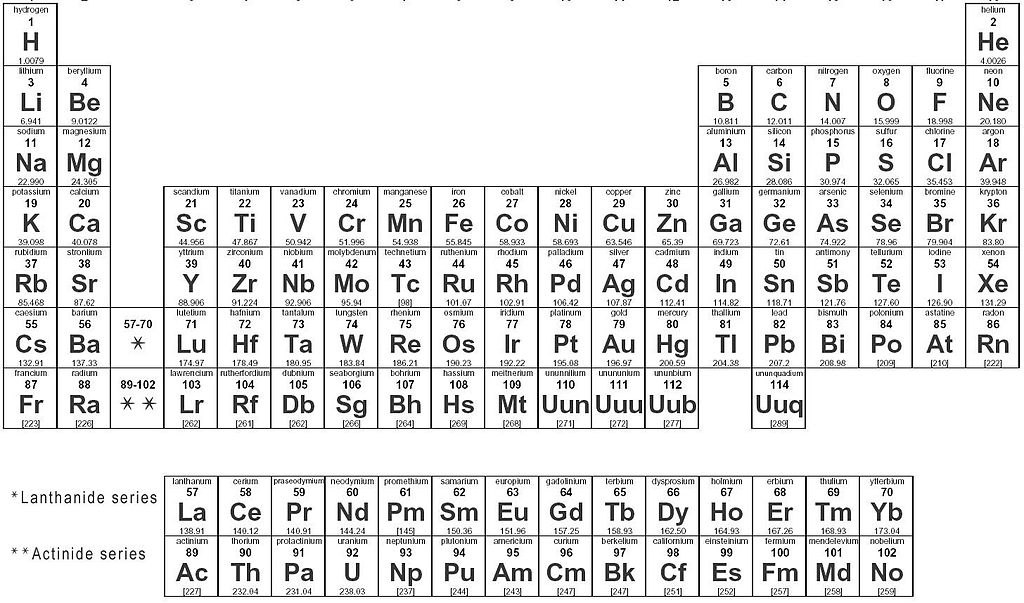
What side of the periodic table are metals on?
a)
left
b)
right
c)
top
d)
bottom
81.
What does malleable mean?
a)
able to bend
b)
will break easily
c)
can be used for wire
d)
is shiny
82.
What does ductile mean?
a)
electricity flows easily
b)
quacks like a duck
c)
can be drawn into a wire
d)
able to bend
83.
What side of the periodic table are nonmetals on?
a)
left
b)
right 
c)
top
d)
bottom
84.
Is oxygen metal or nonmetal?
a)
metal
b)
nonmetal
85.
Is gold metal or nonmetal?
a)
metal
b)
nonmetal
86.
Which has a higher density?
a)
metal
b)
nonmetal
87.
What do metals conduct?
a)
heat
b)
electricity
c)
both
d)
neither
88.
All of these properties describe metals EXCEPT...
a)
malleable
b)
conductors
c)
brittle 
d)
luster
89.
How would this element be classified?
a)
Metal
b)
Nonmetal
c)
Metalloid
d)
Metamorphic
90.
Silicon is a semiconductor and has properties of both metals and nonmetals. What type of element is Silicon? 
a)
Metal
b)
Nonmetal
c)
Metalloid
d)
Pretty
91.
If a material can easily be drawn into the shape of a wire, it is
a)
Ductile
b)
Magnetic
c)
Malleable
d)
Reactive
92.
Rows on the period table are called _____ while columns are called _____.
a)
groups, families
b)
groups, periods
c)
periods, groups
d)
families, groups
93.
A certain substance does not conduct heat or electricity, and breaks easily when hit with a hammer. What other property might this substance have?
a)
can be pulled into long wires
b)
dull surface
c)
high density
d)
malleable
94.
Which of the following elements is a metal?
a)
calcium
b)
chlorine
c)
iodine
d)
oxygen
95.

Which refers to the amount of water vapor present in the atmosphere?

a)

Atmospheric pressure

b)

Humidity

96.

Which measures all forms of precipitation?

a)

Barometer

b)

Rain gauge

97.

Which measures wind speed?

a)

Anemometer

b)

Wind vane

98.

Stevenson Screen is a special box in which the maximum and minimum thermometers and the wet and dry bulb thermometers are kept.

a)

True

b)

False

99.

What is a ceilometer used to measure?

a)

Rain

b)

Clouds

c)

Temperature

d)

Pressure

100.

The wind that heralds the rainy season in Nigeria is the

a)

Northeastern wind

b)

Northwestern wind

c)

Southeastern wind

d)

Southwestern wind