
 Worksheets
Muscle and muscle control
Total questions: 44
Worksheet time: 24mins
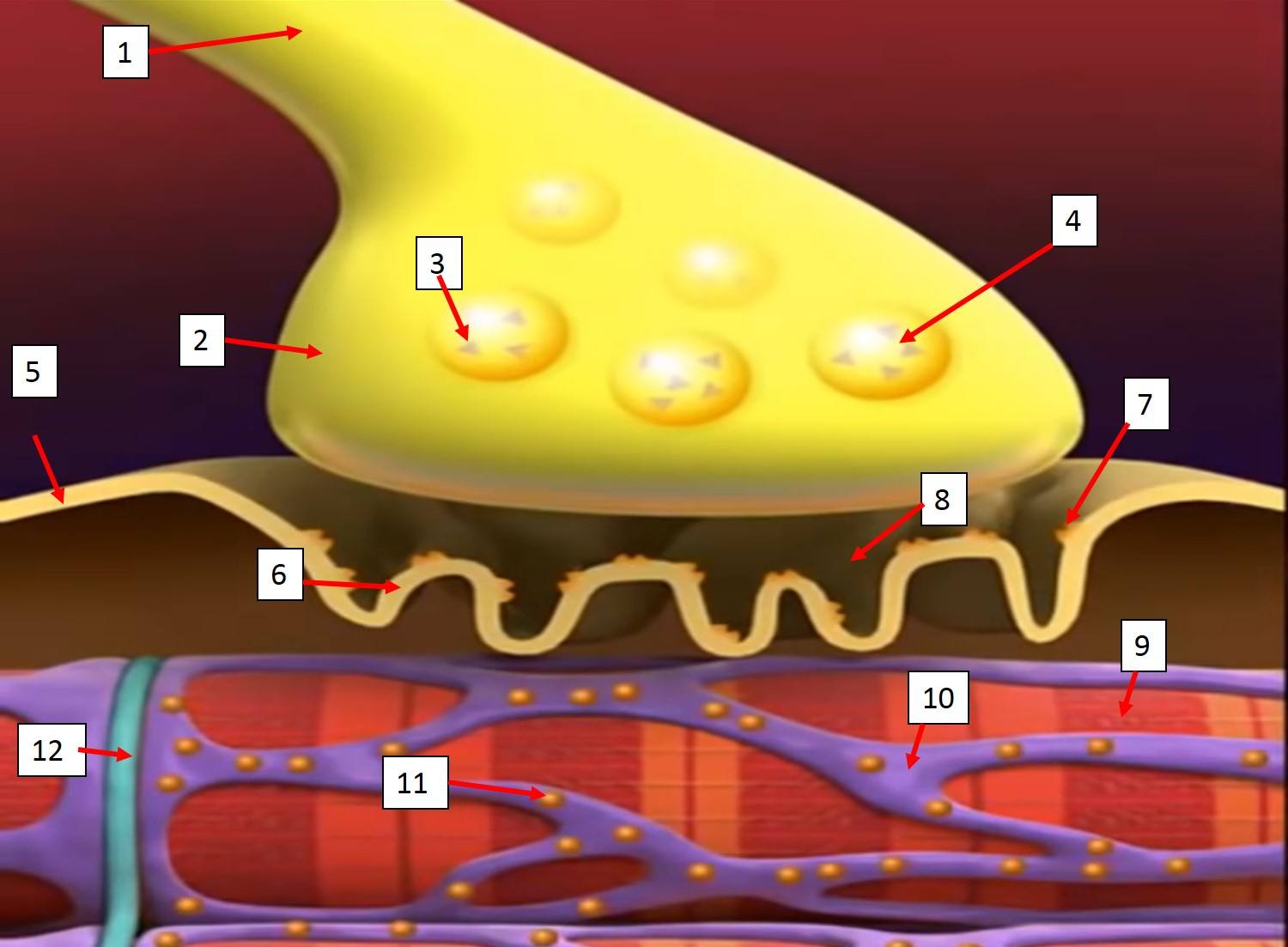
Messages are sent as electrical impulses from the brain, they travel down the spinal cord and the branch off into
Motor Neurons
Sarcolemma
Myofibril
fascicles

Reciprocal inhibition is when skeletal muscles work _____.
in isolation
in pairs
involuntarily
none of the above

The type of muscle contraction where the muscle tenses but no movement ocurs.
Isometric
Isotonic
Contraction
relaxation

As the athlete lowers the weights, his biceps undergo a(n)
concentric contraction
eccentric contraction
isometric contraction


What is the name of the thick filament that plays a role in muscle contraction?
Actin
Sarcomere
Myosin
Myofibril
What is the name of the thin filament that plays a role in muscle contraction?
Actin
Sarcomere
Myosin
Myofibril
True or False. Muscles must be stimulated by a nerve (motor neuron) to contract.
True
False
The largest muscle in the body is the
gluteus medius
gluteus maximus
gluteus minimus
buccinator
What are the parts of the skeletal muscle?
Point of entry, point of exit and point of contact
Point of origin, point of insection and the body of the muscle
Point of origin, point of end and the body of the muscle
Body of the muscle, tendons and bones


Name the following in order from largest to smallest:
muscle, muscle fascicle, myofibril, myofilaments
muscle, muscle fascicle, myofilaments, myofibril
muscle, muscle fascicle, myofibril, myofilaments
muscle, muscle fascicle, myofilaments, myofibril

What muscle is the arrow pointing toward?
biceps
traps
pecs
triceps

What muscle is the arrow pointing to?
Biceps
Triceps
Lats
Quads

What muscle is the arrow pointing to?
Pectoralis (Pecs)
Biceps
Triceps
Lats

Agonists
Are the muscles that contract and shorten, and produce the movement.
Are the muscles that lengthens (relaxes). This muscle also slightly contracts to ‘slow down’/control movement
Antagonists
Are the muscles that contract and shorten, and produce the movement.
Are the muscles that lengthens (relaxes). This muscle also slightly contracts to ‘slow down’/control movement
Identify the Trapezius


Identify the Triceps Brachii


Identify the Latissimus Dorsi


Identify the External Obliques
Identify the Rectus Abdominis
Identify the Gluteus Maximus
Identify the Quadriceps


Identify the Gastrocnemius


Tibialis Anterior
Gastrocnemius
Achilles tendon
Quadriceps
All motor units in a muscle
All muscle fibres in a motor unit contracting once a certain threshold is reached
Each individual muscle fibre.
All skeletal muscle is made up of bundles of muscle fibres called
muscle fibers
myofibrils
myofilaments
fascicles
The increase in muscle tension that is produced by increasing the number of active motor units is called
recruitment.
•complete tetanus.
incomplete tetanus.
wave summation
The contraction of a muscle exerts a pull on a bone because
muscles are attached to bones by ligaments
muscles are directly attached to bone
muscles that are attached to bones by tendons
All of the above are correct
Which of the following is INCORRECT about motor units in skeletal muscle?
One neuron activates ALL the fibers in the motor unit
Motor units are the same size in each muscle
If one fibre in a muscle contracts, the rest will contract
One motor neuron only stimulates ...
a small portion of the muscle
the whole muscle

