
NEW
Font size
 Worksheets
History of Life on Earth
Total questions: 40
Worksheet time: 20mins
Fossil are the remains of an organism that is preserved in the Earth
True
False
The way to determine which of two fossils is older is
Absolute Dating
Elemental Dating
Relative Dating
The way to determine the actual age of fossils is
Absolute Dating
Elemental Dating
Relative Dating
A type of rock made of hardened sediment
Igneous
Metamorphic
Sedimentary
A species that has no living members today is called
Threatened
Extinct
Endangered
Fossils do not consist of bones, bone fragments, imprints, and preserved remains
True
False
How can scientists determine the relative age of a fossil
Radioactive Dating
Compare it with fossils found in other rock layers
Chemical Dating
How can scientists determine the absolute age of a fossil
Radioactive Dating
Compare it with fossils found in other rock layers
Chemical Dating
Organisms began living on Earth about 3.8 billion years ago. Then 1.2 billion years ago, ______ evolved
multicellular organisms
single celled organisms
humans
Unicellular organisms are those organisms that are made up of a single cell
True
False
What were the first land-dwelling multicellular organisms ?
birds
simple plants and fungi
dinosaurs
What were the first animals to live on land?
snakes
lizards
insects
Periods during Earth’s history when huge numbers of species suddenly disappeared are called _____.
mass extension
mass endangerment
mass extinction
According to patterns in the fossil record, what typically happens after a mass extinction?
increasing number of old species develop
increasing number of new species develop
decreasing number of new species develop
During the Cretaceous Extinction, about 65 million years ago, the fossil record for dinosaurs disappeared
True
False
Which era is the most modern and the one that we are currently living in?
Cenozoic
Cretaceous
Permian
The process through which species change and develop new traits over time is called ____.
constitution
evolution
revolution
Where did Darwin go to study the variations in different species of animals?
Cocos Islands
Hawaiian Islands
Galapagos Islands
Darwin’s theory that members of a species who are best suited to their environment survive and reproduce at a higher rate than other members of the species is called ____.
artificial selection
natural selection
random selection
The four key principles of Darwin’s theory of natural selection are overproduction, variation, adaptation, selection
True
False
Which of the four key principles of Darwin’s theory of natural selection explains why no two zebras have the exact same pattern of stripes?
overproduction
variation
adaptation
Which of the four key principles of Darwin’s theory of natural selection explains why, out of several thousands of eggs that a pike lays, only several dozen will live to adulthood?
overproduction
variation
adaptation
An inherited trait that gives an organism an advantage in its particular environment is called a(n) ____.
overproduction
variation
adaptation
The principle behind selection is that only those species of organisms who have developed an adaptation that has been passed on from one generation to the next will survive the most.
True
False
What was the name of Darwin’s book in which he published his ideas about evolution and natural selection?
On the Origin of Species
Silent Spring
Missing Marshes
Finches on one of the Galapagos Islands have thin beaks for capturing insects. Finches on another island have short, heavy beaks for pecking trees. This is a result of ____.
artificial selection
natural selection
random selection
When the cichlid population of Lake Tanganyika was separated into isolated groups, _____ occurred.
overpopulation
speciation
variation
23) A(n) _____ is a widely accepted statement based on scientific evidence that helps explain and predict natural phenomena.
Protagoean's theory
scientific theory
theory of evolution
23) The three main types of evidence on which the theory of evolution has been built and has been accepted by the scientific community are fossil, biological, & genetic.
True
False
A(n) _____ is an early form of an organism from which the later forms descend?
descendant
ancestor
off spring
Humans and chimpanzees cannot be traced back to a common ancestor because humans evolved from chimpanzees.
True
False
The ancestors of snakes used legs to walk on land. The small leg bones that are still in the bodies of snakes are called ______ organs.
homologous
vestigial
biological
Genetic evidence is based on the study of _____ sequences.
geological
DNA
archeological
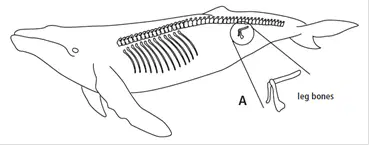
In the image above, the structure labeled A in the figure below is an example of a(n) _____ organ for a whale.
homologous
vestigial
biological

In the image above, the structures labeled B, C, and D in the figure below are the forelimbs of a human, whale, and bat, respectively. They all have the same basic structure. These are examples of ______ structures.
homologous
vestigial
biological
The forelimbs of the human, whale, and bat do not have the same function for each organism.
True
False
A species that is in danger of becoming extinct is called ____.
rare
endandered
threatened
A species that is in trouble but is not quite endangered is called ____.
endangered
threatened
adapted
Once a species is classified as endangered, it is impossible for it to recover and be taken off the endangered list.
True
False
Humans, chickens, and rabbits look similar to each other in their earliest stages of life.
True
False

