
Font size
 Worksheets
Benchmark Review 2023
Total questions: 49
Worksheet time: 2hrs 47mins
(8.5A) An atom has 30 protons, 35 neutrons, and 30 electrons. What is the charge of the atom's NUCLEUS?
+35
-35
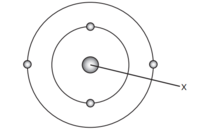
(8.5A) Which of these best describes ONE of the subatomic particles that could be found at location X in the model of an atom shown above?

Which two atoms are of elements
in the SAME GROUP in the periodic table?
Atom 1 and Atom 2
Atom 1 and Atom 4
Atom 2 and Atom 3
Atom 3 and Atom 4
(8.5D) The chemical formula for sodium sulfate is Na2SO4. How many sodium atoms are in the formula for sodium sulfate?
1
2
6
7
Which element has 2 more energy levels and 3 more valence electrons than Carbon (C)?
Sulfur (S)
Chlorine (Cl)
Bromine (Br)
Tellurium (Te)
Which element has 6 valence electrons and 2 energy levels?
Radium (Ra)
Barium (Ba)
Sulfur (S)
Oxygen (O)
How many energy levels are in Potassium (K)?
1
2
3
4
Which metal listed below is the least reactive alkali metal in group 1?
Hydrogen (H)
Litium (Li)
Sodium (Na)
Francium (Fr)
What catagory of elements is the element with 4 more protons than Copper (Cu)?
Metal
Metalloid
Nonmetal
Gas
Name the nonmetal in Period 5 that is more reactive than Selenium (Se)-
Selenium (Se)
Pollonium (Po)
Iodine (I)
Astatine (At)
How many neutrons are in an atom of Iron with a mass of 56 amu?
26
30
56
82

In what group is this element found?
2A
3A
5A
6A

In what period is this element found?
1
2
3
11
Noble gases are stable and nonreactive because -
they like being last in line
they all have 8 valence electrons.
they all have 8 energy levels.
they all have a full valence energy level
What is significant about the placement of Aluminum on the periodic table?
It is a metal on the metalloid line.
It is a nonmetal on the metalloid line.
It is a metalloid not on the metalloid line.
It is the magnetic metalloid.
Atoms of which two elements have a combined total of 23 protons?
Sodium, Na, and magnesium, Mg
Boron, B, and carbon, C
Copper, Cu, and zinc, Zn
None of these

4 carbon atoms, 11 hydrogen atoms, and 1 oxygen atom
7 carbon atoms, 14 hydrogen atoms, and 1 oxygen atom
7 carbon atoms, 11 hydrogen atoms, and 8 oxygen atoms
6 carbon atoms, 14 hydrogen atoms, and 3 oxygen atoms

What is the mass of H2O in the reaction above?
82.10
33.46
32.46
82.00

In an experiment, 12.6g of NaHCO3 reacts with an unknown amount of H4C2O2 to produce 6.4g of NaH3C2O2 and 11.8g of H2O, and 2.6g of CO2 gas. What was the mass of the acetic acid used in the experiment to show that mass was conserved?
33.4 grams
20.8 grams
8.2 grams
2.8 grams

What would the distance vs time graph look like for an object travelling at a constant velocity?
Horizontal line
Straight line
Curved line

When was the object at rest?
first 10 seconds
first 20 seconds
20th ~30th seconds
30th~40th seconds

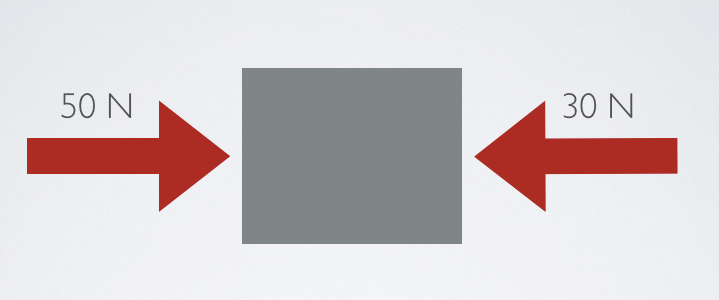
How will this object move?
It will move left at a constant speed.
It will accelerate to the right.
It will accelerate to the left.
It will move right at a constant speed.
Unit for Speed
Meter
Second
Meter/Second
Meter/Second2
Unit for Acceleration
Newton
Kilogram
Meter and Vector for direciton
Meter/Second2
Unit for Force
Newton
Kilogram
Meter and Vector for direciton
Meter/Second2
A ball at the top of a hill has ________ ________ because if pushed it will roll down the hill.
Mechanical Force
Unbalanced Energy
Potential Gravitational Energy
Unbalanced Force
When a student runs and kicks a ball, they have applied an ___________ force to move the ball.
Balanced
Magnetic
Spring
Unbalanced
Standing still is an example of a ________ ________ since you are not moving forward, backward, or sideways.
negative acceleration
balanced force
unbalanced force
3rd law of motion
What form of energy does a microwave have?
Magnetic
Electromagnetic
Solar
Elastic
You are in a car driving and the breaks are applied, you fly forward, which Law is this?
Newton's 1st Law
Newton's 2nd Law
Newton's 3rd Law
Newton's 2nd and 3rd law

Which tide would be the highest and lowest?
Tide 1 would be highest
Tide 1 would be lowest
Tide 2 would be lowest
Tide 2 would be highest
What is continental drift?
Made of igneous rock
Where two plates collide
Theory that all of earths continents were once joined together in a singe, huge land mass and then started drifting away from each other.
The process by which new oceanic crust forms when when magma rises up.
What is pangaea?
Huge supercontinent that existed millions of years ago,
Where two plates slide
Where two plates divide
Where two plates collide
What are Transform Plate Boundaries?
Where two plates divide
Where two plates collide
Where two plates slide
How do tectonic plates move?
Wind
Convection currents
Water

