
 Worksheets
Evolution 2 & Speciation
Total questions: 43
Worksheet time: 21mins

According to the diagram, which organism is LEAST related to the others?
5
4
3
2

Which scenario describes an example of extinction?
Water pollution kills off all the fish that live in a small pond.
Every individual in a species is killed by hunters or a lack of food.
The cutting down of a tree forces a bird to build a new nest in another tree.
A population of deer must move to a new forest when its original habitat is destroyed by fire.
Which best describes punctuated equilibrium?
Speciation occurs due to natural selection
Speciation occurs due to isolation
Speciation occurs slowly in geologic time, followed by long periods with very fast evolutionary change.
Speciation occurs suddenly and rapidly in geologic time, followed by long periods with little evolutionary change.

What is the common ancestor of Letters A, B, C, D, E?
1
2
3
4

When one species evolves in response to the evolution of another species.
Convergent evolution
Divergent evolution
Coevolution
Results in analogous structures like the flippers of whales and fins of sharks.
Convergent evolution
Divergent evolution
Coevolution

Results in a symbiotic relationship like flowers and their pollinators.
Convergent evolution
Divergent evolution
Coevolution
Results in homologous structures like the arm bones of humans and cats.
Convergent evolution
Divergent evolution
Coevolution
The Galapagos tortoises share a common ancestor but have necks of differing lengths to best reach food in their environment. This is an example of ...
Convergent evolution
Divergent evolution
Coevolution
When is adaptive radiation most likely to occur, and for what reason?
When the climate is stable because a stable environment tends to decrease the rate of evolutionary change
When the climate is warmest, because high temperatures act to increase the rate of evolutionary change
Just before a mass extinction, because species are competing intensely for limited resources
After a mass extinction, because the survivors give rise to species that fill new niches

A forest fire ignites in the Sam Houston State Forest and kills many members of a population of pigmy rattlesnakes.
Gene Flow
Genetic Drift

Select the best answer based on the image.
Gene Flow
Genetic Drift
Genetic diversity is decreased through this process.
Gene Flow
Genetic Drift
Genetic Diversity is increased through this process.
Gene Flow
Genetic Drift

Select the best answer based on the image.
Gene Flow
Genetic Drift

A population of flowers on one side of a river transports pollen to flowers on the other side of the river
Gene Flow
Genetic Drift
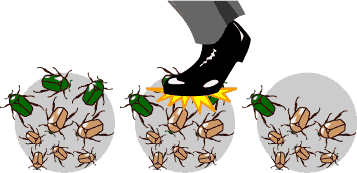
Someone steps on some bugs and randomly removes their alleles from the population. This is an example of
gene flow
genetic drift
speciation
allele frequency
If a population of lizards is isolated on an island, with no new immigrants over many years, any new genetic variations are most likely to come from
recessive alleles
natural selection
mutations
speciation
An allele combination (BB, Bb, or bb) is called a
phenotype
genotype
mutation
gene flow
The movement of alleles from one population to another is called
genetic drift
the bottleneck effect
the founder effect
gene flow
Why are advantageous traits more likely to be passed onto offspring?
Because they are more likely to survive and reproduce.
Because they come from dominant alleles.
Because they come from recessive alleles.
Because the organism knew it needed that trait, survives, and passes it on.
When two species share a common ancestor but they develop different traits to live in different environments.
Convergent evolution
Divergent evolution
Coevolution

If you take antibiotics only the resistant bacteria survive and the non-resistant bacteria die. This is an example of...
Resistance
Survival of the fittest
How antibiotics work

Refer to the graph. Which bacteria is MOST resistant to the antibiotic?
Blue
Pink
Yellow
None are resistant
Which is an example of evolution by genetic drift, and NOT by natural selection?
A female frog lays hundreds of eggs in a clutch, but only a few of the eggs hatch and develop into adult frogs
A small population of bark beetles is carried in driftwood to a new island, where the members reproduce rapidly
A population of lizards develops longer tongues when their food sources change
The bright red feathers of a male cardinal help attract mates

Which letter represents the most recent common ancestor of sponges and mushrooms?
A
B
C
D
E

According to the diagram, what is the common ancestor of ALL organisms on the phylogenetic tree?
B
C
D
E

Which group on the cladogram arose FIRST?
Theropods
Allosaurus
Robin
Velociraptor

