
NEW
Font size
 Worksheets
His101
Total questions: 73
Worksheet time: 37mins
According to the authors one of the first and finest work of literature was-
Illiad
Hamlet
Pentatuch
The Epic of Gilgamesh
Cuneiform refers to
astronomical calculations
the earliest system of writing- symbol writing on clay tablets
the first stage of planning for a ziggurat
the instrument used for writing
Each of the following is true about civilization Except
civilization first arose with the creation of humankind five thousand years ago
civilization is tied to urban life
a system of writing is characteristic of a civilization
the first civilizations appeared along Near Eastern river valleys
The "land between the rivers" refers to
Persia
Lower and Upper Egypt
ancient irrigation systems
Mesopotamia
The Neolithic Revolution -
All of these
included the invention of agriculture, which resulted in a more reliable food supply
resulted in more organized and complex societies
included the domestication of animals and development of polished stone tools
The first great conqueror and founder of an empire in the history of Mesopotamia was
Cyrus
Thutmose I
Alexander the Great
Sargon of Akkad
What made the Near East a hotbed of historical development?
The writing systems its peoples created
The invention of iron and the war chariot.
The contact and competition among peoples
Its rich agricultural surplus
Which of the following was contained in the Code of Hammurabi?
All of these
If someone strikes you on the right cheek, turn to him the other
Punishment depended on the status of both the victim and perpetrator
Government officials are exempt from punishment
Prehistory is normally thought of as that period before the invention of
war
writing
government
medicine
Why was Mesopotamia always susceptible to invasion?
It lacked natural barriers to keep outsiders out
Mesopotamian society was sharply divided between nobles and commoners
The Mesopotamians had not yet developed sophisticated bronze weapons.
It was politically weak and fragmented.
State power in Egypt flowed to officials from the -
Ma'at
pharaoh and through him from the gods
law code of Hammurabi
tablet of Namer
Why was Egypt more politically stable, confident, and self-sufficient than Mesopotamia?
Egypt possessed an older and more sophisticated law code than that of Mesopotamia
Egyptian society was much less hierarchical than that of Mesopotamia
Egypt’s geography left it isolated and protected from frequent turmoil.
Egypt was poorer than Mesopotamia and thus was a less tempting target for invaders
Which of the following best descibes Egyptian religion?
Three of the most important features of Egyptian religion were polytheism,the belief in an afterlife,and an ethical code emphasing truth and compassion
Altough it lacked an ethical code, religion dominated all aspects of Egyptian society
In Egyptian religion the universe was alive with malevolent divinities
Egyptian religion evolved and polytheism was replaced by monotheism
In ancient Egypt, the king:
organized labor and public works under an elaborate bureaucracy
did not need to establish a military since Egypt was protected by the deserts
had the primary responsibility to ensure religious beliefs were upheld
depicted himself as a ferocious lion
Ancient Egypt :
was strongly shaped by the unpredictability of the Nile River as it flooded
formed a highly coherent culture stretched out along the Nile River
drew on the vast hinterlands in the Sinai peninsula to support its population
had vast desert lands that contained nothing of value
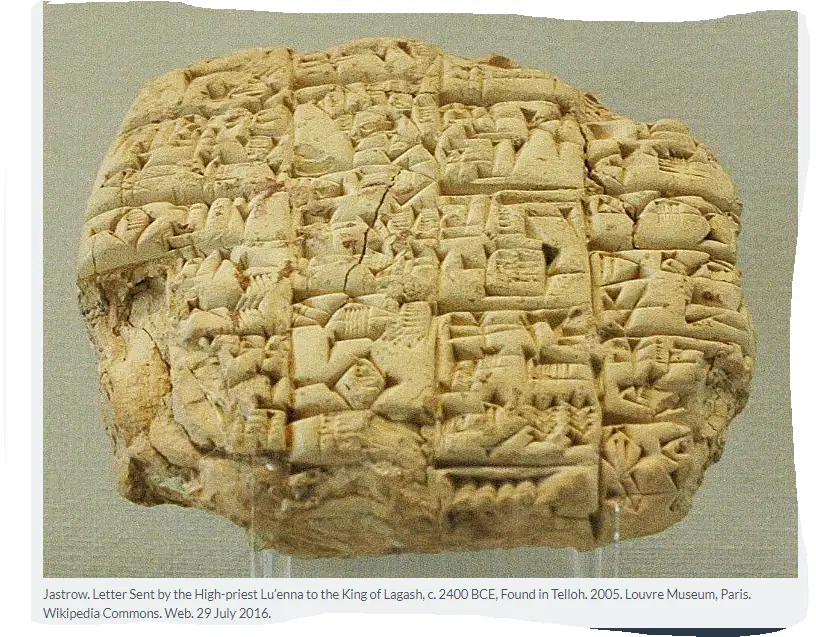
This is an example of what type of early form of writing?
Cuneiform
Pictograms
Sanskrit
Hieroglyphics
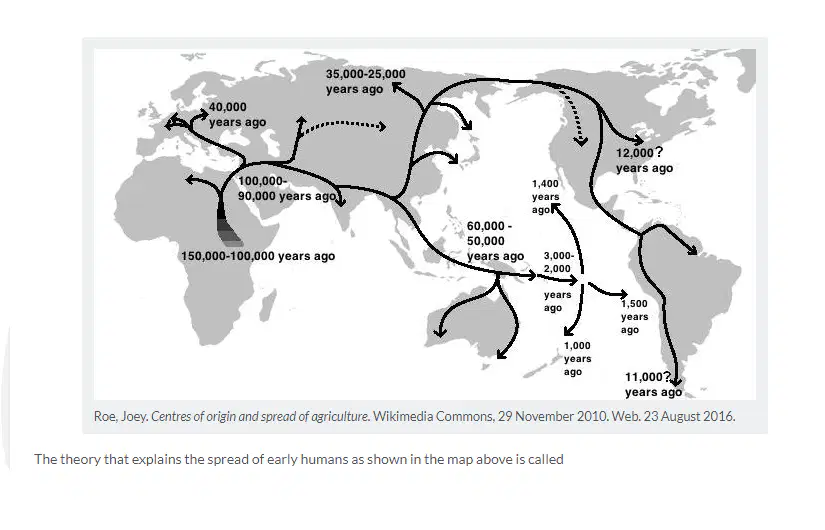
Out of Africa theory
Migration Theory
Out of Asia theory
Out of Europe theory
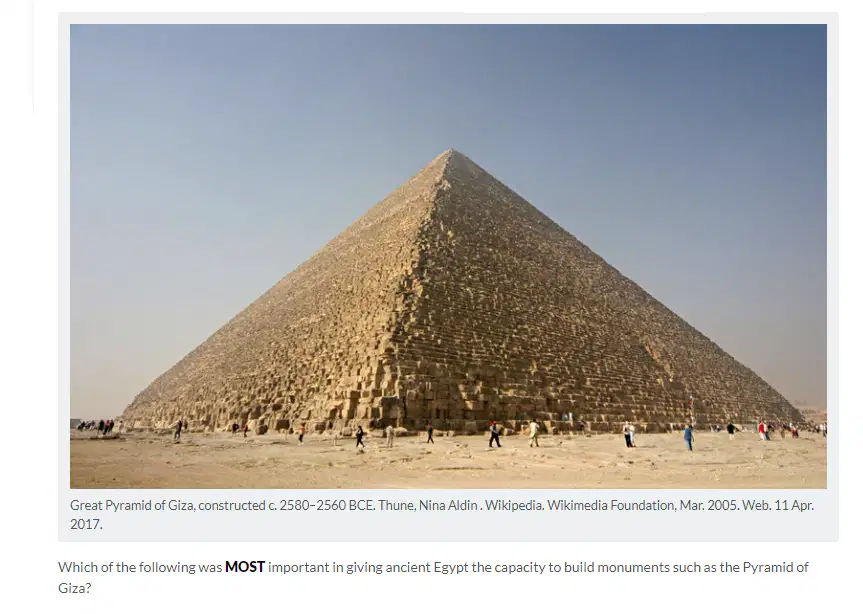
aliens
availability of building materials
construction technology
organized religion and government
The term hieroglyphics refers to
sacred writing of Egypt
an early alphabet
wedge shaped writing
any written inscription

The Neolithic Revolution perpetuated gender inqualties left over from hunter-gatherer societies
The Neolithic Revolution was detrimental to society as it created gender inequality and social classes
A women in an agricultural community gained more rights as her workload increased,
Nomadic socities required men to work more then did agricultural societies
Although the Phoencians established a small nation , they are reconized for-
establishing cities along the Mediterranean from what is now Lebanon to Spain
being the greatest sea traders in the ancient world
All of these
inventing the alphabet
Compared to the people of the civilizations in Mesopotamia and Egypt, the Hebrews-
were a minor people with a major impact on the West
were peaceful and refused to use violence
possessed the same view of nature as ththeir neighbors
excelled in poilitcal stabilty
How has the Jewish tradition influenced the West?
Monotheism encouraged the concept of the will and a conscience answerable to God
All of these
Hebrew Scripture has been an inspiration for Western religious thinkers
As part of Christianity,many Jewish ideals became a part of the Western tradition
Which of the following groups built an empire based on an all consuming concern for war and the use of terror?
Persians
Medes
Chaldeans
Assyrians
The impact of the Sea Raiders on early Mediterranean civilizations was to
destroy Mycenaean civilization
drive the Hittites to attack Egypt
end the Minoan stranglehold on Mediterranean trade.
limit its immediate growth and economic prospects
Which of the following statements is true of the Hittite Empire?
The Hittites were the first to develop a substantial iron industry
The empire came to control Asia Minor, Syria, and the trade routes along the Euphrates leading to Syria.
The empire blended the culture of Indo-Europeans, Mesopotamia, and Asia Minor
all of these
Ideas were spread throughout the Mediterranean by Phoenician?
merchants/traders
priests
philosophers
soldiers
The new metal that transformed ancient warfare after 1200 B.C. was
copper
bronze
iron
steel
Among the Hebrew beliefs that have had an important impact on Western Civilization was
all of the above
The concept of ethical monotheism
That history was a purposeful, morally significant event
The creation of the world at a specific time
The most important contribution of the Phoenicians to Western Civilization was
The development of monotheism
the development of irrigated agriculture
The art of building great stone monuments
the alphabet

new weapons and modes of transportation developed by pastoralists
social stratification within agrarian civilizations
new techniques of administration of empires and states
warfare among classical empires
Mycenaean Civilization
all of the above
Was centered around maritime trade
Was depicted many years later in the Homeric epics
Was centered around palaces and warrior kings
What are historians trying to do when they study the development of religions?
Prove whether a religion is objectively true
Understand the contextual factors that shaped a religion
Show that certain religions are better or worse than others
show that certain religions exist for many reasons
During its Dark Age, Greece experienced-
all of the above
extensive migrations of Greek tribes from the mountains to the plains and Asia Minor
a complete collapse of the palace system of the Minoans
insecurity, warfare,poverty,and isolation
During the half century following the Peloponnesian war
The major poleis recovered their original power and cultural vitality
Constant warfare between the poleis weakened Greece politically and culturally
The Greeks united into a single state under the leadership of Sparta
The Persians conquered Greece and made it into a province
Greek plays dealt with the following theme(s)
The consequences of hubris, or arrogance and pride
Relationship of men to the gods
Just relationships between rulers and their subjects
All of the above
Homer's major epic poems were-
Antigone & The Bacchas
Illiad & Peloponnesian
The Illiad and the Odyssey
Lysistrata and the Frogs
I._______________________________________________
A. City-states depended on goods exchanged directly with Mediterranean peoples
B. Political loyalty centered on the city-state
C. A common enemy, Persia
Which title best completes the partial outline, above ?
Attributes of Indus Valley Civilizations
Traits of Ancient China
Characteristics of Ancient Greece
Features of Gupta Empire
The Greek Polis known for its emphasis on military training was-
Sparta
Athens
Thebes
Rome
The Greek invention of philosophy, or the search for knowledge, involved the idea that
All could be learned by studying the texts of ancient Egypt and Mesopotamia
The cosmos was orderly, accessible to human reason, and based on natural laws
People could hasten the acquisition of knowledge by increasing religious sacrifices
The gods would reveal all knowledge according to their own plan
The Peloponnesian War was
war between Thebes and Sparta
a war between the Delian League and the Peloponessian League
war between Macedonia and Greece
The Persian invasion of Greece
The greatest achievment of the Greeks was:
the principle of womens rights
the rational outlook that becomes a distinctive feature of the West
their military
the creation of a lasting world empire
The historian who wrote about the Peloponessian War was-
Homer
Aristotle
Plato
Thucydides
What role did the Assyrians and the Phoenicians play in the development of Greece after the end of the Dark Age?
They annexed most of Greece and taught the Greeks their seafaring ways
Their commercial and cultural contacts provided Greece with the opportunity to break out of its depressed economic state
They attacked and defeated Persia, which created a “breathing space” for Greece to develop without the threat of Persian aggression.
Their constant aggression toward Greece forced the Greek poleis to band together as they had against Persia
Which of the following apply to Pericles, the architect of Athens’ Golden Age?
Provided the leadership for the building of the Acropolis, including the Parthenon
He was elected chief strategos, or general, from 443 to 429 B.C.
All of the above
Advocated the supremacy of Athens over members of the Delian League
Which of the following best characterizes Golden Age sculpture?
true-to-life portrayals of individuals, scars and all
disproportional characterization of the human body
amorphous human forms
mathematical precision of the human body in motion
Why did Peloponnesian cities led by Sparta fight Athens in the Peloponnesian War?
Athenian imperialism undermined the peace with Persia
Athenian imperialism threatened the city-state system of Greece
Sparta sought to unite Greece into a Spartan empire
Athens destroyed Greek trade in the Mediterranean
Why did almost a third of the poleis decide not to resist the second Persian invasion?
Many smaller poleis believed that incorporation into the Persian Empire would enrich them at the expense of larger poleis such as Athens and Sparta
Many of them lacked the funds to contribute to the powerful navy Themistocles was building for the protection of Greece
Many of them already belonged to the Peloponnesian League, headed by Sparta, which had made a separate peace with Persia already
Many smaller poleis realized that they had as much to fear from Sparta, Athens, and hostile neighboring poleis as they did from Persia.
Why should Athenian democracy always be qualified as Athenian democracy?
It was the root of all democracy in the modern world.
It closely resembled the complex and multi-ethnic democracy of modern society
It was very different from democracy in Sparta or elsewhere in the Greek world
It was complex and quite different from democracy today.
Why was Herodotus been called the "father of history"?
He called himself an historian
He was a liar
He authored the first great narrative history
He lived in the age of Pericles
Why was the development of coinage among the the Greeks by 500 BCE so signifcant?
It marked the re-entrance of Greece as a trading presence in the Mediterranean
It marked the end of the reign of Tyrants
It marked a growing rivalry among Greeks that would lead to the Peloponnesian War
Evidence of the Greek's growing agricultural surplus
Which of the following was Socrates’ preferred method of acquiring knowledge?
extensive reading
civil service exams
lecturing
Dialogue with others or oneself
The political world of the ancient Greeks
usually consisted of independent, autonomous city-states
was a history of early, long-lasting centralized government
was very similar to that of Egypt
stabilized after the conquest by Persia
During the half century following the Peloponnesian war
The Persians conquered Greece and made it into a province
The Greeks united into a single state under the leadership of Sparta
Constant warfare between the poleis weakened Greece politically and culturally
The major poleis recovered their original power and cultural vitality
The Greek invention of philosophy, or the search for knowledge, involved the idea that
The gods would reveal all knowledge according to their own plan
The cosmos was orderly, accessible to human reason, and based on natural laws
All could be learned by studying the texts of ancient Egypt and Mesopotamia
People could hasten the acquisition of knowledge by increasing religious sacrifices
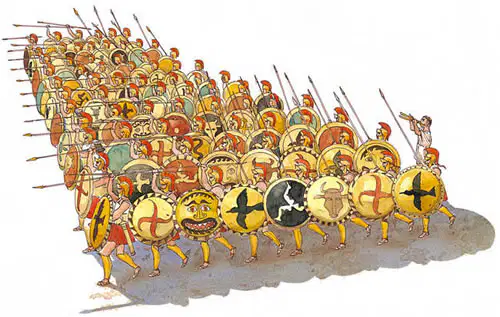
This Greek military formation was know as -
marines
cavalry
phalanx
legion
According to the author, which features of the Hellenistic Age most facilitated the later rise of Christianity?
Hellenistic philosophies and the individual search for happiness and salvation
The spread of Judaism
Scientific inquiry and the blending of Greek and Near eastern technologies
Divine monarchy
According to the textbook, Hellenistic society was characterized by-
a Hellenization of culture and disappearance of native tradition
a decline in Greek culture
a decline in trade
a mingling of peoples and an interchange of culture
Alexander's empire stretched from___________ to _____________
Greece to England
Italy to Greece
Asia Minor to the Scandinavian peninsular
Greece to India
Alexander's legacy includes
The idea of a single great empire of many people ruled by one king
an ideal of heroic military genius emulated by many subsequent rulers
The blending of Greek and Asian culture we call Hellenistic
All of the above
Alexander's love of Greek culture,literature, and science seems to have come from his tutor-
Zeno
Socrates
Aristotle
Plato
Following Alexander's death his empire
was destroyed by an invasion of Indo-European peoples
Was divided by his generals into three main sucessor kingdoms
survived intact for a century under one successors
Disintegrated as the native people rose in revolt
In his lifetime ,Aristotle-
tutored Alexander the Great
studied under Plato
all of the above
founded his own school, the Lyceum
According to the author, which features of the Hellenistic Age most facilitated the later rise of Christianity?
Divine monarchy
The spread of Judaism
Scientific inquiry and the blending of Greek and Near eastern technologies
Hellenistic philosophies and the individual search for happiness and salvation
The Hellenistic school of philosophy, called Skepticism, held that-
nothing can be known for certain
all theory is worthless
The Stoics were right about the Logos
the Cynics were right to renounce all possessions and the role of reason in human life
The period of ancient greek history that followed Alexander the Great is called
Medieval
Renaissance
Hellenistic
Paleolithic
During the Hellenistic World
Kings ruled large kingdoms rather than citizens ruling independent city-states
Ancient Middle Eastern and Greek civilizations joined in a manner that changed them both
The Eastern Mediterranean was dominated by Greek language and culture
all of the above
The Hellenistic culture, associated with the rule of Alexander the Great, developed as a result of
direct democracy
embargo's
cultural diffusion
ethnocentrism
Julius Caesar's assassins viewed themselves as-
defenders of republican tradition
opponents of Roman imperialism
opponents of the Senate
protectors of the plebeian class
Why did the agreements and shared interests of the Roman people breakdown in the late Roman Republic?
What worked for a city- state worked less well for the governance of a vast territory
Class warfare between the patricians and plebeians
The Gauls were invading Italy
Political Corruption
Historically and culturally, Carthage was most tied to
Mesopotamia
Egypt
Phoencia
Greece
In its earliest history, Rome-
was limited to an area near the tiber river in central Italy
was strongly influenced by the Etruscans, its neighbor to the north and Greek cities in Italy
consisted of a group of peasant villages among several hills
All of the above
Rome's rise to great power status followed which sequence of events?
Unification of the Italian peninsula, defeat of Gaul, seizure of Egypt
Defeat of Carthage, unification of the Italian peninsula, defeat of Gaul
Unification of the Italian peninsular, the defeat of Carthage, subjucation of the Hellenic states
Conquest of Gaul,subjugation of the Hellenic states, seizure of Egypt

