
 Worksheets
GCSE Physics Revision
Total questions: 66
Worksheet time: 57mins
Which among the following is a vector quantity?
Mass
Displacement
Temperature
Density
A body is said to have the power of 1 Watt if it does work at the rate of ______.
1 joule
1 joule in 1 second
1 second
1 radian / second
Why can lights travel in a vacuum but not sound?
Light waves are dual in nature
Due to the electromagnetic nature of light waves.
Due to the electromagnetic nature of sound waves.
Speed of sound is very slow than light
What is the net force of an object when you combine a force of 10 N north with a force of 5 N south?
(a)
Which type of electromagnetic radiation has the shortest wavelength?
Gamma ray
Radio wave
X-ray
Microwave
Ohm's law describes the relationship between what?
Current and velocity
Current, voltage, and resistance
Frequency, wavelength, and velocity
Kinetic energy and momentum

What is the distance that the object travels in the first 5 seconds?
4m
5m
9m
20m
It is impossible to tell.

What is the acceleration during the first five seconds?
0 m/s^2
1m/s^2
4m/s^2
9 m/s^2
20 m/s^2
What is the acceleration during the last five seconds?
0 m/s^2
1m/s^2
4m/s^2
9 m/s^2
20 m/s^2

As shown to the right, a ball is thrown straight up from point A it
reaches a maximum height at point B and falls back to point C.
Which of the following is true about the direction the ball’s velocity
and acceleration between A and B?
velocity down, acceleration up
velocity up, acceleration down
velocity up, acceleration up
velocity down, acceleration down
velocity zero, acceleration zero
Velocity is a vector quantity
True
False
Acceleration is rate of change of
Velocity
Distance
Time
Displacement


In which situation is it IMPOSSIBLE for the object to be in equilibrium?
What is the equation that links acceleration (a), change in velocity (Δv) and time (t)?
Acceleration = Change in Velocity x Time, or a=Δv x t
Acceleration = Change in Velocity / Time, or a=Δv/t
Acceleration = Time / Change in Velocity, or a=t/Δv
What is the equation that links acceleration (a), mass (m), and resultant force (F)?
Resultant Force = Mass x Acceleration, or F=ma
Resultant Force = Mass / Acceleration, or F=m/a
Resultant Force = Acceleration / Mass, or F=a/m
What is the equation that links kinetic energy (Ek), mass (m) and velocity (v)?
Kinetic Energy = 0.5 x Mass x Velocity², or Ek=0.5 x m x v2
Kinetic Energy = 0.5 x Mass² x Velocity, or Ek=0.5 x m2 x v
Kinetic Energy = 0.5 x Mass² / Velocity, or Ek=0.5 x m2 / v
What is the equation that links gravitational field strength (g), gravitational potential energy (Eg), height (h), and mass (m)?
Gravitational Potential Energy = Mass x Gravitational Field Strength x Height, or Eg=mgh
Gravitational Potential Energy = Mass / (Gravitational Field Strength x Height), or Eg=m/(gh)
Gravitational Potential Energy = Mass x Gravitational Field Strength / Height, or Eg=mg/h
What are the two quantities needed to work out momentum and also kinetic energy?
mass
time
acceleration
velocity
distance
Which of these is not a non-renewable energy source for a power station?
coal
nuclear
woodchips
oil


If a crate is moved 10 m with a force of 50 N, how much work is done?
40 Joules
60 Joules
500 Joules
5 Joules
A wave where the particles oscillate perpendicular to the direction of energy transfer is called a ___________ wave.
sound
high frequency
transverse
right angled
A wave where the particles oscillate parallel to the direction of energy transfer is called a ___________ wave.
parallel
perpendicular
transverse
longitudinal
Which of these words describes the point of maximum displacement from the equilibrium position of a wave?
wavelength
frequency
amplitude
focal point
What is the speed of light?
3 × 10⁸ m/s
undefined m/h
undefined km/s
undefined km/h
The thermal energy of a substance is called the........
Maternal energy
External energy
Paternal energy
Internal energy
When we increase the kinetic energy of particles we also increase their .............?
mass
temperature
size
area
In what unit is charge measured?
Volts
Amps
Quarks
Coulombs
Which of these factors does NOT affect the resistance of a wire?
The material the wire is made from
The length of the wire
The diameter of the wire
The shape of the wire

What does this graph show?
Resistance and length of wire are proportional
Resistance and length of wire are directly proportional
Resistance and length of wire are inversely proportional
Resistance and length of wire are unrelated
Which of these materials would NOT act as an electrical insulator?
Rubber
Glass
Copper
Wood

Look at this circuit.
What is the total resistance of this combination of resistors?
2 Ohms
8 Ohms
15 Ohms
35 Ohms
Which of these statements about a diode is true?
A diode lets current through in only one direction
A diode lets current through in both directions
A diode has low resistance in all arrangements
A diode has zero resistance

The diagram shows a temperature sensing circuit used to control a heating system in a house.
What quantity does the ammeter measure?
Current
Potential difference
Resistance
Power
What is power?
The number of repetitions of squats a body-builder can perform
The number of cylinders in a car
The rate at which energy is absorbed
The rate at which energy is transferred

This is the symbol for a...
Light Dependent Resistor
Light Emitting Diode
Thermistor
Cell

This is the symbol for a...
Light Emitting Diode
Light Dependent Resistor
Fuse
Cell

This is the symbol for a...
Thermistor
Fixed Resistor
Variable Resistor
Fuse
Gravitational Potential Energy (Ep) is...
the energy stored in a stretched object
the energy stored in an electrically charged object
the energy stored in a frozen object
the energy stored in a raised object
An object's gravitational potential energy store can be increased by...
by lifting the object higher
increasing the velocity (speed) of the object
decreasing the size of the object
decreasing the mass of the object
The formula for calculating gravitational potential energy is...
1/2 x mass2 x gravitational field strength x height
mass x gravitational field strength x height
1/2 x mass x gravitational field strength x height
mass x gravitational field strength x height2
The units for gravitational potential energy are...
metres, m
degrees Celsius, oC
kilograms, kg
Joules, J
To convert grams into kilograms...
multiply the grams by 100
divide the grams by 100
multiply the grams by 1000
divide the grams by 1000
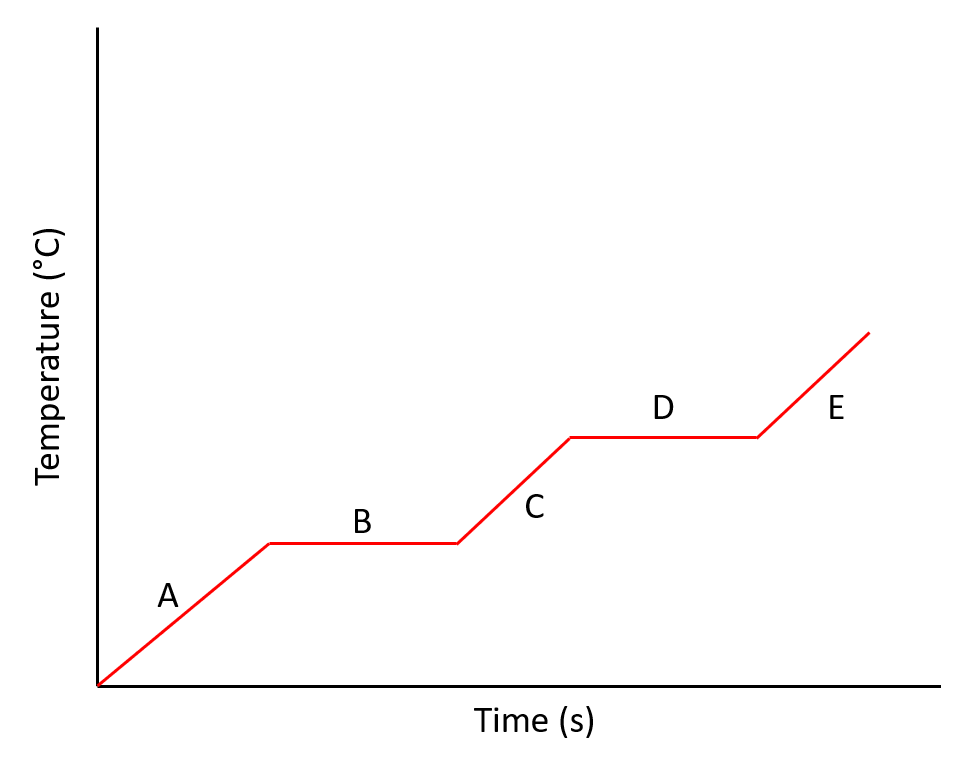
The diagram shows a heating curve for ice. Which line represents the ice in a liquid state (water)?
A
B
C
D
E

The pressure inside the syringe will decrease if we move the plunger in :
Direction A
Direction B
We don't have to move the plunger as the pressure will change on its own.
None of the above answers.
What is the energy of a moving object called?
Kinetic energy
Elastic potential energy
Gravitational potential energy
Electrostatic energy
Thermal energy
Which one is a Switch?


What is the correct unit for resistance?
Ω
V
A
C
Which of these statements best describes an induced magnet?
Produces its own magnetic field, with field lines going from north to south
Produces its own magnetic field, with field lines going from south to north
Becomes magnetic in a magnetic field
Can never experience the magnetic force
Which of these materials will feel a force from a permanent magnet? Tick all that apply
Iron
Graphite
Aluminium
Copper
Cobalt
Which statement best describes the field lines around a spherical magnetic object?
Straight lines going to the centre of the sphere
Straight lines going from the centre of the sphere
Curved lines going from the north pole to the south pole
Curved lines going from the south pole to the north pole
Which of these is not a vector quantity
Acceleration
Distance
Velocity
Displacement

What is the resultant force on this box?
30 N to the right
10 N to the right
30 N to the left
10 N to the left

What aspect of this graph is equal to the spring constant of the spring?
The area under the line
The gradient
1 ÷ the gradient
The point of greatest extension
Which of these is not an example of a transverse wave?
Ultraviolet
Gamma rays
Tidal
Sound

