wayground logo

Free Printable Worksheets

Font size

S
M
L
XL
Worksheets

Force and Motion Review

Total questions: 75

Worksheet time: 3600secs

Name
Class
Date
1.

An object's motion won't change unless acted on by an unbalanced _________

a)

spell

b)

force

c)

motion

d)

command

2.
For every action there is ______ and opposite reaction.
a)
an equal
b)
a stronger
c)
a weaker
d)
an exciting
3.
_______ force is needed to move objects of larger mass.
a)
Less
b)
Equal
c)
More
d)
Light
4.
A still object __________ have forces acting upon it.
a)
does
b)
can't
c)
doesn't
d)
will sometimes
5.
The force that pulls objects down towards the center of the Earth.
a)
Friction
b)
Gravity
c)
Air Resistance
d)
Wind Resistance
6.
This force is caused by objects rubbing together.
a)
Gravity
b)
Air Resistance
c)
Friction
d)
Spinning
7.
A rocket launches because of ______.
a)
its large mass
b)
an opposite reaction
c)
gravity
d)
air resistance
8.
Objects in motion tend to stay in motion, while objects at rest, tend to _____________.
a)
stay at rest
b)
roll
c)
start moving
d)
bounce
9.
______________ forces do not affect the movement of an object.
a)
Strong
b)
Weak
c)
Light
d)
Balanced
10.

What is gravity?

a)

The force that pulls objects together

b)

The force that pushes objects apart

11.

What direction is the force of gravity?

a)

Up

b)

Down

c)

Sideways

12.

Which Law of Motion does the picture display?

a)

1st Law of Motion

b)

2nd Law of Motion

c)

3rd Law of Motion

13.

How does gravity affect water on Earth?

a)

Waterfalls fall towards the Earth

b)

Rain falls toward the ground

c)

Rivers flow downstream

d)

Water goes down the drain

14.

How is a football affected by gravity?

a)

When it is kicked, it stays in the air.

b)

When it is kicked, it goes up and comes back down.

c)

When it is thrown, it goes up and comes back down.

d)

When it is thrown, it stays in the air.

15.

How would a classroom be without gravity?

a)

People would be floating in the air

b)

Chairs would stay on the floor

c)

Water would float around as spheres (circular shapes)

d)

It would be hard to move and get supplies

16.

If an unbalanced force acts on an object at rest, the object will move in the direction of the force. Which of the following best models an object with unbalanced forces acting on it?

a)
b)
c)
d)
17.

What is a force?

a)

a push or pull

b)

speed or acceleration

c)

potential or kinetic energy

d)

balanced or unbalanced force

18.

What is the non-contact force that causes everything to be pulled down to earth?

a)

friction

b)

gravity

c)

balanced

d)

unbalanced

19.

When an object is getting faster, it is called...

a)

potential energy

b)

kinetic energy

c)

acceleration

d)

deceleration

20.

Inertia is...

a)

for every action, there is an equal and opposite reaction

b)

larger objects take more force to move

c)

an object in motion tends to stay in motion unless acted on by an opposite force

d)

a push that acts in the opposite direction and it slows down

21.

Which of these will cause a rolling soccer ball to slow down and stop?

a)

gravity

b)

friction

c)

magnetism

d)

pull

22.

Which surface(s) will create friction for a ball?

a)

school hallway

b)

gym floor

c)

carpet

d)

gravel

23.
Is it BALANCED? 
a)
Yes
b)
No
24.
What is the unit for FORCE? 
a)
N (Newtons)
b)
lbs (pounds)
c)
g (grams)
d)
m/s (meters per second)
25.
A 20 kg bike accelerates at 10 m/s2.  What was the force?
a)
25 Newtons
b)
20 Newtons
c)
200 Newtons
d)
10 Newtons
26.
45 m/s2 is the... 
a)
Mass
b)
Force 
c)
Acceleration
d)
weight
27.

What is the BEST definition of acceleration?

a)

a decrease in speed

b)

an increase in speed

c)

a change in direction

d)

a change in velocity

28.
Based on the graph, it can be determined that:

a)
Swimmer 1 and Swimmer 2 were moving in the same direction
b)
Swimmer 2 is faster than Swimmer 1
c)
Swimmer 1 and Swimmer 2 were moving in different direction
d)
Swimmer 1 is faster than Swimmer 2
29.

A change in position is called . . .

a)

position

b)

frame of reference

c)

reference point

d)

motion

30.

Tells you how the position of an object changes during a certain amount of time

a)

speed

b)

velocity

c)

acceleration

d)

force

31.

You can measure time in . . .

a)

hours (hr)

b)

minutes (min)

c)

seconds (sec)

d)

all of the above

32.

The speed of an object in a particular direction is called . . .

a)

speed

b)

velocity

c)

acceleration

d)

force

33.
What is the formula to calculate speed?
a)
S = t/d
b)
S = d/t
c)
S = d x t
d)
S = t x d
34.
What does this graph represent?
a)
Constant Speed
b)
Acceleration
c)
Not moving
35.
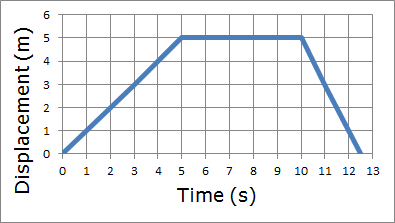
According to the graph how far does the person travel in the first 5 seconds?
a)
2 m
b)
10 m
c)
0 m
d)
5 m
36.
What is the person doing from 5 seconds to 10 seconds?
a)
Walking 
b)
Running
c)
Standing Still 
d)
Walking Fast
37.
Total distance divided by total time is
a)
average speed
b)
constant speed
c)
instantaneous speed
d)
acceleration
38.

Which is a correct statement about the object shown in Graph W?

a)

The object speeds up during the trip.

b)

The object slows down during the trip.

c)

The object travels at a constant speed during the trip.

39.
Which runner had a head start?
a)
A
b)
B
c)
C
40.
What does this graph represent?
a)
Constant speed
b)
Acceleration
c)
Not moving
41.
What is the speed of this object at 3 seconds?
a)
5 m/s
b)
45 m/s
c)
5 s/m
d)
45 s/m
42.
What two measurements are necessary for calculating speed?
a)
Mass and time
b)
Temperature and mass
c)
Mass and distance
d)
Distance and time
43.

A girl on a bike rides down a hill 500 meters long in 50 seconds. What is her speed?

a)

100 m/s

b)

10 m/s

c)

1,000 m/s

d)

10 mph

44.

What is the speed of a jet plane that travels 528 meters in 4 seconds ?

a)

140 m/s

b)

132 mph

c)

142 mph

d)

132 m/s

45.
During which interval is the object traveling at a constant velocity?
a)
B to C
b)
D to E
c)
F to G
d)
it traveling at a constant velocity during all of the intervals shown.
46.
Which is correct?
a)
speed = distance x time
b)
speed = speed divided time
c)
speed = distance divided by time
d)
speed = time x speed
47.

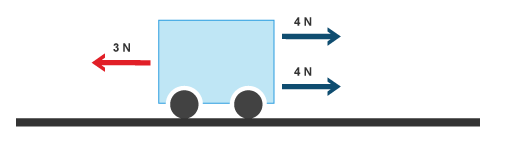
What is the net force?

a)

3 N

b)

3 N, right

c)

17 N, right

d)

3 N, left

48.
What is the net force?
a)
20 N 
b)
0 N 
c)
400 N 
d)
40 N 
49.

What is the unit to MEASURE force?

a)

Kilogram

b)

Meter

c)

Pounds

d)

Newton

50.

A ____________ is a push or a pull on an object.

a)

friction

b)

force

c)

magnet

d)

gravity

51.
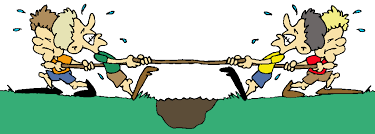
If these teams are pulling with the same amount of force what will happen?
a)
The boy in blue will win.
b)
They will not move at all.
c)
The boy in red will win.
d)
Both will fall down.
52.
Balanced or unbalanced?
a)
balanced
b)
unbalanced
53.

Forces that have a net force of zero Newtons

a)

Balanced force

b)

Unbalanced force

54.
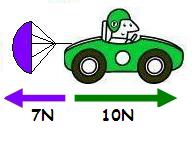
Calculate the net force of the object in the image shown.
a)
20N
b)
35N
c)
5N
d)
25N
55.
Is this a balanced or unbalance force?
a)
Balanced
b)
Unbalanced
c)
Neither one
d)
Both
56.
Which direction will the object move?
a)
Up
b)
Down
c)
Right
d)
Left
57.
What is the net force of this object?
a)
0N
b)
50N
c)
25N
d)
5N
58.
Students are playing tug-of-war. If group B pulls the rope to the right with a force of 400 N and group A pulls the rope to the left with a force of 250 N, what will happen to the ribbon in the middle of the rope?
a)
The ribbon will move to the left and group A will win the tug-of-war.
b)
The ribbon will move to the left and group B will win the tug-of-war.
c)
The ribbon will move to the right and group B will win the tug-of-war.
d)
The ribbon will move to the right and group A will win the tug-of-war.
59.

What is the net force and to what direction.

a)

210 N to the right

b)

280 N to the right

c)

110 N to the left

d)

180 N to the left

60.

If a person is picking up a book with the force of 50 N and the gravity is pushing down with 15 N, what is the net force?

a)

50 N

b)

35 N

c)

65 N

d)

15 N

61.

You and your friend, are playing tug of war. Your friend pulls with a force of 55 N, to the rights. You pull with a force of 65 N, to the left. What is the net force on the rope?

a)

20 N, to the left

b)

20 N, to the right

c)

10 N, to the right

d)

10 N, to the left

62.

During which interval is the object speeding up?

a)

A to B

b)

B to C

c)

D to E

d)

E to F

63.
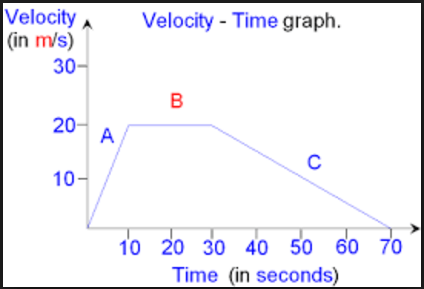
This is a velocity-time graph.  What is the object doing in segment C?
a)
Positive acceleration
b)
Negative acceleration
c)
Constant Velocity
d)
Not moving
64.
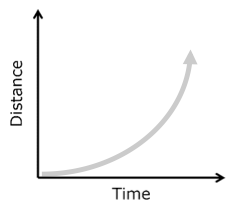
This graph demonstrates an object that is -
a)
Increasing speed
b)
At a constant speed
c)
Decreasing speed
d)
Stationary
65.
This graph demonstrates an object that is -
a)
At a constant speed
b)
Increasing speed
c)
Decreasing speed
d)
Stationary
66.
Which runner won the race?
a)
Albert
b)
Bob
c)
Charlie
67.

During which segment is the object decreasing speed?

a)

X

b)

Y

c)

Z

68.

During which segment is the object increasing speed?

a)

X

b)

Y

c)

Z

69.

During segment Y, the object is -

a)

Increasing speed

b)

Decreasing speed

c)

Stationary

d)

Moving at constant speed

70.
How long did one of the runner's rest?
a)
8 seconds
b)
13 seconds
c)
5 seconds
d)
50 seconds
71.
How fast is the object moving in segment B?
a)
2 m/s
b)
20 m/s
c)
-2 m/s
d)
0 m/s
72.
This graph demonstrates an object that is -
a)
At a constant speed
b)
Increasing speed
c)
Decreasing speed
d)

Stationary

(not moving)

73.
This graph demonstrates an object that is -
a)
At a constant speed
b)
Increasing speed
c)
Decreasing speed
d)
Stationary
74.

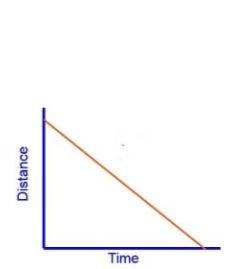
What is this line of this graph showing?

a)

moving away from starting point at a constant speed

b)

moving back towards the starting point

c)

acceleration (getting faster)

d)

deceleration (getting slower)

75.
According to the graph how far does the person travel in the first 5 seconds?
a)
2 m
b)
10 m
c)
0 m
d)
5 m