
NEW
Font size
 Worksheets
Unit 5 Review
Total questions: 35
Worksheet time: 22mins
Mass is the amount of _______ an object takes up.
gas
atom
matter

How much matter an object contains for it´s size
Mass
Density
Matter
Volumen
The amount of space accupied by a substance is called?
Density
MAtter
Volume
Space

This is an example of what type of matter?
solid
liquid
gas

This is an example of what type of matter?
solid
liquid
gas
The ___ is the thing being dissolved.
solute
solvent
mixture
solution
If I dissolve salt in water, what is the solute?
water
salty water
none of the above
salt
Measured using a thermometer.
mass
volume
temperature
atmospheric pressure
Measured in grams.
mass
volume
Measured in liters (or milliliters).
mass
volume
the smallest particle that can still be identified as the matter it came from
energy
atom
electrons
compounds
The periodic table lists all the ___________________________ in order
groups
elements
symbols
letters

What is a solvent
A liquid that will dissolve a solid solute
Another word for solution
A thing that make drinks change colour
Usually the solid about to be dissolved
If I dissolve salt in water, what is the solvent?
salt
water
salt & water
none of the above
______ refers to the ability of a substance to combine and form a solution
solvent
solute
solution
solubility
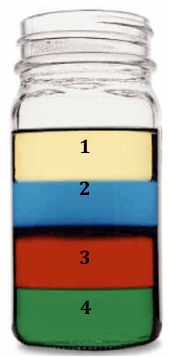
What 2 measurements are used for DENSITY
Mass and Weight
Mass and Acceleration
Mass and Volume
Length and Width
The change of one state of matter to another is called
Osmosis
Phase Change
Matter
Energy
What happens to molecules when their kinetic energy increases?
The molecules move slower
The molecules move faster
The molecules get heavier
It depends on the type of molecule

Three containers with the same amount of the same material are shown below. Which container has the substance with the lowest amount of energy?
The container on the left
The middle container
The container on the right
All have an equal amount of energy
Which statement best describes what happens when heat is added to a substance?
Energy moves out of the substance causing the molecules to slow down.
Energy moves out of the substance causing the molecules to speed up.
Energy moves into the substance causing the molecules to slow down.
Energy moves into the substance causing the molecules to speed up.
The slower the particles in a substance move,
the colder it is.
the warmer it is.
the more energy it has.

