wayground logo

Free Printable Worksheets

Font size

S
M
L
XL
Worksheets

Changes of state

Total questions: 107

Worksheet time: 1hrs 17mins

Name
Class
Date
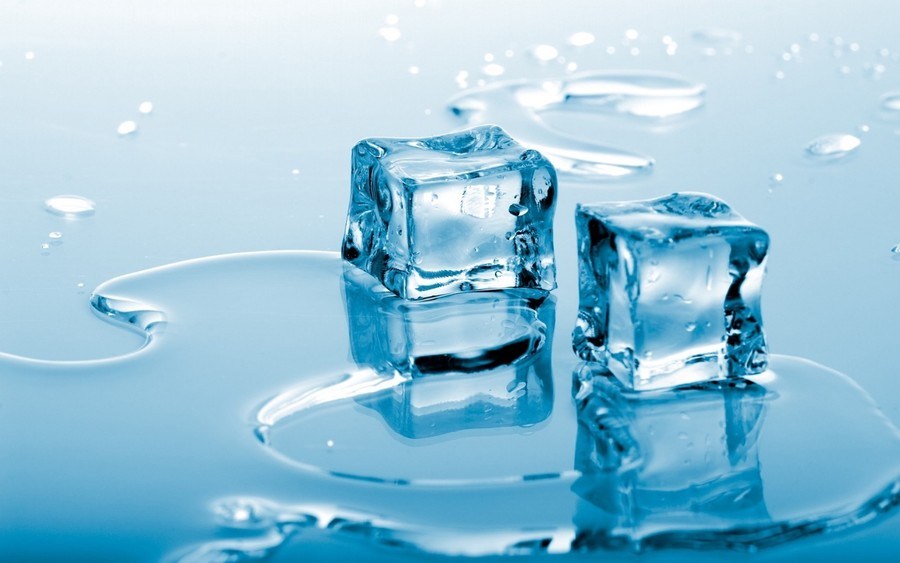
1.

When ice melts...

a)

The mass of the water decreases during melting.

b)

The mass of the water stays the same before, during and after melting.

c)

The mass of the water is always changing.

d)

The mass of the water increases during melting.

2.
What change of state does this pot show?
a)
Boiling
b)
Condensation
c)
Freezing
d)
Melting
3.

Which of the following is a correct description for solids?

a)

closely arranged and in fixed positions

b)

closely arranged and vibrate in fixed positions

c)

closely arranged and can move around

4.

When something goes from gas to liquid, it is called...

a)

Evaporation

b)

Condensation

c)

Deposition

d)

Freezing

5.
Which of the following statements about the kinetic particle theory is not true?
a)
The particles of a gas move faster than those of a liquid.
b)
The particles of a solid have more kinetic energy than those of a gas.
c)
The particles that make up matter are always moving.
d)
The forces of attraction between the particles of a solid are very strong.
6.
The graph below shows part of the cooling curve of a substance. Which row correctly identifies P, Q and R?
a)
P: Gas, Q: Gas and Liquid, R: Liquid
b)
P: Liquid, Q: Gas and Liquid, R: Gas
c)
P: Gas, Q: Liquid, R: Solid
d)
P: Solid, Q: Liquid, R: Gas
7.
A solid compound X was heated steadily for 20 minutes. The graph below shows the change in temperature of X with time. At what temperature did X melt?  
a)
20°C
b)
40°C
c)
90°C
d)
100°C
8.
A solid compound X was heated steadily for 20 minutes. The graph below shows the change in temperature of X with time. What is the boiling point of X?
a)
20°C
b)
40°C
c)
90°C
d)
100°C
9.
What is/are the physical state(s) of X at 100°C?
a)
Solid
b)
Solid and liquid
c)
Gas
d)
Liquid and gas
10.
Which of the following statements about the particle of a gas is true?
a)
The particles of a gas vibrate about fixed positions.
b)
The particles of a gas are packed close together in a disorderly arrangement.
c)
The particles of a gas are far apart and move in all directions.
d)
The particles of a gas are stationary in an orderly arrangement.
11.
Which of the following states of matter has the LOWEST level of energy?
a)
Solid
b)
Liquid
c)
Gas
d)
Plasma
12.
What happens to the average kinetic energy of matter when it is heated?
a)
It increases
b)
It decreases 
c)
It doesn't change
d)
It cannot be determined
13.
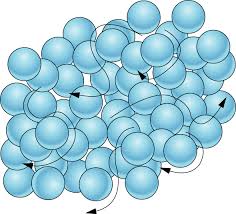
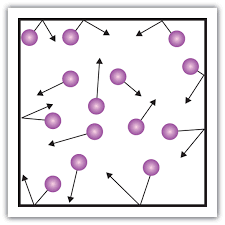
What state of matter is shown in the image?
a)
Solid
b)
Liquid
c)
Gas
d)
Thermal Energy
14.
At what temperature does matter change phases from a solid to a liquid?
a)
Melting Point
b)
Boiling Point
c)
100 degrees Celsius
d)
Condensation Point
15.

Particles in a solid move __________, than particles in a liquid

a)

faster

b)

slower

c)

more randomly

d)

more fluidly

16.

The process of a solid changing directly into a gas is called

a)

condensation.

b)

evaporation.

c)

freezing.

d)

sublimation.

17.

According to the law of conservation of mass

a)

mass is lost only in chemical changes.

b)

mass is lost only in physical changes.

c)

total mass stays the same in changes of state.

d)

only energy is lost in changes of state.

18.

According to the law of conservation of energy,

a)

energy is not absorbed or released in changes of state.

b)

energy is not transferred during changes of state.

c)

energy is not created or destroyed in changes of state.

d)

a substance has the same energy before and after a change of state.

19.

When ice melts to form liquid, energy is

a)

created

b)

destroyed

c)

released

d)

absorbed

20.

The temperature at which a substance changes from a liquid to a solid is the

a)

freezing point.

b)

saturation point.

c)

boiling point.

d)

condensation point.

21.

The engine of a car left running for a long period of time becomes hot because

a)

energy is created by burning gasoline.

b)

energy is absorbed by burning gasoline.

c)

energy is transferred from burning gasoline.

d)

energy is released as gasoline evaporates.

22.

A substance changes from a liquid to a gas during evaporation because

a)

energy is lost.

b)

energy is released.

c)

energy is created.

d)

energy is absorbed.

23.

What happens to the particles of a substance when it condenses?

a)

Particles speed up and spread out.

b)

Particles slow down and clump together.

c)

Particles stick together and stop moving.

d)

Particles vibrate as they lose energy.

24.

According to the kinetic theory of matter, which of the following statements is true about matter?

a)

The atoms and molecules of a substance are always in motion.

b)

The higher the temperature of a substance, the faster its particles

move.

c)

More massive particles move more slowly than less massive

particles.

d)

All are true

25.

The measure of the average kinetic energy of the particles in an object is called

a)

plasma

b)

kinetic temperature

c)

thermal energy

d)

particle energy

26.

Butter on a hot pancake is an example of?

a)

Freezing

b)

Melting

c)

Condensation

d)

Freezing

27.

Water turning into ice is an example of?

a)

Condensation

b)

Freezing

c)

Melting

d)

Evaporation

28.

When your glasses get foggy is an example of?

a)

Freezing

b)

Melting

c)

Condensation

d)

Evaporation

29.

Steam is an example of?

a)

Condensation

b)

Melting

c)

Freezing

d)

Evaporation

30.

A lit candle is an example of?

a)

Melting

b)

Condensation

c)

Freezing

d)

Evaporation

31.

When you pour juice into a mold and put in the freezer what happens?

a)

It melts

b)

It condensates

c)

It freezes

d)

It evaporates

32.
Matter changes state when...
a)
energy is added or removed
b)
energy is added
c)
energy is removed
d)
there is no energy
33.
Energy(heat) is added in order to go from ...
a)
solid to gas
b)
liquid to solid
c)
gas to liquid
d)
gas to solid
34.
Energy(heat) is removed in order to go from ....
a)
gas to solid
b)
solid to liquid
c)
solid to gas
d)
liquid to gas
35.
Suppose you pour a glass of ice water and set it on the kitchen table. After a few minutes, the outside of the glass will be covered with drops of water. Why did this happen?
a)
Oxygen in the air cooled and condensed onto the cold glass.
b)
Water vapor in the air cooled and condensed onto the cold glass.
c)
Water vapor in the air cooled and evaporated onto the cold glass.
d)
Water seeped through pores in the glass.
36.
When a gas forms directly into a solid, skipping the liquid phase
a)
deposition
b)
sublimation
c)
evaporation
d)
condensation
37.
Which is needed for both boiling and melting to occur?
a)
solids
b)
gases
c)
heat
d)
pressure
38.

When thermal energy is increased in a solid, what change in state is happening?

a)

Melting

b)

Evaporation

c)

Freezing

d)

Condensation

39.

When thermal energy is decreased in a liquid, what change in state is happening?

a)

Melting

b)

Freezing

c)

Condensation

d)

Evaporation

40.
What is an example of sublimation?
a)
Ice cream melting
b)
Dry ice
41.

How we call the change when a liquid become gas?

a)

Vaporization

b)

Fusion

c)

Condensation

d)

Solidification

42.
Water freezing into ice is an example of a...
a)
Physical Change
b)
Chemical Change
43.
Physical or Chemical Change?  Iron rusts
a)
Physical Change
b)
Chemical Change
44.
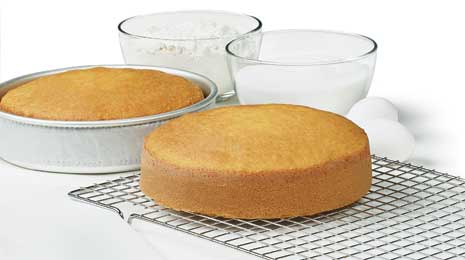
Physical or Chemical Change?  Baking a cake.
a)
Chemical Change
b)
Physical Change
45.
Physical or Chemical Change?  Logs burning in a campfire.
a)
Physical Change
b)
Chemical Change
46.
What temperature does water freeze? 
a)
212 F
b)
0 C
c)
100 C
d)
37 F
47.
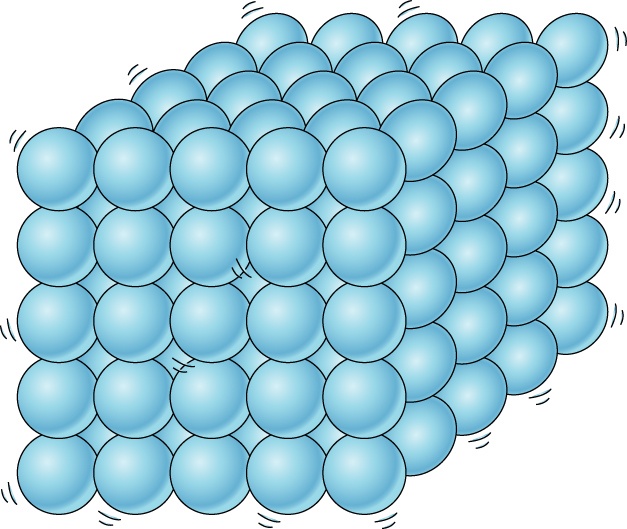
The molecules in the picture are tightly held together with little movement. They have shape and energy.  Therefore, the picture represents _________.
a)
solid
b)
liquid
c)
gas
d)
plasma
48.
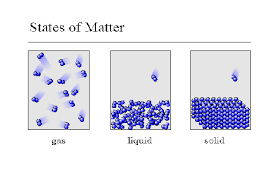
What does the picture represent?
a)
Solid
b)
Liquid
c)
Gas
d)
Mickey Mouse 
49.
What do the molecules in the picture represent?
a)
solid
b)
liquid
c)
gas
d)
which way to go
50.
Which conclusion could be drawn by observing the change from ice to water to water vapor?
a)
The kinetic energy of the particles increase as thermal energy is taken away.
b)
The kinetic energy of the particles increase as thermal energy is added.
c)
The kinetic energy of the particles decreases as thermal energy is added.
d)
The kinetic energy of the particles never decreases.
51.

Which of the following can be used to separate salt and water?

a)

Filtration

b)

Chromatography

c)

Simple Distillation

d)

Evapouration to Dryness

52.

Descending chromatography is favoured by _________?

er

a)

Length of chromatography pap

b)

Gravitational pull

c)

Type of solutes being separated

53.

The solid substance left on the filter paper is known as ___________?

a)

Remains

b)

Residue

c)

Crystals

d)

Sublimate

54.

The substance that gets through the filter paper is called the ___________?

a)

Refuse

b)

Distillate

c)

Filter

d)

Filtrate

55.

The biggest advantage that filtration has it that it is ____________?

a)

Cuts on costs

b)

Produces 100% pure substance

56.

Evaporation is not involved in filtration.

a)

True

b)

False

57.

Evaporation to dryness is very similar to which of the following experimental technique?

a)

Distillation

b)

Filtration

c)

Crystallisation

d)

Chromatography

58.

Which of the following can help to find the purity of a water?

a)

Boiling point

b)

Colour

c)

Smell

d)

Solubility in water

59.

Which of the following is the best way of obtaining pure water from ink?

a)

Chromatography

b)

Distillation

c)

Filtration

d)

Freezing

60.

Sublimation is the term used to mean which change of state?

a)

Solid to Liquid

b)

Liquid to Gas

c)

Gas to Solid

d)

None of the above

61.
does not have a definite shape or volume
a)
volume
b)
solid
c)
liquid
d)
gas
62.
___________________ this state of matter has a definite shape and definite volume. 
a)
solid
b)
liquid
c)
gas
d)
matter
63.
Particles in this state of matter are moving the fastest.
a)
solid
b)
liquid
c)
gas
64.
Particles in this state of matter are moving the slowest.
a)
solid
b)
gas
c)
liquid
65.

This state of matter takes ONLY the shape of its container.

a)

liquid

b)

gas

c)

solid

66.
This state of matter keeps its shape and volume.
a)
gas
b)
solid
c)
liquid
67.
This state of matter takes both the shape and volume of it container.
a)
gas
b)
solid
c)
liquid
68.

In this state of matter, the molecules have enough energy to completely separate from each other.

a)

gas

b)

solid

c)

liquid

69.
In this state of matter, the molecules can move around each other, but cannot break the force of attraction between them.
a)
liquid
b)
gas
c)
solid
70.
In this state of matter, there is a strong attraction between molecules and they cannot break away from each other. 
a)
solid
b)
liquid
c)
gas
71.
When water beads on the outside of a cold glass of water.
a)
vaperization
b)
condensation
c)
melting
d)
freezing 
72.
When boiling water creates steam.
a)
condensation
b)
melting 
c)
freezing
d)
vaporization
73.
When dripping water turns into icicles. 
a)
melting
b)
freezing
c)
vaporization
d)
condensation 
74.
When a scoop of ice cream drips down the side of the cone.
a)
freezing 
b)
vaporization
c)
melting
d)
condensation
75.

When a solid changes straight to a gas.

a)

condensation

b)

sublimation

c)

deposition

d)

freezing

76.

When a gas turns straight to solid.

a)

sublimation

b)

melting

c)

deposition

d)

evaporation

77.

All matter is made of atoms or groups of atoms that are in constant motion. This idea is the ___________________________________.

a)

States of Matter Theory

b)

Kinetic Theory of Matter

c)

Matter Theory

78.

What happens to a substance with an increase in temperature?

a)

it gains energy

b)

it loses energy

c)

its energy stays the same

79.

Anything that has mass and takes up space is called

a)

mass

b)

volume

c)

matter

d)

solid

80.

Suppose you pour a glass of ice water and set it on the kitchen table. After a few minutes, the outside of the glass will be covered with drops of water. Why did this happen?

a)

Oxygen in the air cooled and condensed onto the cold glass.

b)

Water vapor in the air cooled and condensed onto the cold glass.

c)

Water vapor in the air cooled and evaporated onto the cold glass.

d)

Water seeped through pores in the glass.

81.

Why do atoms in a solid still vibrate?

a)

All solids have some thermal energy.

b)

Some solids have some thermal energy, and some do not.

c)

Atoms in a solid do not vibrate.

d)

None of the above.

82.

When heat is added to a liquid, what occurs?

a)

Liquid molecules begin to condense to form a solid.

b)

Liquid molecules are being slowed down to become a gas.

c)

Liquid molecules speed up and begin to spread out to become a gas.

d)

Liquid molecules begin to slow down to become a solid.

83.

What happens to molecules as temperature and energy increase?

a)

Matter condenses

b)

Substances expand when heated

c)

Atoms become less active

d)

Phase change slows down

84.

Which of the following is an example of a liquid (select ALL that apply).

a)

tree

b)

ice

c)

water

d)

oxygen

e)

oil

85.
At higher temperatures
a)
particles in an object have less energy
b)
particles in an object move faster
c)
a gas contracts
86.
Which form of matter does not take the shape of its container?
a)
liquid
b)
gas
c)
solid
d)
air
87.
How is a gas defined?
a)
Indefinite shape, indefinite volume
b)
Definite shape, definite volume
c)
Found in stars
d)
Definite volume, indefinite shape
88.

Particles of a liquid

a)

are tightly packed together and stay in a fixed position.

b)

are free to move around one another but still touch.

89.

The slower the particles in a substance move,

a)

the colder it is.

b)

the warmer it is.

c)

the more energy it has.

90.

What state of matter?

a)

Solid

b)

Liquid

c)

Gas

d)

Plasma!!!

91.

What state of matter?

a)

Solid

b)

Liquid

c)

Gas

92.

What state of matter?

a)

Solid

b)

Liquid

c)

Gas

93.

What is the phase change of a solid to a liquid?

a)

freezing

b)

melting

c)

boiling

d)

condensation

94.
5. What is it called when a solid turns directly into a gas?
a)
Sublimation
b)
Condensation
c)
Liquid
95.
7. All phase changes (changing states) requires energy to be added or taken away.
a)
True
b)
False
96.

Change from Liquid to Solid is called ...

a)

fusion

b)

Freezing

c)

sublimation

d)

evaporation

97.
Change from gas to liquid...
a)
condensation
b)
evaporation
c)
expansion
d)
movement
98.

Change from liquid to gas is called....

a)

expansion

b)

evaporation

c)

condensation

d)

sublimation

99.
Matter changes state when...
a)
energy is added or removed
b)
energy is added
c)
energy is removed
d)
there is no energy
100.
 The process where water vapor changes from a gas to a liquid is called:
a)
sublimation
b)
precipitation
c)
evaporation
d)
condensation
101.

Mass cannot be created or destroyed

a)

True

b)

False

102.

Energy cannot be created or destroyed

a)

True

b)

False

103.

Which definition describes buoyancy?

a)

The upward force fluids exert which keeps objects aloft

b)

A change that produces a new substance

c)

How hot or cold something is, determined by the kinetic energy of its particles

d)

Anything that has volume and mass

104.
When pressure is applied to a confined fluid, the increase in pressure is transmitted equally to all parts of the fluid. This fact is called________.
a)
Pascal's Principle
b)
Newton's Principle
c)
Archimedes' Principle
d)
Bernoulli's Principle
105.

What is the unit of pressure?

a)

Pascals

b)

Newton meter

c)

Kilogram

d)

Meter

106.

What is the correct equation to calculate pressure?

a)

pressure = force × area

b)

pressure = force  ÷\div   area

c)

Force = pressure × area

d)

pressure = mass × area

107.

This principle says that an increase in pressure on a confined fluid is transmitted equally to all parts of the fluid.

a)

Newton's Principle

b)

Bernoulli's Principle

c)

Archimedes' Principle

d)

Pascal's Principle