
 Worksheets
grade910 revision book
Total questions: 112
Worksheet time: 2hrs 46mins
A wave is a disturbance that transfers ________ from one place to another.
Matter
Mass
Energy
What types of waves can travel through empty space AND mediums?
Longitudinal
Mechanical
Electromagnetic
Which 2 types of waves require a medium to travel?
Electromagnetic
Mechanical
Light
Sound
Which of the following is a mechanical wave?
X-ray
Infrared
Radio waves
Sound
What medium do sound waves travel fastest through?
Solids
Liquids
Gases

The height of a wave from its resting point (B).
Frequency
Wave speed
Wavelength
Amplitude
The length of a wave, from crest to crest or trough to trough. (D)
Frequency
Wave speed
Wavelength
Amplitude
The number of waves passing a given point each second is:
Frequency
Wave speed
Wavelength
Amplitude
What is the correct formula for wave speed?
Wave speed = frequency x wavelength
Wave speed = amplitude x wavelength
Wave speed = amplitude x period
Wave speed = frequency x period
As wavelength decreases, the crests of the wave:
become wider
become shorter
get closer together
get farther apart
If a wave has a long wavelength, it will have __________ energy.
High
Medium
Low
If a wave has a short wavelength, it will have __________ energy.
High
Medium
Low
If a wave has a high frequency, it will have __________ energy.
High
Medium
Low
If a wave has a high amplitude, it will have __________ energy.
High
Medium
Low

Waves move ___ through vibrations
Energy
Matter
Mass
Weight


When placed in water, a ball moves from one place to another with the waves.
True
False
Waves DO NOT transfer ______?
Matter
Energy

You can't hear sounds in outer space because there is no
medium
light
energy
heat

The highest point on a wave is:
the crest
the trough
the top
the coast

Which word is used to identify the distance between points C & G?
Amplitude
Crest
Frequency
Wavelength
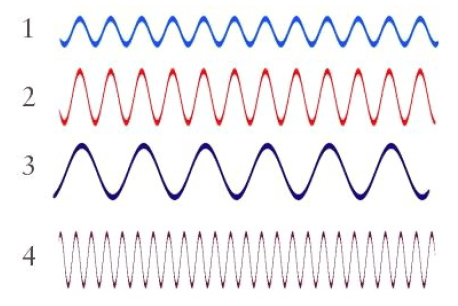
Which wave in the diagram has the greatest frequency?
1
2
3
4
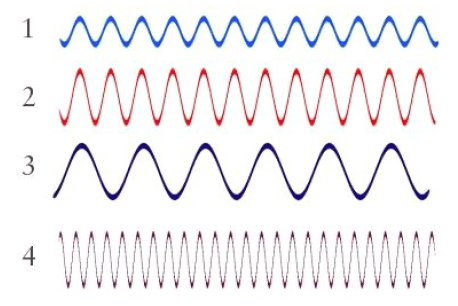
Which wave in the diagram has the greatest wavelength?
1
2
3
4
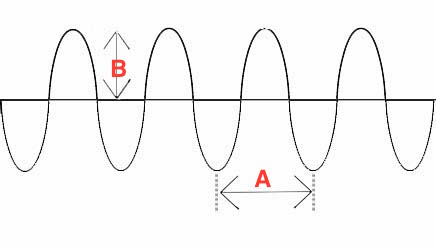

a disturbance caused by energy moving through a system in a cyclical pattern
Wave
Amplitude
Frequency
Speed
How fast the wave is moving through a medium
wave speed
wavelength
amplitude
frequency
When a wave bounces off of something and moves in a different direction
reflection
refraction
absorption
propagation
when a wave is bent by traveling from one medium to another
reflection
refraction
absorption
propagation


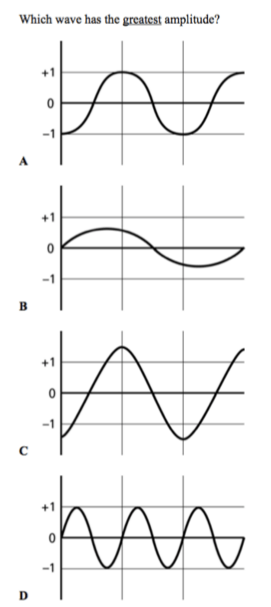


What is the amplitude of this wave?
4
8
2
6.3
What is the wavelength of this wave?
4
8
3.3
6.3
What type of wave move in a back and forth motion?
Compression wave
Light wave
Transverse wave
Hicks-Riddick Wave
A pattern of disturbance that travels through a substance from one location to another location.
Wave
Amplitude
Wave Crest
Wave Trough
Wave Height
The distance from the wave crest or trough to the equilibrium Level
Wave
Amplitude
Wave Crest
Wave Trough
Wave Height
The highest part of a wave.
Wave
Amplitude
Wave Crest
Wave Trough
Wave Height

The lowest part of a wave.
Wave
Amplitude
Wave Crest
Wave Trough
Wave Height

The vertical distance between the wave trough and the wave crest.
Wave
Amplitude
Wave Crest
Wave Trough
Wave Height

distance between two consecutive wave crests or between two consecutive wave troughs.
Wave
Amplitude
Wave Length
Wave Trough
Wave Height

The number of waves passing a fixed point in a specified period of time
Wave Height
Wave Length
Wave Frequency
Wave Trough

The part of a wave that the particles are more pushed together.
Compression
Rarefaction
Particles
Wave

The part of a wave that the particles are pulled apart
Compression
Rarefaction
Particles
Wave

Are the small piece of matter that make up an object.
Compression
Rarefaction
Particles
Wave
The correct unit for wavelength is:
Hz
S
m
cm
The distance between two troughs in a wave is:
frequency
wavelength
equilibrium
period
A substance (like solid, liquid or gas) that the energy of a wave can travel through
amplitude
compression
medium
frequency
The area of a longitudinal wave where the particles are crowded together.
compression
crest
transverse
medium
The highest point on a wave.
frequency
compression
trough
crest


What is frequency measured in?
Milliseconds
Miles
Hertz
Kilograms
a disturbance that transfers energy from place to place
amplitude
wave
crest
pitch
mechanical waves that travel through the air or another medium and can be heard when they reach a person or animal's ear
light
amplitude
sound
frequency
electromagnetic waves that can be perceived by the human eye
sound
crest
pitch
light
a wave that requires a medium through which to travel
mechanical wave
transverse wave
wavelength
wave
a wave that moves the medium in a direction perpendicular to the direction in which the wave travels
longitudinal (compression) wave
electromagnetic wave
mechanical wave
transverse wave
a wave that moves a medium in a direction parallel to the direction in which the wave travels
mechanical wave
electromagnetic wave
transverse wave
longitudinal (compression) wave
the distance between two corresponding parts of a wave
wavelength
amplitude
medium
crest
the number of complete waves that pass a given point in a certain amount of time
pitch
crest
frequency
trough
the highest part of a transverse wave
pitch
crest
trough
frequency
the lowest part of a transverse wave
crest
pitch
frequency
trough
perception of the frequency of a sound
sound
pitch
crest
light
the maximum distance the particles of a medium move away from their rest positions as a wave passes through the medium
wavelength
crest
amplitude
wave
the material through which a wave travels
wavelength
amplitude
medium
wave
transverse waves that transfer electrical and magnetic energy
wave
mechanical wave
electromagnetic wave
longitudinal (compression) wave
Water waves and light waves are both examples to ___
Longitudinal Wave
Transverse Wave
Frequency wave
Sound Wave
As the wavelength increases, the frequency ____
increases
decreases
remain same
none of the above
The highest point of the transverse wave is called _____
trough
amplitude
crest
wavelength
The lowest point on the transverse wave is called_______
trough
crest
wavelength
frequency

This is the distance from the equilibrium position to the crest or to the trough.
crest
trough
wavelength
amplitude
In a transverse wave, particles vibrate perpendicular to the direction that the wave is traveling
True
False
none of the above
What do all waves transmit
energy
matter
frequency
water

The wavelength can be measured from ( check all that apply)
crest to crest
crest to trough
trough to crest
trough to trough
Examples of transverse wave ( check all that apply)
Vibration in guitar strings
a Mexican wave in sports stadium
ultrasound waves
micro waves

