
 Worksheets
Science
Total questions: 84
Worksheet time: 1hrs 21mins
Branch of science that deals with experiments and talks about substances.
(a)
Anything that has mass and occupies space.
(a)
What are the states of matter? (3)
(a)
true or false:
a. all matter is made up of large particles
b. there is empty space between particles
c. particles are in constant motion
d. there are no forces between particles
(a)
Has fixed volume and a definite shape. It vibrates due to compact molecules.
(a)
What do you call the expansion of solid through heat and its contraction through cold.
(a)
Has no definite shape but has definite volume due to the strong attraction of molecules. It is affected by temperature and its particles can move or slide past one another.
(a)
Has no definite shape and volume with loose particles that can move around freely at a high speed.
(a)
Phase change can be discussed through (a) .
Nuclear Change:
a. combining
b. separating
a. nuclear fission
b. nuclear fusion
a. nuclear fusion
b. nuclear fission
It is when solid absorbs energy which eventually increases kinetic energy of particles (compact to loose). From solid to liquid.
(a)
_____ is from liquid to solid. _____ is the temperature at which liquid freezes.
Temperature: _____ degrees Celsius or _____ degrees Fahrenheit
(a)
It is when liquid boils to gas causing high energy to leave the molecule. From liquid to gas.
(a)
It is part of the process of forming gas. From gas to liquid.
(a)
It is when particles of solid absorbs enough energy to overcome force of attraction. From solid to gas.
(a)
It is when gas particles become very cold. From gas to solid.
(a)
What are the properties of matter?
(a)
Which property of matter:
a. perceived by senses and does not change in properties
b. matter reacts with something and creates a new substance
a. physical
b. chemical
a. chemical
b. physical
Identify which property of matter. (physical - p, chemical - c)
a. texture
b. combustibility
c. flammability
d. tearing of paper
e. oxidation of iron
f. volume
g. smell
(a)
Everything is a pile of atom.
true
false
eslaf
eurt
The basic unit of element.
(a)
Who was the Greek philosopher who discovered the atom and when was the word "atom" first used.
(a)
_____ is derived from the Greek word _____ meaning indivisible. It is the smallest unit of matter.
(a)
Atoms are composed of three particles called as (a) .
What are the three subatomic particles?
(Z-A, may s sa dulo ng sagot)
(a)
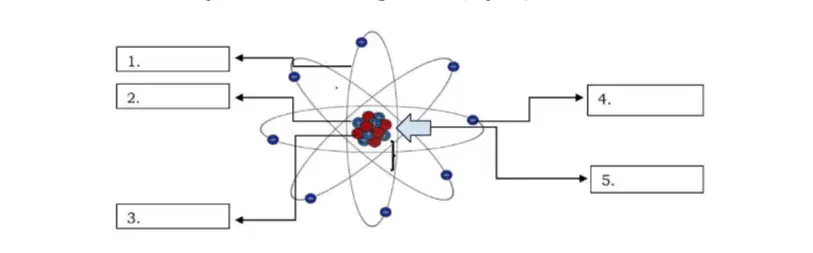
Identify the parts of the atom.
(a)
Which subatomic particles has a net charge of:
a. -1
b. +1
c. +1
(a)
Which subatomic particle has this symbol:
a. e^-
b. n^0
c. p^+
(a)
What do you call a stable atom?
(a)
Number of _____ are equal to the number of _____.
(lagyan mo s sa dulo)
(a)
The mass of an atom is due to the mass of _____ and _____.
(lagyan mo s sa dulo)
(a)
Protons and neutron are also called as (a) .
Which is the (a) subatomic particle:
a. heaviest
b. lightest
_____ is the number of protons of an element with a symbol of _____.
(a)
It is the amount of protons and neutrons. It is the atomic weight or mass of an element.
(a)
Which subatomic particle has the atomic mass of: ('wag lagyan s sa dulo)
a. 9.109 x 10^-28
b. 1.678 x 10^-24
c. 1.672 x 10^-24
(a)
(a) is also known as the "billiards ball theory" which suggested that every matter is made up of atoms and that they are indivisible is by John Dalton year 1803.
What model is described by Joseph John Thomson in the year 1904 as a positively charged sphere with electrons inside?
(a)
Who discovered the presence of electrons?
(a)
What was the first name of electrons?
(a)
What experiment was used in the plum pudding model?
(a)
(a) is when Ernest Rutherford (1911) modified the atomic structure with the discovery of the subatomic particle and that the atom is mostly empty space.
In what model was the nucleus discovered?
(a)
What experiment was used in the nuclear model?
(a)
According to the nuclear model, the nucleus has a _____ charge.
positive
negative
Neil Bohr (1913) worked with Rutherford's idea and said that Electrons orbit the
nucleus in a circular motion. This resulted to what model?
(a)
The planetary model is inspired by the (a) .
Erwin Schrodinger (1926) contradicted Bohr. He found out that the atom is composed of a dense nucleus with protons and neutrons as well as electrons existing on different clouds at various energy levels.
(a)
How many known elements are there?
(a)
Who was the German chemist who formed the triads of element with similar properties?
(a)
What periodic table was formed in 1817 by Johann Wolfgang Dobereiner?
(a)
Who was the English chemist who proposed the law of octaves?
(a)
Newland's octaves was formed by John Newlands in what year?
(a)
Who were the proponents of the Modern Periodic Table? (alphabetically arranged)
(a)
Who was the English physicist who observed that the order of X-ray frequencies emitted by elements follows the ordering of elements by atomic number.
(a)
The Modern Periodic Law was developed by Henry Moseley in what year?
(a)
What do you call the elements that are in the:
a. horizontal rows
b. vertical rows
(a)
The elements belonging to a (a) have similar chemical properties.
The group number corresponds to the number of (a) in their outermost shell.
What do you call the electrons that are present in the outermost shell?
(a)
How many groups of elements are there?
(a)
How many periods are in the elements?
(a)
Very reactive, soft, malleable, and ductile, good conductors of heat and electricity and only has one valence electron.
(a)
Second most reactive elements, malleable, ductile, and good conductors of heat
and electricity but not as soft as Group 1 elements
with two valence electrons.
(a)
Are post-transition metals, except for Boron which is a metalloid and Nihonium which is a synthetic chemical element that is extremely radioactive
with three valence electrons.
(a)
Also known as the Carbon family, or the tetrels. Elements in this family are the key importance for semiconductor technology, with four valence electrons
(a)
Also known as pnictogen group, with five valence electrons.
(a)
Widely known as Oxygen group, they are generally nonmetals
with six valence electrons.
(a)
Salt formers, they exist in all three states of matter
with seven valence electrons.
(a)
Stable gases, they are non-reactive or inert elements
with eight valence electrons except Helium.
(a)
Hard (with Mercury as an exception), they are malleable, ductile, and good conductors of electricity with one and/or two valence electrons.
(a)
What do you call the inner transition metals?
(a)
What are the three classification of elements?
(a)
Metals are located on the _____ side of the Periodic Table of Elements. Most of the elements are metals which are solids at room temperature except _____.
(a)
These elements are lustrous (shiny), malleable, hard, ductile, and good conductors of heat and electricity.
(a)
Elements that are found far right of the periodic table are called (a) which may be solids, liquids or gases.
These elements are dull in appearance, brittle, and poor conductors of heat and electricity.
(a)
A stair-step line on the table separates the metals from nonmetals. The elements along this line are called (a) . They exhibit the properties of metals and nonmetals.
These elements have some properties of metal but behave chemically like a nonmetal in certain instances. Some are semiconductors, which means they will insulate and conduct electricity.
(a)
In a period, the reactivity of metals (a) from left to right.
In a group, the reactivity of metals (a) from top to bottom.
a. A reaction always happens between a metal and a compound.
b. There is an existing definite order of reactivity among metals and hydrogen according to their ability to displace one another.
a. true
b. true
a. true
b. false
a. false
b. false
a. false
b. true
A less reactive metal can replace a more reactive metal; hence a reaction will occur. On the other hand, a more reactive metal cannot replace a less reactive metal and will not produce a reaction.
true
false
In the reactivity series of metals, the chemical reactivity is (a) .

