
Font size
 Worksheets
Fossils, Evolution, and Mutations Test Review
Total questions: 81
Worksheet time: 20hrs 15mins
(a) was a naturist, who studied (b) on the Galapogos island.
(a) selection is when humans choose traits of an organism like breeding dogs
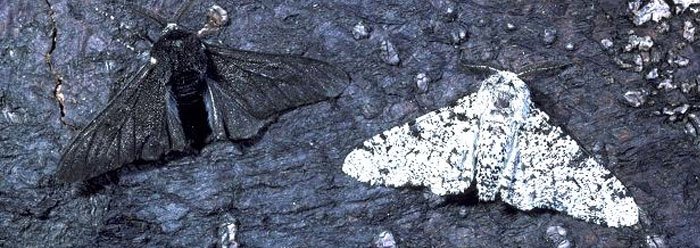
Match the following pictures with the words they represent

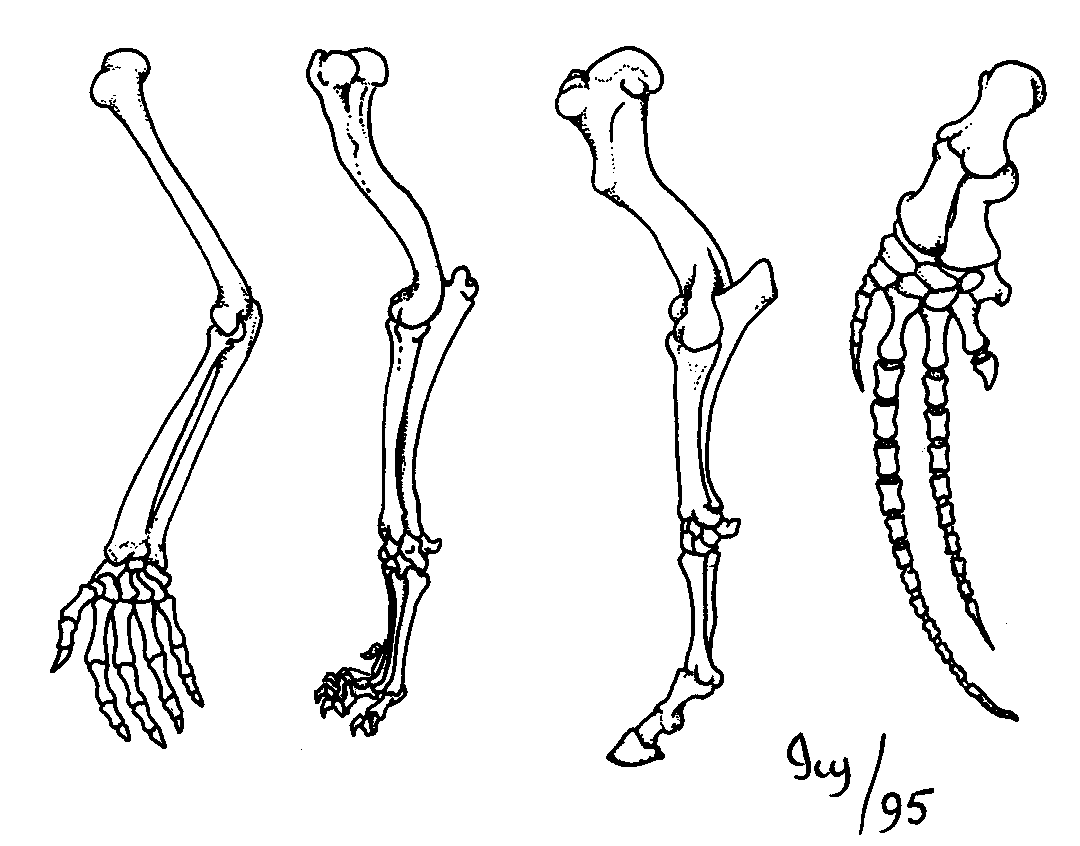
Analogous Structure

Homologous Structure

Adaptation

Artificial selection

Natural selection
vestigial structures, like the tail bone, are
No longer used
Serve an important role in our body
allow us to connect with animals
serve multi-purposes
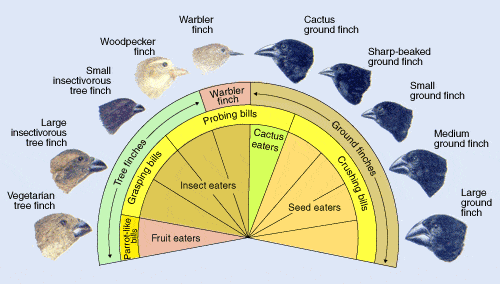
When Darwin was studying the finches and noticed the different types of beaks, this was an example of (a)


Whales are aquatic mammals that contain a pelvis (hip) bone. Even though it does not aid in its movement, the function must have been used by a common ancestor of the whale. Thus, the pelvis is referred to as a(n)
vestigial structure
analogous structure
homologous structure
The fossils found closer to the surface of the ground are generally -
(a)
A bat wing and a butterfly wing are both used for flying but they are made differently. What type of structure is this?
Homologous structure
Analogous structure
Vestigial structure
Fossil structure

The moth wing and the bat wing are example of structures.
(a)

What type of evidence is shown with the diagram above?
Molecular
Anatomical
Embryological
Fossil
Which mutation would be more harmful for an organism?
Point mutation (substitution)
Frameshift (insertion/Deletion)
Why would a frameshift be more harmful?
It changes all the code downstream
Only one nucleotide is changing
All mutations are harmful
It can't correct iself
Mutations are always bad
true
false
Three Nucleotides in a row of DNA or mRNA are called a...
(a)
What types of living organisms have no genetic material at all?
Insects
Bacteria
Plants
All living organisms have genetic material
Which of the following is an example of a beneficial mutation?
When an organism's lifespan becomes shorter.
When an organism becomes unable to reproduce.
When an organism's body becomes deformed.
When an organism develops immunity to a disease.
A parent that has a mutation to their skin cells can pass this mutation to their offspring
True
False

What mutation has occurred here?
T-G-A-C-C-A
T-G-A-G-C-A
Substitution
Deletion
Insertion
Frameshift
Original: ATC CAT
Mutation: ATC GCAT
What mutation occurred?
deletion
insertion
silent
transverse

DNA molecule segment is : TTA-CGC-AAG
The mutated DNA segment is TTC-GCA-AG. This is an example of ___ mutation.
Substitution
Deletion
Insertion
Inversion
Mutations can be...
Harmful
Beneficial
Neutral
All of the Above
Mutations are...
Changes in the sequence of DNA
Broken chromosomes
Bad genes
What is a type of Mutation?
Deletions
Insertions
Substitutions
All of the Above
Mutations are SOMETIMES helpful to the organism.
true
false
True or false, mutations create genetic diversity?
True
False
Transcribe the following DNA sequence into RNA:
GTAGTCA

Phe
Tyr
Leu
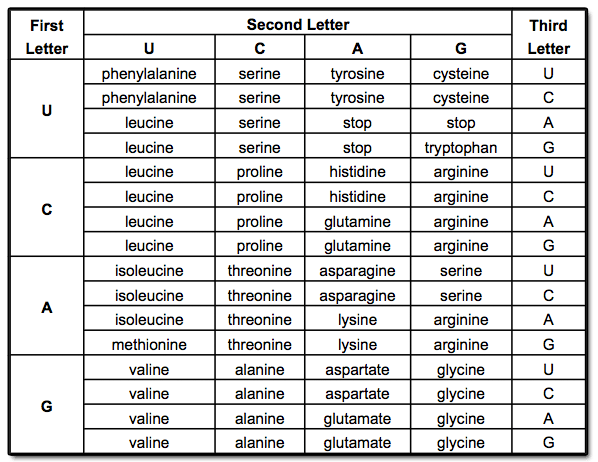
What is the correct amino acid sequence for the mRNA code AUGCCAGUA
In DNA, adenine base pairs (bonds with) ______________.

What amino acid is represented by the codon UUU?
phe - Phenylalanine
tyr - Tyrosine
leu - Leucine
Stop codon

What is the correct amino acid sequence for the mRNA code AUG CCA GUA UGA
Met-Val-Val
Met-Pro-Val
Tyr-Gly-Val
Tyr-Gly-Val
A characteristic or trait that helps an organism survive in its environment is a/an (a)
Variation in (a) would best help bison survive a harsh winter

An inherited trait that helps those organisms that have it to survive
niche
structure
characteristic
adaptation

A giraffe has a long neck in order to better reach leaves to eat. This is an example of _____.
an adaptation
environment
response
stimulus

Which of the following is an inherited trait?
swimming
eye color
skateboarding
callused fingers
Bullfrogs are Florida’s largest frog. Frogs spend part of their life cycles in water and part on land. Which physical characteristic is most useful for a water environment?
Thin skin
Large eyes
Webbed feet
Long, strong legs

Water lilies live in lakes and ponds. The lilies have very long stems. The picture shows a water lily in a pond. How do long stems help water lilies live in ponds?
They absorb food for the plant.
They absorb water from the pond.
They enable the pads and flower to reach sunlight.
They prevent the plant from floating away.
It is estimated that fewer than 100 Florida panthers are still living. Florida now has a protected habitat for the panther. How will the protected habitat affect the panthers?
The panthers will probably become extinct.
Panthers will no longer be adapted to living in Florida.
The Florida panther population will decrease in the near future.
The panther population may increase now that they are being conserved in a protected habitat.

Which of these is the best indication of the relative age of a rock layer?
The chemical make-up of the layer
The thickness of the layer
The position of the layer compared to another layer
The distance of the layer extending over Earth
Summarize the Law of Superposition
The youngest rocks are located at the bottom of the rock layers
The oldest rocks are located at the bottom of the rock layers
The ages of the rocks are mixed between the layers of the rock
The ages of all the rocks are the same throughout all the layers
What does the Law of Original Horizontality mean?
Sedimentary Rocks nautrally form vertical layers and then they fall horizontally
Sedimentary Rocks form in horizontal layers
Sedimentary Rocks form vertical and horizontal layers
Sedimentary Rocks cannot change direction once formed

Using the information from the previous slides. Which Rock layer is the oldest?
1
2
3
4

Using the information from the prevous slides. Which rock layer is the youngest?
1
2
3
4

The fossil record shows that horseshoe crabs have existed with very little change for about 1 billion years. Would horseshoe crabs be useful as an index fossil?
Yes, because they were around for a very long time
No, because horseshoe crabs can never be used as index fossils
No, because they were around for TOO LARGE of an amount of time
Yes, because horseshoe crabs can always be used as index fossils

How old is the Earth estimated to be?
4.6 billion years
1.4 billion years
4.6 million years
6000 years

A fossil that is useful for dating and correlating the strata in which it is found is called:
absolute fossil
radiometric dating
index fossil
reference fossil
Fossils such as footprints, burrows or droppings.
Index Fossils
Unconformities
Petrified Wood
Trace fossils
Fossils made from organisms that were fairly common and existed only during a certain span of time, used to determine the age of rock layers.
Index Fossils
Unconformities
Inclusions
Trace Fossils

This type of fossil forms when a mold is filled with sand or mud that hardens into the shape of the organism.
Mold
Cast
Trace
Petrified

This type of fossil forms when sediments bury an organism and then sediments change into rock; the organism decays leaving a cavity in the shape of the organism.
Mold
Cast
Trace
Petrified

This type of fossil forms when minerals soak into the buried remains, replacing the remains, and changing them into rock.
Cast
Mold
Petrified
Trace

The type of fossil shown here, where only the carbon from an organism is preserved
Carbonized
preserved remains
Trace Fossil
Cast

