
 Worksheets
Practice SCHE0201
Total questions: 106
Worksheet time: 1hrs 4mins
In a reversible adiabatic process, entropy
increases
decreases
remains unchanged
none of these
A power plant transfers 82 percent of the energy produced from burning fuel to convert water to steam. Of the energy transferred as heat by the steam, 36 percent is converted doing work through a spinning turbine. Which equation best describes the overall efficiency of the heat-to-work conversion in the plant?
eff > 82 percent
eff = 82 percent
eff = 36 percent
eff < 36 percent
If two-thirds of the energy added to an engine as heat is removed to the engine’s surroundings as heat, what is the efficiency of the engine?
1
2/3
1/2
1/3
If the energy added to an engine as heat is 2.5×10⁴ J and the net work done by the engine is 7.0×10³ J what is the engine’s efficiency?
0.72
0.39
0.28
0.22
What must be true of the combined entropy of a system and its environment?
It increases.
It remains constant.
It decreases.
It decreases at first, then increases.
An engine takes in 7.6 x 10⁵ J of energy as heat and gives up 5.7 x 10⁵ J of energy as heat to the surroundings. What is the efficiency of the engine?
1.33
0.33
0.25
0.75

Process B on the PV diagram is an ______________ process.
adiabatic
isobaric
isochoric
isothermal
For an isothermal process, which of the following statements is correct?
a. Work, heat, and internal energy all undergo changes.
d. No work is done; internal energy change is due to heat.
c. Work and heat balance each other, so that there is no change in internal energy.
d. No energy is transferred as heat; internal energy change is due to work.

In the above image of carnot cycle step D to A shows?
Adiabatic reversible compression
Isothermal Compression
Isentropic
Isothermal Expansion
What is the source temperature of the Carnot engine in K required to get 70% efficiency? Given sink temperature is 27 degree C.
1000 K
90 K
270 K
727 K
The efficiency of carnot heat engine
1+(Temperature of sink/Temperature of source)
1-(Temperature of sink/Temperature of source)
1+(Temperature of source/Temperature of sink)
1+(Temperature of source/Temperature of sink)
In thermodynamics, which is not a state variable
Density
Internal Energy
Enthalpy
Heat
Heat does not spontaneously flow from a colder body to a hotter one. Which of the following thermodynamics law states this?
Zeroth law of thermodynamics
First law of thermodynamics
Second law of thermodynamics
Third law of thermodynamics
Which of the following is true according to Clausius statement?
it is possible to construct a device that can transfer heat from a cooler body to a hotter body without any effect
it is impossible to construct a device that can transfer heat from a cooler body to a hotter body without any effect
it is impossible to construct a device that can transfer heat from a hotter body to a cooler body without any effect
none of the mentioned
What is a heat engine?
device that make heat flow from low temperature to high temperature
device that use heat to produce work
device that make heat flow from cold to hot
device that use work to produce heat

During an adiabatic process, a sample of gas does 400 J of work on the environment. What change occurs with the internal energy of the gas?
The internal energy increases by 400 J.
The internal energy doesn't change.
The internal energy decreases by 400 J.
There is not enough information if we don't know how much heat was added or removed.

On which law of thermodynamics does your centrifugal pump work on!!
Zeroth Law of Thermodynamics
First Law of Thermodynamics
Second Law of Thermodynamics
Third Law of Thermodynamics
Area under P-V diagram gives
Heat
Internal energy
work done
temperature
A reaction has both positive ∆S° and ∆H° values. From this information alone, you can conclude that the reaction
can be spontaneous at any temperature.
cannot be spontaneous at high temperatures.
can be spontaneous only at low temperatures.
can be spontaneous only at high temperatures.
Your enthalpy is high and negative but your entropy is also negative. What type of temperature would you want to get a spontaneous reaction?
low
high
Your enthalpy is positive and your entropy is positive. What type of temperature would you want to ensure a spontaneous reaction.
very high
very low
Your enthalpy is -20 and your entropy is -8. Which temperature will give you a spontaneous reaction?
1
3
5
At what temperature would a given reaction become spontaneous if ΔH =+119kJ and ΔS=+263J/K.mol
452 K
2210 K
382 K
363 K
Which combination of ΔH and ΔS NEVER has a spontaneous reaction?
+ΔH and +ΔS
+ΔH and -ΔS
-ΔH and -ΔS
-ΔH and +ΔS

A
B
C
D
Sr(OH)2(s) ↔ Sr+2(aq) + 2OH-1(aq)
When HCl is added: H+(aq) + OH-1(aq) → H2O(l)
What effect does the addition of the acid have on the solubility of strontium hydroxide?
the solubility increases because some of the OH-1 is removed and the equilibrium shifts to the left.
the solubility increases because some of the OH-1 is removed and the equilibrium shifts to the right
the solubility decreases because the hydroxide is removed
the acid does not affect the solubility of the magnesium hydroxide
Zinc hydroxide is a sparingly soluble base. If you add sodium hydroxide to a solution of zinc hydroxide, what will happen?
The addition will have limited impact.
The solubility of zinc hydroxide will increase.
The solubility of zinc hydroxide will decrease.
We would need to know the molar concentrations of each substance in order to answer this question.

Two beakers have liquids in them. When you add a base such as ammonia to beaker 1, the pH did not change. But when you add ammonia to beaker 2, the pH changes drastically. Choose the best explanation.
Beaker 1 had only water and Beaker 2 contained a buffer.
Beaker 1 contained a buffer and Beaker 2 contained only water.
Beaker 2 contained an acid.
The beaker that changed pH contained a buffer.
The Ksp expression for a saturated solution of Ca3(PO4)2 is
Ksp = [Ca2+][PO43-]
Ksp = [3Ca2+][2PO43-]
Ksp = [Ca2+]3[PO43-]2
Ksp = [3Ca2+]3[2PO43-]2
The molar solubility of silver sulphide is 5.0 x 10⁻¹⁷ mol/L. Calculate its solubility product.
Ksp = 5 x 1049
Ksp = 5 x 1033
Ksp = 5 x 10-49
Ksp = 5 x 10-33
The solubility product of silver chromate (VI) at room temperature is 2.4 x 10⁻¹². Calculate the molar solubility of Ag+(aq) and CrO42-(aq) ions in a saturated solution of silver chromate (VI) at room temperature.
Ag+ = 1.68 x 10⁴ M and CrO42- = 8.4 x 10⁻⁵ M
Ag+ = 1.68 x 10⁴ M and CrO42- = 8.4 x 10⁵ M
Ag+ = 1.68 x 10⁻⁴ M and CrO42- = 8.4 x 10⁵ M
Ag+ = 1.68 x 10⁻⁴ M and CrO42- = 8.4 x 10⁻⁵ M
The Ksp value for PbF2 is 4 x 10⁻⁸. Calculate the molar solubility of solid PbF2 in a 0.5M NaF solution.
8 x 10⁸
1.6 x 10⁷
8 x 10⁻⁸
1.6 x 10⁻⁷
A person mixes 100.0 mL of 0.0015M CaCl2 and 50.0 mL of 0.0081M K2SO4. If the Ksp for CaSO4 is 2.4 x 10⁻⁵ , will a CaSO4 precipitate be observed?
No precipitate occur
Precipitate occur
Which of the following is the correct units of the solubility product, Ksp for PbI2?
mol dm-3
mol2 dm-6
mol3 dm-9
mol4 dm-12
no unit
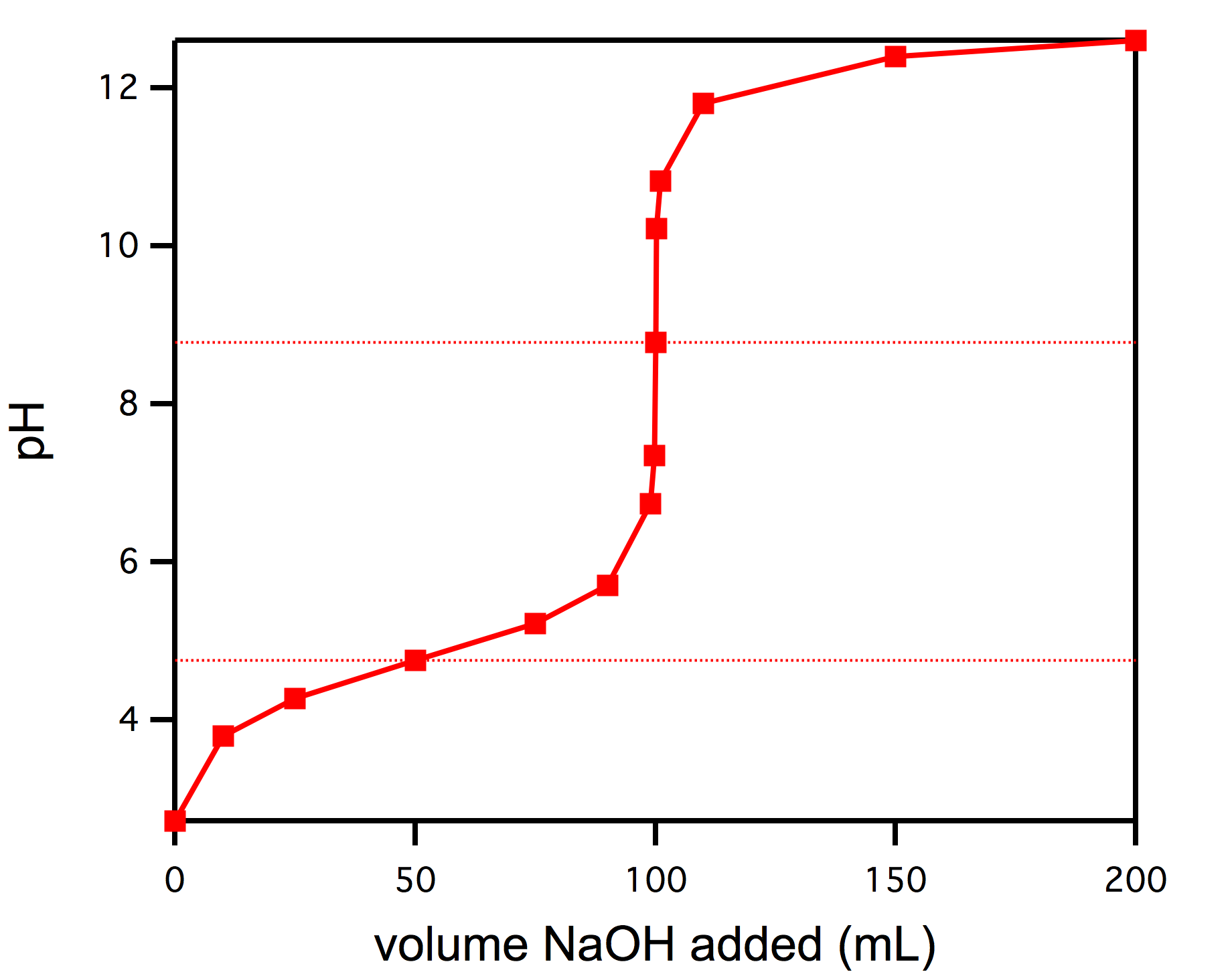
What is the pH at the equivalence point?
The pH is approximately 5
The pH is approximately 6
The pH is approximately 8
The pH is approximately 9
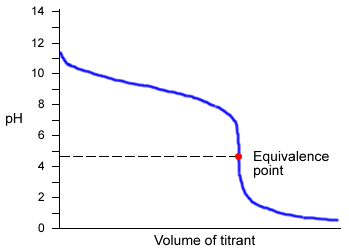
Which type of titration is shown by this titration curve?
Titration of a strong acid by a strong base
Titration of a weak acid by a strong base
Titration of a strong base by a strong acid
Titration of a weak base by a strong acid

Which acid base pair produce the titration curve shown below?
HCI + KOH
HCI + NH3
CH3COOH + KOH
CH3COOH + NH3
Which of the following salts is the most soluble?
AgCl, Ksp = 1.8x10⁻¹⁰
AgBr, Ksp = 5.3x10⁻¹³
AgI, Ksp = 8.3x10⁻¹⁷
CuBr, Ksp = 5.3x10⁻⁹
Titrations based on reactions between reducing and oxidising agents are called_______
back titrations
redox titrations
complexometric titrations
acid-base titrations
rough titrations
Tick all correct statements about EDTA.
EDTA is an important complexometric reagent
EDTA can be used to determine the concentration of metal ions in a solution
EDTA is a monodentate ligand
EDTA is a hexadentate ligand
Titrations based on reactions in which complexes are formed are called_______
back titrations
redox titrations
complexometric titrations
acid-base titrations
rough titrations
__________ is a suitable indicator for the titration of a weak acid and a strong alkali.
Methyl orange
Phenolphthalein
Litmus solution
Universal indicator
__________ is a suitable indicator for the titration of a strong acid and a weak alkali.
Methyl orange
Phenolphthalein
Litmus solution
Universal indicator
Which of the following is not an oxidising agent?
potassium permanganate
Oxalic acid
potassium dichromate
potassium iodate
Name the acid used in permanganometric titration.
dil sulphuric acid
dil hydrochloric acid
dil. nitric acid
What is the stoichiometric ratio in titration of K2Cr2O7 vs Fe2+
1/6
6/1
1/5
5/1
Select the external indicator used in dichrometry.
N-phenyl anthranilic acid
Sodium diphenylamine sulphonate
Potassium ferrocyanide
Potassium ferricyanide
The direct titration of a reducing agent with a standard solution of iodine is called iodimetry.
True
False
Select the redox indicators and its colour change .
Mureoxide ,red to colurless
Diphenyl amine ,blue to colourless
Diphenyl amine,violet to colourless
2. If acidic solution are used in Mohr method?
Chromates ion are decreased.
Chromates ion are increased.
A and B
None of the above
5. In Volhard Method ,the solution filled in the burette.
Silver Nitrate
Potassium chromate
Potassium thiocyanate
Ferric ammonium sulphate
7. Which type of solution is used in Mohr method ?
Strong acid
Strong base
Neutral
A and B
9. End point colour in Mohr method is?
Red colour
Green colour
Yellow colour
Black colour
10. Indicator used in Mohr method?
Fluorescein
Fe3+
Eosin
Potassium Chromate
Volumetric analysis is a quantitative analysis
TRUE
FALSE
The following are types of titrations:
Comlpexometric
Acid base
Precipitation
Gravimetric
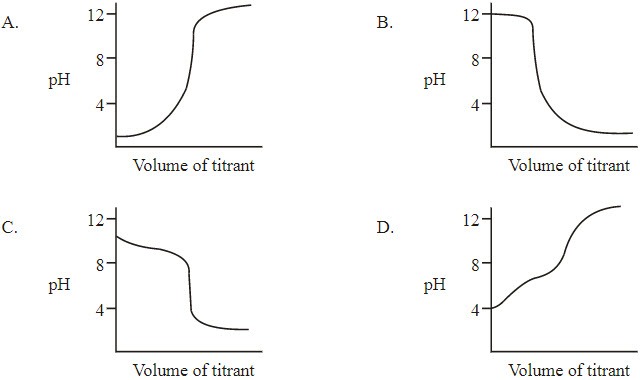
Condition for the molecule to be vibrational active
permanent dipole moment
change in dipolemoment
change in polarisibility of the molecule
All
Homonuclear diatomic molecules with no permanent dipole moment show
Vibrational spectroscopy
Rotational spectroscopy
Electronic spectroscopy
NMR
A straight line representing a transition between electronic states will be
Inclined with x axis
Inclined with Y axis
Horizontal
Vertical
Molecules which are having _______ are microwave active.
Dipole moment
High pressure Detector
Principle axis
Acidity
A photon of wave number 100 cm-1 has a wavelength of
1 m
1 mm
1000 nm
100 m
The energy in joules of a photon of wavelength 355 nm is
5.596 x 10¹⁹ J
5.596 x 1028 J
Full form of NMR is
Nuclear Magnetic Reaction
Nuclear Magnetic Resonance
Nuclear Mass Reaction
Nuclear Mass Resonance
Which among the following impart colour to the organic compound?
Auxochrome
Chromophore
Chromone
Auxochromone
Which of the following has shortest wavelength?
γ-rays
radio waves
visible spectrum
micro waves
Infrared rays have a shorter wavelength than
Ultraviolet ray.
X-rays.
radio waves.
gamma rays
Which of the following molecule shows rotational spectra?
CO
CO2
H2
N2


When electrons of an element comeback from an "excited" state, ___ lines are produced.
dark
emission (bright)
continuous
invisible

Which of the following molecule shows rotational spectra?
CO
CO2
H2
N2
Select the statement regarding IR Spectroscopy which is wrong.
Infrared radiation is higher in energy than UV radiation.
Infrared spectra record the transmission of IR radiation.
Molecular radiations are due to periodic motions of atoms in molecules and include bond stretching, torsional changes and bond angle changes.
Infrared spectra give information about bonding features and functional groups in molecules.
How does IR spectroscopy identify different molecules?
By measuring the vibrational movement and absorption of each bond.
By measuring the weigh of each atom.
By watching how molecules react to different compounds.
By breaking apart the molecule into individual atoms.
Raman effect is scattering of
Atoms
Molecules
Protons
Photons
Which of the following lines are most intense?
Stokes lines
Rayleigh-scattered lines
Anti-strokes lines
All have the same intensity
Which of the following molecule has no rotational spectrum?
NH3
HCl
N2
H2O.
Can two different elements have the same emission spectrum?
Yes
No
Only if they are in the same group in the periodic table
What molecular vibrations are inactive in IR spectra?
Antisymmetric stretching vibrations
Bending vibrations
Symmetric vibrations
The anti-Stokes scattering component has a wavelength which is ... the wavelength of the incident light
smaller than
larger than
the same as
Raman scattering ...
is elastic
occurs with a change in the wavelength of light
occurs without changing the wavelength of light
Which term does not apply to atomic spectroscopy?
Atomic absorption
Atomic emission
Atomic fluorescence
Atomic force
light that continues after the light source has been removed
bioluminescence
phosphorescence
incandescence
chemiluminescence
fluorescence
light created when a material absorbs higher frequency EM light and emits visible light
incandescence
chemiluminescence
fluorescence
bioluminescence
phospherescence
T1 to S0 transition is referred to as (T Stands for triplet state)
Phosphorescence
Fluorescence
Vibration cascade
Which of the following is a non-radiative transition
to a lower vibrational level within the same electronic state
Internal conversion
fluorescence
inter system crossing
vibrational relaxation
This process promotes the molecule from the S0 to one of the vibration levels of the singlet excited states (S1, S2,..)
Absorption of photon
Emission of photon
Fluorescence
Vibrational relaxation
Which of the following is the way how to measure a color changes by proper instrument?
Thermometer
Colorimeter
Pipette

Which of the following is the correct equation for BeerLambert law?
ϵ=Acl
c=Alϵ
A=ϵcl
l=Acϵ
if concentration is expressed in g dm-3, then epsilon is known as
molar absorptivity
absorptivity
None of the above
The amount of light that passes through a sample is called:
Transmittance
Absorbance
Radiation
Quantum force
The function of the monochromator in a UV Visible spectrophotometer is to
detect the transmitted light
detect the absorbed light
produce light of a range of wavelengths
select the wavelength of light
molar extinction coefficient is
characteristic of solute
depends upon temperature
depends on nature of solvent
All are correct
option 1 and 3 are only correct
Stokes lines show negative Raman shift
T
F
The concentration of OH– in a saturated solution of Mg(OH)2 is 3.6 x 10⁻⁴ M. The Ksp of Mg(OH)2 is
1.3 x 10⁻⁷
4.7 x 10⁻¹¹
3.6 x 10⁻⁴
2.3 x 10⁻¹¹
Calculate the solubility of Ag2CrO4 [Ksp = 9.0 x 10⁻¹²] in a 1.0 x 10⁻² M AgNO3 solution.
1.3 x 10⁻⁴ mol/L
2.3 x 10⁻⁸ mol/L
9.0 x 10⁻⁸ mol/L
9.0 x 10⁻¹⁰ mol/L

