
 Worksheets
Chemistry Final Practice (fall 2024)
Total questions: 107
Worksheet time: 2hrs 36mins
A pure substance made of only one type of atom (e.g., O₂)
Heterogeneous Compound
Homogeneous Mixture
Two or more atoms chemically bonded (e.g., H₂O).
Mixture
Element
Compound
Homogeneous Mixture
Uniform composition (e.g., saltwater)
Heterogeneous Mixture
Element
Homogeneous Mixture
Compond
Non-uniform composition (e.g., sand and water)
Heterogeneous Mixture
Element
Homogeneous Mixture
Compond

Definite shape and volume, particles vibrate but don’t move.
Solid
Liquid
Gas
Definite volume, but indefinite shape, particles can move past each other.
Solid
Liquid
Gas
Indefinite shape and volume, particles move freely
Solid
Liquid
Gas
Change in appearance (e.g., freezing, dissolving).
Chemical Change
Physical Change
New substance is formed (e.g., combustion, rusting).
Chemical Change
Physical Change
Which is an example of separating a mixture?
chromatography
Independent of amount (e.g., density, boiling point) is known as the ----- property.
(a)
The Dependent on the amount (e.g., mass, volume) is known as a ----- property.
(a)
Which image shows Distillation?
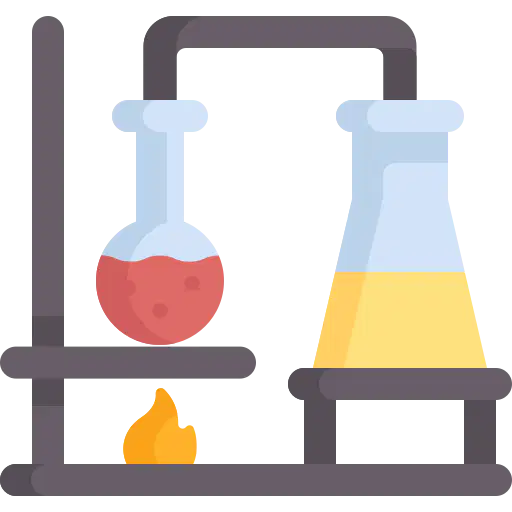

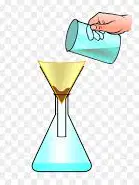
.
Define Filtration:
What is Chromatography?
The separation of mixtures based on their movement through a medium
What is the order of units? (smallest to largest)
What is the name of the conversion of different units in our curriculum?
Dimensional Analysis
How many kilograms of calcium are there in 173 pounds of calcium? (1 pound = 454 grams; 1 kg = 1000 g)
1.10 kg
78.5 kg
110 kg
78500 kg
What are the rules for significant figures?
Non-zero digits are always significant.
Zeros between non-zero digits are significant.
Leading zeros are not significant.
Trailing zeros are significant in decimals.
All of the above
What is the equation for Percent Error?
Percent Error = |(Experimental Value - True Value)| /
|True Value| * 100
Percent Error = (Experiment Value + True Value) /
(True Value) * 100
Percent Error = |(True Value - Experimental Value)| /
|Experimental Value| * 100
Percent Error = (Experimental Value - True Value) / (Experimental Value) * 100
Density
How close a measurement is to the true value
(a)
How consistent repeated measurements are
(a)
What are the forms of energy?


Heat needed to change the temperature
Q = mHv
q = mHf
Heat for fusion (melting)
Q = mHv
q = mHf
Heat for vaporization (boiling)
Q = mHv
q = mHf

According to the reference table, what is the boiling point of ethanoic acid at 80 kPa?
28 oC
100oC
111oC
125oC

At which temperature is the vapor pressure of ethanol equal to the vapor pressure of propanone at 35oC?
35oC
60oC
82oC
95oC
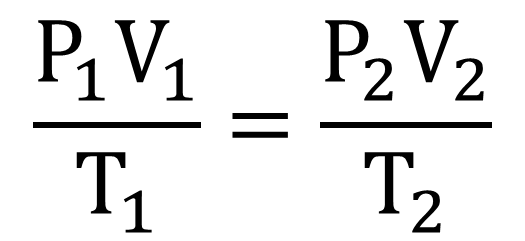
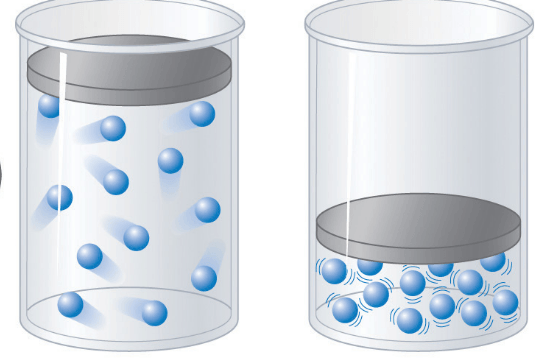
Charle's Law states that the ______________of a gas is directly proportional to its ______________.
pressure and temperature
volume and pressure
volume and temperature
temperature, volume, and pressure
What is the formula for Charle's Law?
P1V1/ P2V2
P1V2 = P2 V1
P1/V1=P2/V2
P1V1=P2V2
Which one of these is NOT an Ideal Gas Assumption?
Gas particles are hard, round spheres.
Gas particles are strongly attracted to one another.
Gas particles do not take up space.
Gas particles collide perfectly elastically.
A hypothetical gas that perfectly fits all the assumptions of the kinetic molecular theory is known as
real gas
ideal gas
imaginary gas
perfect gas

Why does ice float on liquid water?
Ice does not float on liquid water.
It has a higher density than liquid water.
It floats because it has lower density than liquid water.
adhesion and cohesion
Collisions in which particles transfer all their kinetic energy to other particles are called ___.
elastic
inelastic

Fill in the blank: Postulate #2 of the KMT states that the particles of a gas are in constant rapid ________.
degeneration
deceleration
acceleration
motion

Fill in the blank: Postulate #1 of the KMT states that gases consist of large numbers of tiny particles that are _________ in comparison to their size.
far apart
close together
heavy
light

Which gas is least likely to obey the ideal gas laws at very high pressures and very low temperatures?
He
Ne
Kr
Xe
Which of the following is NOT a factor in the ideal gas law?
pressure
temperature in Kelvins
amount of a substance in moles
type of container
What does the variable "n" represent in the ideal gas law?
pressure
volume
moles
temperature
Choose the correct set of variables to solve the following problem: What is the volume of a balloon if it contains 3.2 moles of helium at a temperature of 20⁰C and 1.2 atm?
P = x (unknown), V = 3.2 mol, n = 1.2 atm, T = 20⁰C K
P = 1.2 atm, V = 3.2 mol, n = 20⁰C, T = x (unknown)
P = 293 K, V = 3.2 mol, n = x (unknown), T = 1.2 atm
P = 1.2 atm, V = x (unknown), n = 3.2 mol, T = 293 K
What is the difference between Real and Ideal Gases?
Draw an atom.
Include the 3 types of particles.

Chadwick found the nucleus through the gold foil experiment.
True
False
Aristotle and other early Greek philosophers thought that matter was composed of four elements: air, earth, fire, and water.
True
False

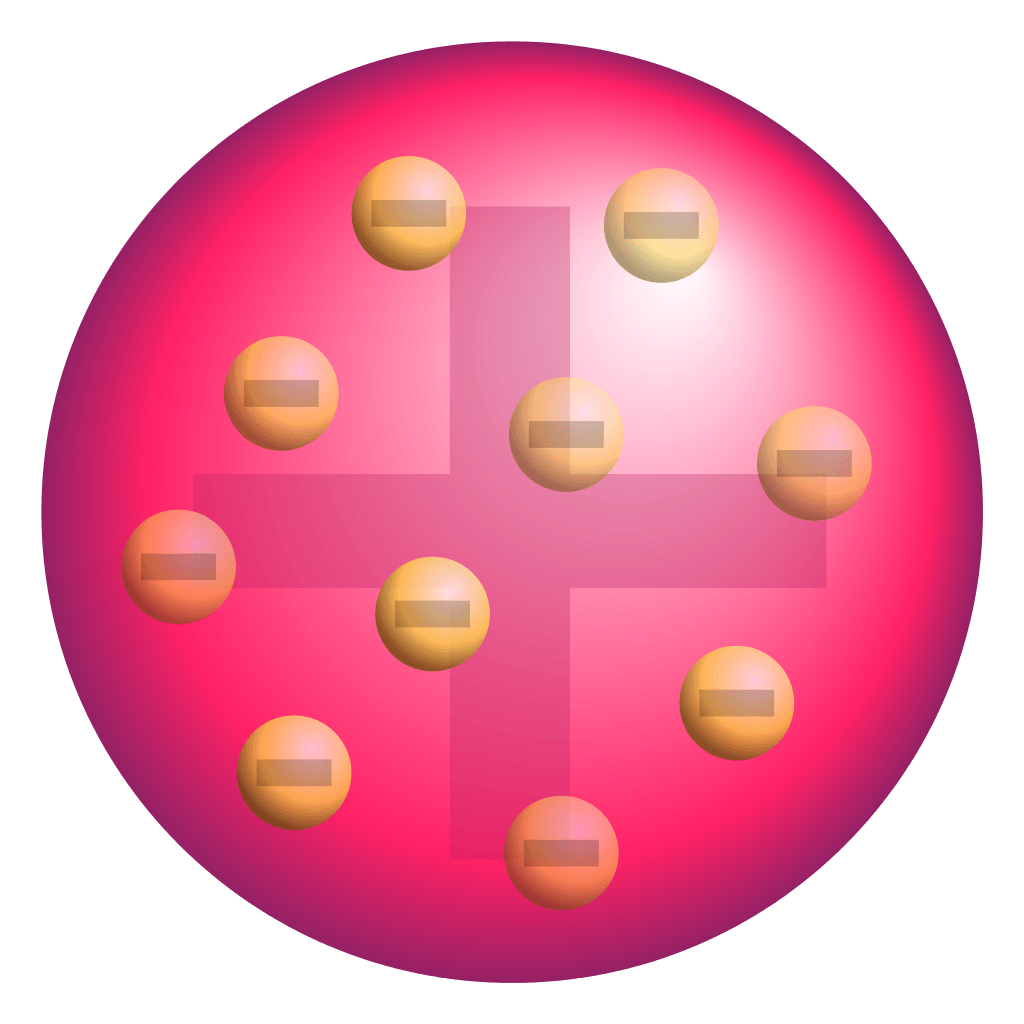
Which scientist developed the model of the atom shown?
Chadwick
Thomson
Rutherford
Bohr

Which scientist developed the model of the atom shown?
Chadwick
Thomson
Rutherford
Bohr
What were the main flaws in Dalton’s atomic theory? (choose all that apply)
All elements are composed of tiny indivisible particles called atoms that cannot be broken down further.
Atoms of different elements differ in their physical and chemical properties.
All atoms of a given element are identical.
In chemical reactions, atoms are combined, separated or rearranged, but not created nor destroyed.
Atoms of different elements combine in simple, whole number ratios to form compounds.

How many protons does krypton have?
84
36
48
8

How many electrons are in Nitrogen? Use the picture to the left.
(a)
Who proposed that electrons move around the nucleus in circular orbits?
Dalton
Thomson
Rutherford
Bohr
Which of the following has the atomic models in the correct Chronological order?
Solid sphere, Plum pudding, Nuclear, Planetary, Quantum Mechanic/Electron Cloud
Solid sphere, Plum pudding, Nuclear, Quantum Mechanic/Electron Cloud, Planetary,
Plum pudding, Nuclear, Planetary, Quantum Mechanic/Electron Cloud,Solid sphere
Nuclear, Planetary, Solid sphere, Quantum Mechanic/Electron Cloud,Plum pudding,
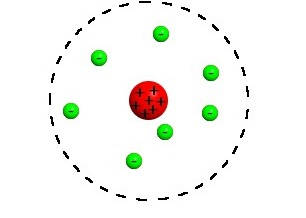
The "Nuclear Model" by Rutherford
The "Plum Pudding Model" of the atom by Thomson
The "Quantum Mechanical Modell" of the atom by Heisenberg

This model added on to previous models by showing electrons existed at certain "energy levels". It is often called the Planetary Model.
In an atom, there are three types of subatomic particles. ______ are positively charged, ______ are negatively charged, and ______ are neutral.
Protons, Electrons, Neutrons
Electrons, Protons, Neutrons
Neutrons, Protons, Electrons
Electrons, Neutrons, Protons
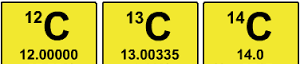
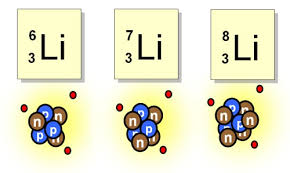
_______ is the average mass of all the isotopes of an element.
Atomic Mass
Atomic Number
Chemical Symbol
Element Name
Rubidium has two common isotopes, 85Rb and 87Rb. If the abundance of 85Rb is 72.2% and the abundance of 87Rb is 27.8%, what is the average atomic mass of rubidium?
85.468 amu
37 amu
85.6 amu
86.4 amu
There are two primary isotopes found in any sample of copper: copper-63 and copper-65. The isotope 65Cu composes 69.2% of the sample and 63Cu comprises the other 30.8%. Based on this data, what is the atomic mass of copper?
29 amu
63.546 amu
64.4 amu
63.6 amu

What is the chemical symbol for iron?
I
Ir
Fe
R
What is iron's atomic number?
12
26
55.85
55
What family is copper in?
alkali metals
alkaline earth metals
noble gases
transition metals
What is silver's chemical symbol?
S
Ag
Si
I
Group 1: These metals are extremely reactive. They all have one valence electron. They are shiny and silver in color. They are soft and can be cut with a knife.
Transition Metals
Alkali Metals
Alkaline Metals
Lanthanides
Group 2: Slightly less reactive because they have 2 valence electrons. They are silver colored and more dense that Group 1 metals.
Transition Metals
Alkali Metals
Alkaline-earth Metals
Actinides
Groups 3-12: These metals have a moderate range of reactivity and a wide range of properties. They are shiny and good conductors of heat and electricity. They have higher densities and melting points than Groups 1 and 2. These have 1 or 2 valence electrons.
Transition Metals
Alkali Metals
Alkaline-earth Metals
Lanthanides
Elements with atomic numbers 57-70 and 89-102: These metals were taken out and placed at the bottom of the table so the table wouldn't be so wide. Some are shiny and reactive. Others are radioactive and unstable. Elements 95-103 do not exist in nature but have been manufactured in the lab.
Alkali Metals
Alkaline-earth Metals
Lanthanides and Actinides
Boron Group
Group 17: All nonmetals. Very reactive. Poor conductors of heat and electricity. Tend to form salts with metals. Example NaCl: sodium chloride which is known as table salt. These elemtns have 7 valence electrons (Group # minus 10).
Boron Group
Oxygen Group
Nitrogen Group
Halogens
Group 18: Unreactive nonmetals. All are colorless, odorless gases at room temperature. These elements have a full outer energy level, usually 8 valence electrons, except for Helium which only has 2 valence electrons.
Nitrogen Group
Oxygen Group
Noble Gases
Halogens
The elements on the right side of the Periodic Table are classified as ________________.
Metals
Nonmetals

Which of the following halogens has the greatest electronegativity?
Chlorine (Cl)
Bromine (Br)
Iodine (I)
Astatine (At)
What is a vertical (up and down) column in the periodic table?
group or family
period
periodic law
octet rule


This could be the dot diagram of
Mg
Cl
C
O
What is the goal of the Lewis Dot Structure?
To determine the electron position.
To show the element's valence electrons & bonding capabilities.
To find the atomic mass of an element.
To search for the number of electrons in an individual atom.
How many valence electrons should Lithium have in its Lewis dot model?
1
2
3
4
Which of these is correct?


How would you draw a Lewis dot diagram for Magnesium?


Which of the following shows a correct Lewis dot structure?


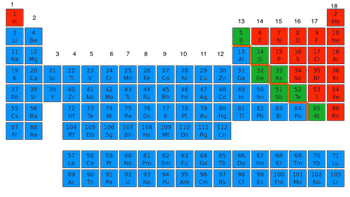
Where are metals located on the periodic table?
right side of the staircase
on the staircase
left side of the staircase
Which of these is incorrect?


Which of these is the correct Lewis Dot diagram for the element Neon (Ne)?


Which of the following is the a correct Lewis dot diagram for nitrogen (N)?


Draw the Lewis Dot Diagram for Nickel (Ni).

