Wayground logo

Free Printable Worksheets

Font size

S
M
L
XL
Worksheets

Natural selection

Total questions: 43

Worksheet time: 25mins

Name
Class
Date
1.

Darwin observed many finch species on the Galapagos Islands. To explain these observations, he

proposed that each species evolved from the same common ancestor, which was a finch species

that migrated to the islands from the mainland. What additional evidence did Darwin use to support

his explanation?

a)

The finch populations were very numerous, and different species often bred with one another.

b)

The finch species lived in different habitats on different islands, which isolated them from one another.

c)

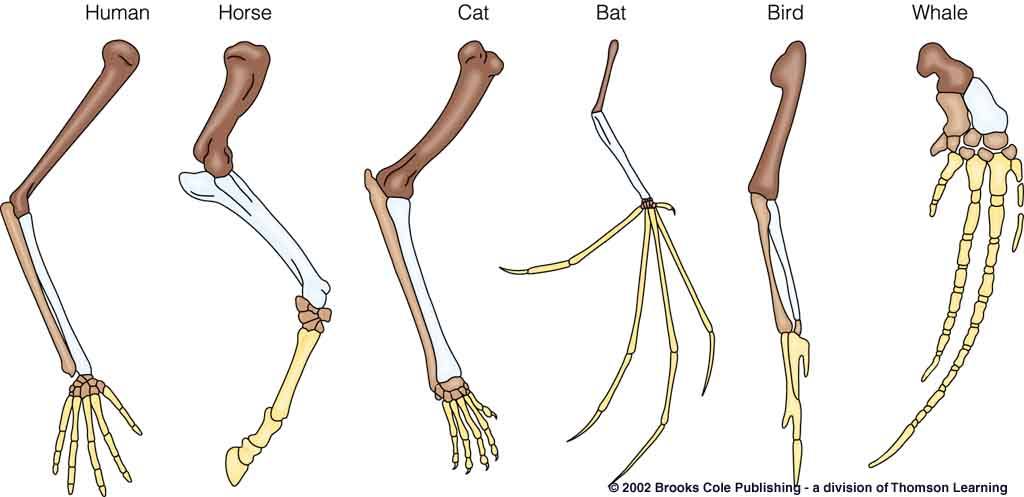
The finch species were distributed evenly among all of the islands, but did not interbreed.

d)

The beaks of the finches were identical, allowing them to eat the same foods on any of the islands.

2.

Which of the following best illustrates natural selection?

a)

An organism with favorable genetic variations will tend to survive and breed successfully.

b)

A population monopolizes all of the resources in its habitat, forcing other species to migrate.

c)

A community whose members work together utilizing all existing resources and migratory routes.

d)

The largest organisms in a species receive the only breeding opportunities.

3.

A species could go extinct if:

a)

food becomes more plentiful.

b)

members of the species have adaptations to enhance survival.

c)

the environment changes drastically and no one can adapt.

d)

there is less competition for resources.

4.

Natural selection occurs during the lifetime of a single organism.

a)

True

b)

False

5.

What is most likely to happen to moth populations in the picture shown?

a)

Light moths--hunted easily, dark moths--population increase

b)

Dark moths--hunted easily, dark moths--population increase

c)

Light moths--hunted easily, light moths--population increase

d)

Lights moths will change their color to match dark moths.

6.

What word describes a trait that helps an organism survive in its environment?

a)

natural selection

b)

mutation

c)

camouflage

d)

adaptation

7.
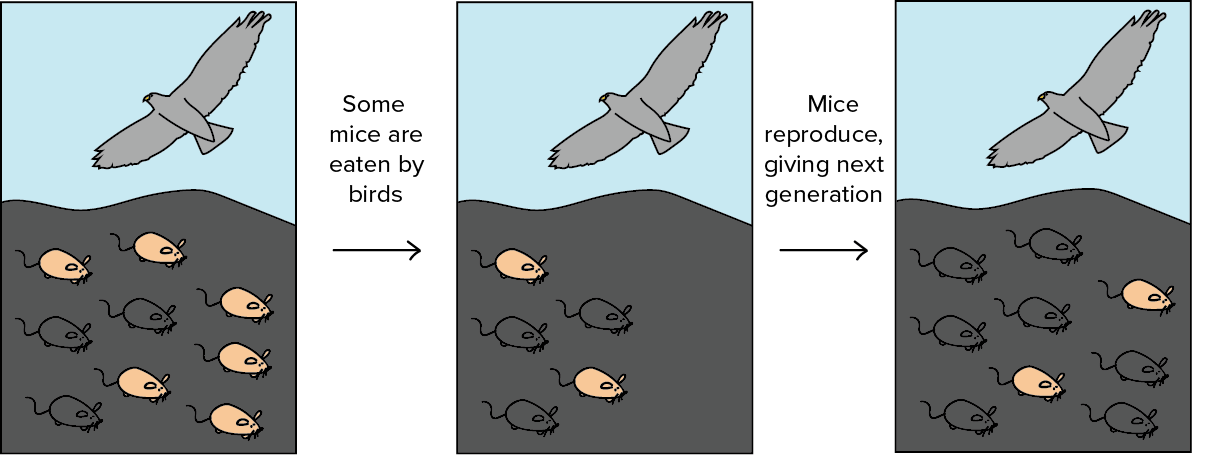
Why is the mouse population changing over time?
a)
The light mice can reproduce more successfully than the dark mice
b)
The hawks eat more dark mice than light mice because the dark mice taste better
c)
The hawks eat more light mice than dark mice because they can see the light mice more easily
d)
The hawks eat more dark mice than light mice because they can see the dark mice more easily
8.
Do organisms "decide" to evolve and change?
a)
Yes, they know they need to change to survive 
b)
No, they change because of natural selection
9.

What is a trait?

a)

a color

b)

the quality or characteristic of an organism

c)

the DNA of an organism

d)

when mutatuons cause extra limbs.

10.
Why are advantageous traits more likely to be passed onto offspring?
a)
Because they are more likely to survive and reproduce.
b)
Because they come from dominant alleles.
c)
Because they come from recessive alleles.
d)
Because the trait is an acquired phenotype.
11.
Mutations are a change in what?
a)
DNA
b)
tRNA
c)
genotype
d)
phenotype
12.
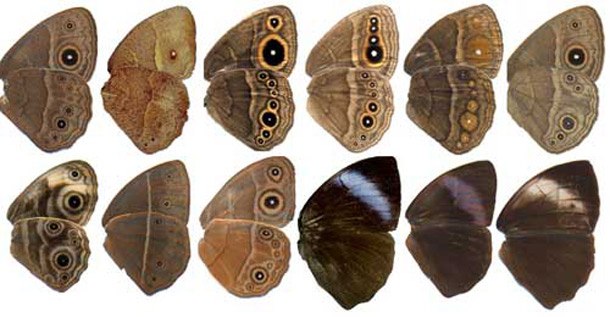
These moths are all the same species. The differences between their wings is an example of ________________
a)
Natural Selection
b)
Variation
c)
Homeostasis
d)
Extinction
13.
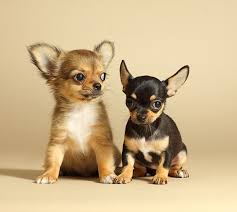
Dogs such as Chihuahuas are examples of....
a)
Artificial Selection 
b)
Natural Selection 
c)
Mutations 
14.
Which method determines a fossil's approximate age by examining which layer of earth is is found in?
a)
radioactive
b)
relative
c)
chemical
15.
Evolution typically happens...
a)
in a few weeks
b)
over millions of years
c)
never
d)
in 100 years
16.

What is survival of the fittest?

a)

Do you even lift brah?

b)

Only the strong survive

c)

Hunger Games

d)

The best adapted animal will live and reproduce

17.

TRUE or FALSE: Animals choose how they adapt to their environment.

a)

TRUE

b)

FALSE

18.

TRUE or FALSE: Mutations are random

a)

TRUE

b)

FALSE

19.
Survival of the Fittest and Evolution were proposed by what scientist?
a)
Charles Darwin
b)
Albert Einstein
c)
Steven Hawking
d)
Isaac Newton
20.
Almost all adaptations started off as?
a)
selective breeding
b)
physiological
c)
structural
d)
mutation
21.
In recent years "SuperBugs" (bacteria that aren't effected by antibiotics) are becoming more and more common. How could natural selection explain this?
a)
Superbugs survive antibiotics and reproduce
b)
Antibiotics cause bacteria to become superbugs
c)
We have always had the same amount of superbugs; modern media just discusses them more.
d)
There is no reliable data on the origin of super bugs.
22.

Natural selection is where ___________ decides which traits should be passed on

a)

Nature

b)

A human

c)

Charles Darwin

d)

The illuminati

23.

Why are some traits more common in some populations?

a)

It is random

b)

organims choose their traits

c)

common traits are usually adaptive and help organisms survive and reproduce

d)

organisms traits change all the time
24.
Structures that are inherited from a common ancestor are homologous.
a)
True
b)
False
25.
Humans, birds, whales, and lizards all have similar arm bones. What is the reason for this?
a)
The function of these bones is the same in all animals
b)
They live in similar environments
c)
They have a common ancestor
d)
All organisms resemble humans
26.
Bird wings and butterfly wings are an example of
a)
Homologous structure
b)
Analogous structure
c)
Mimicry
d)
Camoflague
27.
Shark fins and dolphin fins are examples of analogous structures.
a)
True
b)
False
28.
Analogous structures show common ancestry.
a)
True
b)
False
29.
A scientific theory is proven and based on evidence.
a)
True
b)
False
30.
Individuals within a population can evolve.
a)
True
b)
False
31.
An organism's ability to survive and reproduce in its environment refers to its
a)
Fitness
b)
Variation
c)
Selection
d)
Mutation
32.
Which of the following pieces of evolution evidence deals with aged and identified fossils?
a)
fossil record
b)
comparative embryology
c)
comparative biochemistry
d)
comparative anatomy
33.
Which of the following pieces of evolution evidence deals with comparing similar structures in various species?
a)
fossil record
b)
comparing embryology
c)
comparing biochemistry
d)
comparing anatomy
34.
Which of the following pieces of evolution evidence deals with structures common in embryos that form differently or for different purposes in adult form?
a)
fossil record
b)
comparing embryology
c)
comparing biochemistry
d)
comparing anatomy
35.
Which of the following pieces of evolution evidence contain both homologous and vestigial structures?
a)
fossil record
b)
comparing embryology
c)
comparing biochemistry
d)
comparing anatomy
36.
If an organism has a vestigial structure, that structure likely once had a function in a(n)
a)
close relative
b)
early ancestor
c)
unrelated organism
d)
embryological stage
37.
Some organisms that share a common ancestor have features that have different functions, but similar structures.  These are known as
a)
vestigial structures
b)
analogous structures
c)
homologous structures
d)
fossil structures
38.
Mutations are important because they bring about
a)
death of the organism in which they develop
b)
genetic variation needed for a population to evolve
c)
benefits for the individual, not for the population
d)
Hardey-Weinberg equilibrium within a population
39.
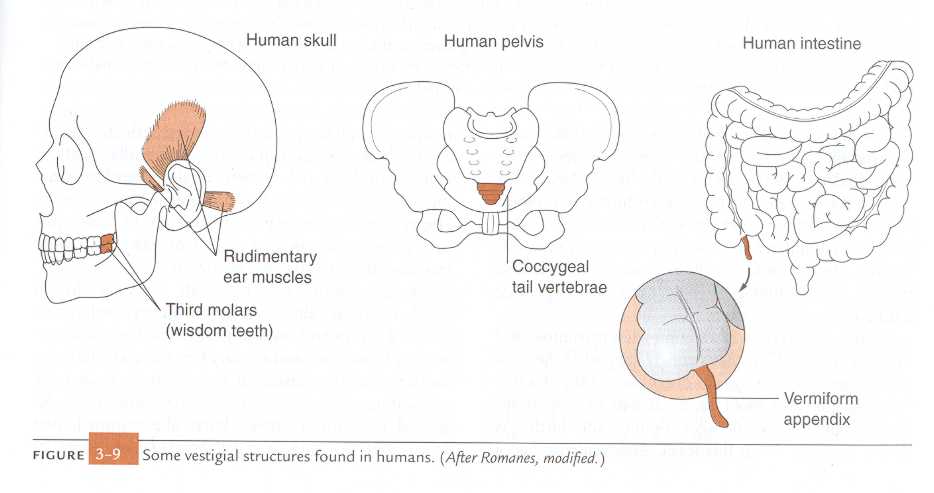
The structures shown are_________
a)
homologous
b)
heterologous
c)
analogous
d)
vestigial
40.

What scientist create a system to categorize all known animals?

a)

Carolous Linnaeus

b)

Jean-Baptiste Lemark

c)

Georges-Louis Leclerc de Buffon

d)

Erasmus Darwin

41.

Who propose that animals arose from common ancestors and thought that the earth was older than 6,000 years old

a)

Louis Pasteur

b)

Georges-Louis Leclerc de Buffon

c)

Jean-Baptiste Lemark

d)

Carolos Linnaeus

42.

Who proposed that complex beings came from simpler beings.

HINT: He could be called the grandfather of evolution

a)

Charles Lyell

b)

Jean-Baptiste Lamarck

c)

Erasmus Darwin

d)

Carolus Linnaeus

43.

This French naturalist believed that animals developed traits while they were alive through behaviors. For example a giraffe could make its neck longer by constantly stretching to reach the limbs of trees.

a)

Erasmus Darwin

b)

Carolus Linnaeus

c)

Georges-Louis Leclerc de Buffon

d)

Jean-Baptiste Lamarck