wayground logo

Free Printable Worksheets

Font size

S
M
L
XL
Worksheets

SPACE Review

Total questions: 102

Worksheet time: 2hrs 33mins

Name
Class
Date
1.
What color of star is the hottest?
a)
Blue
b)
Red
c)
Yellow
d)
Orange
2.
What color of star is the coolest?
a)
Red
b)
Yellow
c)
Blue
d)
White
3.
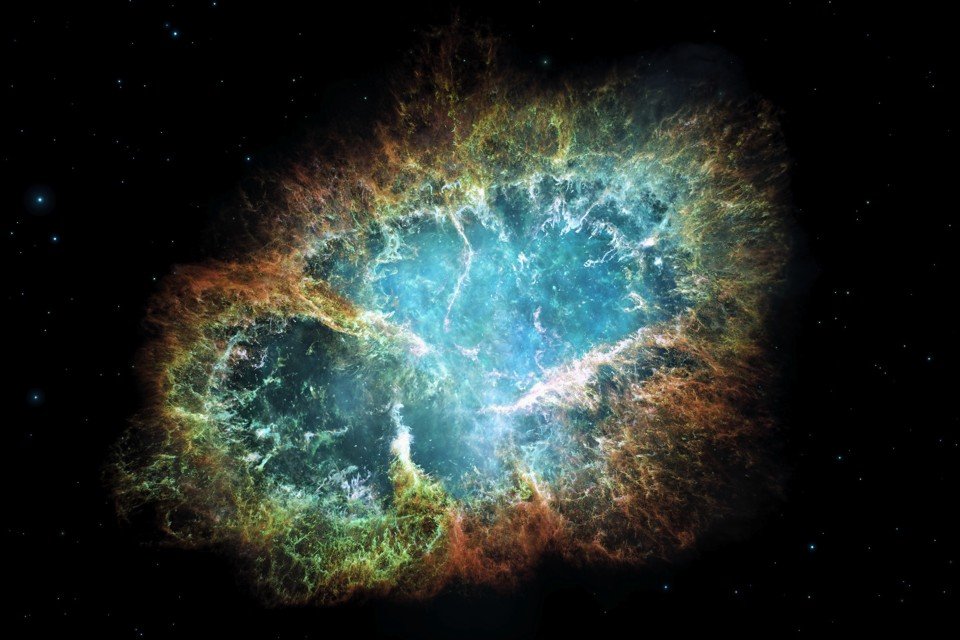
What is the name of the explosion at the death of a massive star?
a)
Supergiant
b)
Supernova
c)
Black Hole
d)
Nebula
4.
What word best describes our sun?
a)
Average
b)
Supergiant
c)
Dwarf
d)
Red Giant
5.
The H-R diagram is a graph that shows the relationship between ______________ for stars. 
a)
temperature and color
b)
temperature and brightness
c)
brightness and color
d)
distance and brightness
6.
______ is a force that causes dust particles to stick together in a nebula.
a)
nuclear fusion
b)
gravity
c)
hydrogen
d)
friction
7.
Most stars are made of which elements?
a)
Hydrogen only
b)
Hydrogen and Lithium
c)
Hydrogen and Sodium
d)
Hydrogen and Helium
8.
A ________ is an object so dense with so much gravity that even light cannot escape.
a)
neutron star
b)
white dwarf
c)
blackhole
d)
black dwarf
9.
What gases are in the unknown mixture?
a)
Gas B & Gas D
b)
Gas C & Gas B
c)
Gas A & Gas D
d)
Gas D & Gas C
10.
This unknown star contains 
a)
beryllium
b)
copper
c)
manganese
d)
strontium
11.
What is red shift?
a)
When a star collapses.
b)
Galaxies and stars are moving away from us. 
c)
A very luminous burst of radiation
d)
When the sun collapses.
12.

We primarily use emission/absorption spectra to identify ____________ of stars.

a)

composition

b)

temperature

c)

luminosity

d)

frankfurter

13.

By studying the spectra of stars, scientists were able to see redshifting, indicating the universe is ____________

a)

shrinking

b)

expanding

c)

not moving

d)

static

14.
What type of galaxy is this?
a)
Spiral
b)
Elliptical
c)
Irregular 
d)
Irrational
15.
What type of galaxy is this?
a)
Spiral
b)
Elliptical
c)
Irregular
d)
Irrational
16.
Distance measurement used by astronomers for distant objects.
a)
Kilometers
b)
Light Years
c)
Miles
d)
Light Seconds
17.
What is the name of our galaxy? 
a)
Our galaxy is called the Milky Way galaxy 
b)
Our galaxy is called the Andromeda galaxy 
c)
Our galaxy is called the Grand spiral  galaxy. 
d)
Our galaxy is called the Whirlpool galaxy.
18.
Earth is __________ astronomical units from the Sun…
a)
A. 0.5
b)
B. 0.8
c)
C. 1.0
d)
D. 1.5
19.
What are in galaxies?
a)
ice and rock
b)
dust, gas, and stars
c)
stars and ice
d)
water and dust
20.

Where are we located within our galaxy?

a)

On one of the spiral arms

b)

On the outer edge

c)

In between 2 of the spiral arms

d)

In the center bulge

21.

If a galaxy appears to be more red-shifted, that means that ...

a)

it contains more red stars

b)

it is moving away from Earth

c)

it has less dark matter

d)

it has just the right amount of gravity

22.

What makes up about 90% of all matter in a galaxy?

a)

Stars

b)

Gases

c)

Dust

d)

Dark Matter

23.

What shape is Earth's orbit?

a)

circle

b)

ellipse

c)

square

d)

spiral

24.

What is Kepler's 1st law?

a)

The planets orbit in an ellipse

b)

The plants move faster when they are closer to the sun and slower when they are further from the sun

c)

The farther a planet is from the sun the slower the orbit

(P2 = a3)

25.

What is Kepler's 2nd law?

a)

The planets orbit in an ellipse

b)

The plants move faster when they are closer to the sun and slower when they are further from the sun

c)

The farther a planet is from the sun the slower the orbit

(P2 = a3)

26.

What is Kepler's 3rd law?

a)

The planets orbit in an ellipse

b)

The plants move faster when they are closer to the sun and slower when they are further from the sun

c)

The farther a planet is from the sun the slower the orbit

(P2 = a3)

27.

The point in the earth's orbit where it is closest to the sun and moves the fastest.

a)

aphelion/apogee

b)

perihelion/perigee

28.

The point in the earth's orbit where it is farthest to the sun and moves the slowest.

a)

aphelion/apogee

b)

perihelion/perigee

29.
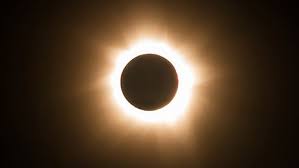
What type of eclipse is this?
a)
Solar Eclipse
b)
Lunar Eclipse
30.

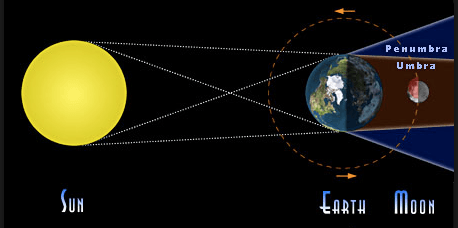
This image is showing us a.....

a)

solar eclipse

b)

lunar eclipse

c)

phases of the moon

d)

earth eclipse

31.

If you look up at the sky and see this, you are witnessing a....

a)

solar eclipse

b)

total eclipse

c)

lunar eclipse

d)

jupiter

32.
This is a diagram of the moon phases Which moon phase would a lunar eclipse occur in?
a)
New Moon
b)
1st quarter
c)
Full moon
d)
3rd quarter
33.
During a solar eclipse...
a)
The sun is blocked by the moon
b)
The Earth is blocked moon
c)
The moon is blocked by the sun
d)
You are blocked
34.
The image depicts a 
a)
solar eclipse
b)
lunar eclipse
35.
Which type of eclipse is shown in the diagram?
a)
Solar Eclipse
b)
Lunar Eclipse
c)
Total Eclipse
d)
Partial Eclipse
36.
Takes two small nuclei and combines them into a larger nucleus
a)
fission
b)
fusion
37.
The splitting of a nucleus into smaller nuclei is
a)
fusion
b)
fission
c)
half-life
d)
gamma radiation
38.

The Sun produces energy by fusing hydrogen atoms into ____ atoms.

a)

Carbon

b)

Helium

c)

Iron

d)

Uranium

39.

The process of fusion happens in a star's

a)

Corona

b)

Convection Zone

c)

Radiative Zone

d)

Core

40.

The process of fusion requires

a)

High heat and high pressure

b)

Cool temperatures and no gravity

c)

A snack

d)

High heat and low pressure

41.

In fusion lower mass elements are used to create. Check all that apply

a)

higher mass elements

b)

Lots of energy

c)

Cookies

d)

Low energy amounts

e)

Smaller elements

42.

What force creates the environment needed for nuclear fusion reactions to happen in stars?

a)

Star Wars Force

b)

Gravity

c)

Friction

d)

Normal Force

43.

Main Sequence stars can only fuse up to this element on the periodic table

a)

Gold

b)

Carbon

c)

Helium

d)

Iron

44.

Which of the following elements is/are represented in the spectrum below?

a)

Hydrogen only

b)

Helium Only

c)

Hydrogen & Helium

d)

Calcium Only

45.

Main sequence stars can only form what color elements on this periodic table

a)

purple

b)

orange

c)

green

d)

yellow

46.

The distance between the Earth and the Moon centres is 3.8 × 10⁸ m. The mass of the Earth is, me= 5.97 × 1024 kg

and the mass of the Moon is, mm = 7.36 × 10²² kg. What is the gravitational force between the Earth and the Moon?

(G = 6.67 × 10⁻¹¹ N m-2 kg-2)

a)

2.03 x 10²¹ N

b)

2.03 x 10²⁰ N

c)

4.03 x 10²⁰ N

d)

4.03 x 10²² N

47.

The mass of the Sun is 2.0 × 1030 kg and the mass of the Earth is, me = 5.97 × 1024kg. The distance from the Earth is 1.50 × 10¹¹km. What is the gravitational force between the Sun and the Earth?

(G = 6.67 × 10⁻¹¹ N m-2 kg-2)

a)

1.54 x 10²² N

b)

2.54 x 10²² N

c)

3.54 x 10²² N

d)

4.54 x 10²² N

48.

A rocket of 2.5 x 10⁴ kg moves from Earth to the moon. The mass of the Earth is me = 5.97 × 1024kg. Calculate the Earth’s gravitational force on the rocket when its distance from the Earth is 1.0 x 10⁹ m. (G = 6.67 × 10⁻¹¹ N m-2 kg-2)

a)

9.95 N

b)

8.95 N

c)

10.95 N

d)

9.81 N

49.

Newton’s Universal Law of Gravitation states that the gravitational force between two objects is directly proportional to the product of masses of the two objects and inversely proportional to

a)

distance between the two objects.

b)

square of the product of the body’s radii.

c)

square of the distance between the centres of the two objects.

d)

cube of the distance between the centres of the two objects.

50.

Planets orbit the Sun in a shape called a(n)

a)

circle

b)

ellipse

c)

focus

d)

perihelion

51.
An ellipse is drawn around two points called
a)
aphelion
b)
perihelion
c)
foci
d)
axis
52.
What has an eccentricity of zero
a)
a straight line
b)
a large ellipse
c)
a circle
d)
a small ellipse
53.

The value of eccentricity can range from ________ to ________.

a)

0.1 to 0.9

b)

-1 to 0

c)

0 to 100

d)

0 to 1

54.
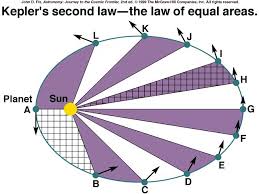
Where is the planet moving faster
a)
Position A to B
b)
Position B to C
c)
Position H to I
d)
Position I to J
55.
What is true about the area between points A, B and the Sun, and the area between points H, I and the Sun?
a)
The area between A, B and the Sun is the largest.
b)
The area between H, I and the Sun is the largest
c)
Both areas are equal in size
d)
There is not enough information to determine the areas
56.
Kepler's 2nd Law deals with 
a)
the shape of the planets' orbits
b)
the speed/area the planet travels 
c)
the length of time it takes the planet to orbit the sun
57.
A planet moves __________ when it is farthest from the sun.
a)
faster
b)
slower
58.

The diagram below shows a moon revolving around a planet in an elliptical orbit. At which position is the moon traveling fastest?

a)

location 1

b)

location 2

c)

location 3

d)

location 4

59.

The diagram below shows a moon revolving around a planet in an elliptical orbit. At which position is the moon traveling slowest?

a)

location 1

b)

location 2

c)

location 3

d)

location 4

60.

The diagram below shows a moon revolving around a planet in an elliptical orbit. At which position is the moon traveling slowest?

a)

location 1

b)

location 2

c)

location 3

d)

location 4

61.

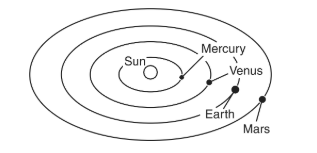
Which planet will take the least amount of time to revolve around the Sun?

a)

Mercury

b)

Venus

c)

Earth

d)

Mars

62.

Which planet will take the most amount of time to revolve around the Sun?

a)

Mercury

b)

Venus

c)

Earth

d)

Mars

63.

Which statement best describes Kepler’s 2nd Law of Planetary Motion?​

a)

Planets revolve around the sun over equal areas in equal time intervals.

b)

Planetary orbits are in the shape of an ellipse.

c)

A planet’s orbital period is proportionate to its distance from the sun.

64.
According to Kepler's 3rd law, the square of the time it takes for an object to orbit, T, is directly related to the cube of the distance, r, between the object and what it is orbiting.    
What this means is that if a satellite moves away from what it is orbiting,
a)
the larger the constant k is.
b)
the smaller the constant k is.
c)
the longer the orbital period is.
d)
the shorter the orbital period is.
65.

Kepler's 3rd law tell us that __ would be dependent on __.

a)

orbital period ; distance

b)

distance ; orbital period

66.

Which theory has CMB radiation as evidence?

a)

Steady State

b)

Big Bang

c)

Both

67.
What is this a picture of?
a)
The weak nuclear force
b)
The Earth
c)
CMB radiation
d)
The cosmic light horizon
68.

___________makes up 74% of the detectable universe.

a)

Hydrogen

b)

Helium

c)

Nitrogen

d)

Carbon

69.

This model is known as

a)

geocentric model

b)

heliocentric model

c)

planetary model

d)

Orion model

70.

Our solar system formed about _________ years ago.

a)

4.6 Billion

b)

6.4 billion

c)

100 billion

d)

200 billion

71.
Who is credited with discovering proof that we live in an expanding universe?
a)
Newton
b)
Hubble
c)
Einstein
d)
Gamow and Alphner
72.

In which direction are nearly all galaxies moving?

a)

toward each other

b)

away from each other

c)

colliding into one another

d)

in the direction of Earth

73.

Hubble's Law states that the farther away galaxies are from us, the _______________ it is that they moving away from us.

a)

more uncertain

b)

slower

c)

faster

d)

more unpredictable

74.
Hubble's law states which of the following?
a)
We live in an expanding universe
b)
The further away a galaxy is, the faster it is receding
c)
Galaxies far away look redder through a telescope
d)
All of these
75.

Select a possibility of what will happen to the universe in the future.

a)

The universe will be destroyed by aliens.

b)

The universe may expand forever, therefore galaxies will continue to get further away from each other.

c)

The universe will explode.

d)

We don't have any hypothesis.

76.

Light Years are a measure of __________.

a)

time

b)

speed

c)

distance

d)

light

77.

matter that does not give off electromagnetic radiation

a)

solar nebula

b)

big bang

c)

dark matter

d)

dark energy

78.

Most scientists believe the Big Bang Theory explains which of the following questions?

a)

How our planets and moons formed

b)

How our universe began

c)

How the sun turns hydrogen into helium

d)

How fast light travels through space

79.

a force that is causing the expansion of the universe to accelerate

a)

dark energy

b)

the big bang

c)

planetesimals

d)

solar nebula

80.

leftover thermal energy from the big bang

a)

solar nebula

b)

cosmic background radiation

c)

planetesimal

d)

dark matter

81.
Who made great advancements to our telescope which helped him be the first to see various things in outer space?
a)
Galileo Galilei
b)
Aristotle
c)
Johannes Kepler
d)
Tycho Brahe
82.

The initial explosion that resulted in the formation and expansion of the universe is called __________________.

a)

the Big Bang

b)

static state

c)

cosmic radiation

d)

dark matter

83.
The moon cycle (lunar cycle) takes approximately _______________ to complete.
a)
a year
b)
29.5 days/about one month
c)
1 day
d)
1 week
84.
The moon is half lit by the sun at all times.        
a)
True
b)
False
85.
The moon is not visible in the night sky during which phase? 
a)
Waning Crescent
b)
Full Moon
c)
Waxing Gibbous
d)
New Moon
86.
Lunar eclipses always occur during a 
a)
full moon
b)
new moon
c)
first quarter moon
d)
any moon phase
87.
Name this moon phase.
a)
New Moon
b)
Full Moon
c)
Waxing Gibbous
d)
Waxing Crescent
88.
During the phases of the Moon, the Moon appears to change shape.  This change in appearance is due to the Moon
a)
physically changing size and shape.
b)
moving closer and then farther away from Earth.
c)
reflecting a different amount of light due to the position with Earth and the Sun.
d)
having craters on its surface.
89.
What way does the Moon revolve around Earth?
a)
clockwise
b)
It doesn't revolve around Earth.
c)
Up and Down
d)
counterclockwise
90.
What phase comes BEFORE this one?
a)
Full Moon
b)
Third Quarter
c)
New Moon
d)
First Quarter
91.
What Moon phase is shown in the picture?
a)
Last Quarter
b)
New Moon
c)
Third Quarter
d)
First Quarter
92.
What Moon phase is shown in the picture?
a)
Waning Crescent
b)
Waxing Crescent
c)
Waxing Gibbous
d)
Waning Gibbous
93.
What Moon phase is shown in the picture?
a)
Waxing Crescent
b)
Waning Gibbous
c)
Waxing Gibbous
d)
Waning Crescent
94.
Waning means to...
a)
Shrink
b)
Grow
c)
Gain Light
d)
Less than 1/2 bright
95.
Waxing means to...
a)
Grow
b)
Get dimmer
c)
Lose light
d)
More than 1/2 bright
96.
Based on the image, A is called ____.
a)
New Moon
b)
Full moon
c)
Waning quarter
d)
Waxing quarter
97.
Why is the moon bright in the night sky?
a)
The moon is made of burning gases.
b)
The moon reflects light from the Earth.
c)
There is a source of light inside of the moon.
d)
The moon reflects light from the Sun.
98.
During which phase of the moon can we sometimes have a solar eclipse?
a)
new moon
b)
full moon
c)
1st quarter
d)
last quarter
99.
What moon phases would be located at X and Z?
a)
X=last quarter moon Z=new moon
b)
X=1st quarter moon Z=new moon
c)
X=last quarter moon Z=full moon
d)
X=first quarter moon Z=full moon 
100.
Which of these best shows that the Earth revolves around the sun as the moon revolves around the Earth?
a)
Picture A
b)
Picture B
c)
Picture C
d)
Picture D
101.
What is the name of the phase happening at number 7?
a)
New Moon
b)
Waning Gibbous
c)
First Quarter
d)
Last Quarter
102.
The moon is a natural  ______ of Earth.
a)
comet
b)
axis
c)
satellite
d)
space probe