
NEW
Font size
 Worksheets
AP Bio - Ch. 25/26
Total questions: 50
Worksheet time: 34mins
What discovery supports the hypothesis that RNA was the genetic material in the earliest organisms?
Ribozymes are RNA that can self-replicated
DNA does not require enzymes to replicate
RNA stores genetic
Chains of RNA forming lipids
Which of the following contributed most to the intense heat of the earth's early atmosphere?
Clouds of carbon dioxide, hydrogen, and other gases
Frequent collisions with asteroids and metorites
Lightening strikes and volcanic eruptions
Closer proximity to the sun

RNA theory hypothesis that
life on Earth began with a simple RNA molecule that could replicate itself without the help of any other molecule
life on Earth began with DNA molecule that could replicate itself without the help of any other molecule
life on Earth began with enzymes that could replicate themselves without any help
life on Earth began with electrolytes and macromolecules that traveled from space in meteorites

The gases that made up early earth's atmosphere were:
oxygen, nitrogen, carbon dioxide, methane
Oxygen, methane, carbon dioxide, carbon monoxide, sulfur
Methane, Carbon dioxide, nitrogen, suflur, water vapor
methane, carbon dioxide, nitrogen

First cells and organisms to have evolved must have been_______________ because of lack of _____________
anaerobic , oxygen
aerobic, oxygen
anaerobic, carbon dioxide
aerobic, oxygen
One of the accepted scientific theories describing the origin of life on Earth is known as chemical evolution. According to this theory, which of the following events would need to occur first for life to evolve?
onset of photosynthesis
origin of genetic material
Synthesis of organic molecules
formation of the plasma membrane
The Miller-Urey experiment of 1953 was designed to test the hypothesis that lightning supplied the energy needed to turn atmospheric gases into organic molecules such as amino acids. Which of the following describes why the Miller-Urey theory is widely accepted today?
Amino acids spontaneously form from molecules in the atmosphere today.
Organic molecules are present today in extremely high concentrations.
The process of synthesizing organic molecules from a mixture of gases has been successfully modeled in the laboratory.
No other alternative hypotheses have been introduced.

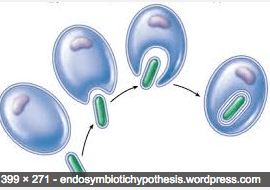
The diagram below shows a proposed theory of the origin of eukaryotic cells, called endosymbiosis.
Which of the following explains why cells that contained mitochondria-like organelles had an evolutionary advantage?
They were able to photosynthesize
They had more DNA
They were able to make more use of available energy
They were immune to bacterial invasion.


Why do many scientist believe that free oxygen was not present in early earth's atmosphere?
Free oxygen could not have been present because there were no plants to produce it
Free oxygen would have reacted with and destroyed organic molecules as they formed
Free oxygen was not needed for a living cell to assemble from nonliving materials
Free oxygen would have escaped from the early atmosphere into space due to high temperatures
In what way are protocells similar to living cells?
They have a semipermeable membrane and can grow and divide
They contain genetic material
They have a phospholipid bilayer
They contain true proteins similar to the ones found in living cells
According to the theory of endosymbiosis, how did cells acquire mitochondria?
A eukaryotic cell engulfed a virus
A large aerobic cell engulfed a chloroplast
A large anaerobic cell engulfed a small aerobic bacterium
A large anaerobic cell engulfed a photosynthetic bacterium
How are mitochondria and chloroplasts like bacteria cells?
They divide by meiosis
They can make their own food
They have the same membrane-bound organelles
They contain their own DNA

Based on the data given in the table, which two are most closely related?
Human & Gorilla
Gorilla & Orangutan
Human & Chimpanzee
Chimpanzee & Orangutan

Based on the given cladogram, which organism is the outgroup?
Human
Chimpanzee
Gorilla
Orangutan
Gibbon

Based on the figure, which organism is most closely related to the polar bear?
Black Bear
European Brown Bear
Western North American Brown Bear
Asian Brown Bear

Based on the figure, how long ago was the common ancestor of the European Brown Bear and the Asian Brown Bear?
4.5 hundreds of thousands of years ago
3.5 hundreds of thousands of years ago
2.2 hundreds of thousands of years ago
1.4 hundreds of thousands of years ago
Which evidence would be the most accurate when developing a cladogram?
Morphological
Molecular
Ecological
Fossil

Based on the figure, which organism is most closely related to A. forsteri?
E. ferus
D. Polylepis
G. gallus
E. africanus

Based on the figure, which organism would be considered the outgroup?
E. ferus
D. polylepis
G. gallus
E. africanus
A. forsteri

Based on the figure, which organism is most closely related to E. africanus?
E. ferus
D. polylepis
G. gallus
E. africanus

Based on the figure, which three organisms are closely related?
Cat, Horse, Human
Cat, Horse, Pig
Cow, Horse, Human
Cow, Horse, Pig

Based on the figure, which two organisms are closely related?
Cat & Human
Cat & Cow
Human & Pig
Human & Horse
In a comparison of birds and mammals, the condition of having four limbs is
a shared ancestral character
a shared derived character
a character useful for distinguishing birds from mammals
an example of analogy rather than homology
All life is classified into _______ domains based on common characteristics.
2
3
4
5
The 8 levels of classification, from most broad to most specific.
Domain, Genus, Family, Order, Class, Phylum, Kingdom, Species
Domain, Species, Kingdom, Genus, Phylum, Family, Class, Order
Domain, Kingdom, Phylum, Class, Order, Family, Genus, Species
Order, Kingdom, Species, Domain, Phylum, Family, Class, Genus
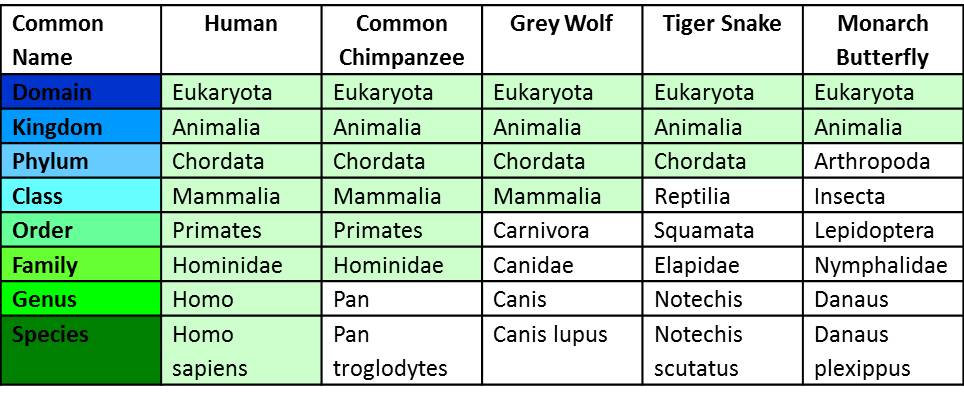

Modern Classification (Phylogeny) adds what to Linnaeus's taxonomic criteria?
evolutionary relationships & DNA (biochemical characters)
habitat type
fewer categories than Linnaeus
a naming system called binomial nomenclature
The endosymbiotic theory is a way of explaining
how eukaryotic cells evolved from prokaryotic cells
how prokaryotic cells came from eukaryotic cells
how mitochondria & chloroplasts are really the same thing
how prokaryotic cells got their nucleus


Based on the given cladogram, which organism is the outgroup?
human
chimpanzee
gorilla
orangutan
gibbon

Using the cladogram: a common ancestor of amphibians and ray-finned fish would have
a bony skeleton
four limbs
scaly skin
eggs with shells
The field of biology that classifies organisms is called...
Taxonomy
Phylogeny
Paleontology
Embryology
Which of the following is NOT a domain of life?
Prokarya
Eukarya
Eubacteria
Archaebacteria
Which level of biological classification is the MOST specific?
Phylum
Kingdom
Order
Species
In binomial nomenclatures, in which order are the names listed?
Genus, Species
Species, Genus
Phylum, Order
Order, Phylum
Which level of biological classification is the LEAST specific?
Domain
Kingdom
Genus
Family
Phylogeny is...
The study of classification of different species
The study of the evolutionary history of a species
The study of prehistoric life
The study of the distribution of different species
Which of the following statements about endosymbiotic theory is FALSE?
Two (2) prokaryotes coevolved the form the first eukaryote
One prokaryote absorbed another prokaryote
Explains the evolution of the mitochondria and chloroplast
Prokaryotes evolved from the first eukaryotes
Phylogenetic trees show...
Evolutionary relationships between different species
How one species has evolved through time
Which species has evolved the most
Which species have evolved from other species
According to maximum parsimony...
The simpler your phylogenetic tree, the better
Phylogenetic trees should have many branches
All organisms in a phylogenetic tree must descend from a common ancestor
Phylogenetic trees must show all traits

