
Font size
 Worksheets
Bio Ch 14 Test Review
Total questions: 51
Worksheet time: 27mins
Speciation, or the formation of new species, is
responsible for the diversity of life
an event that has occurred only a few times in the history of the planet
a form of microevolution
necessary for natural selection and adaptation
Which phenomenon would a biologist describe as microevolution?
the formation of new species
a change in the gene pool of a population from one generation to the next
the extinction of species
dramatic biological changes, such as the origin of flight, within a taxon
Under the biological species concept, a species is a group of organisms that
share a recent common ancestor.
live together in a location and carry out identical ecological roles.
are physically similar.
have the potential to interbreed in nature and produce fertile offspring.
The biological species concept is
applicable to all forms of life, past and present.
easy to apply to all present sexually reproducing organisms but harder to apply to asexual organisms and fossils.
sometimes difficult to put into practice even for present sexual organisms and useless for asexual organisms and fossils.
applicable to all present life-forms but not to fossil organisms whose reproductive behavior cannot be observed.
Under the biological species concept, the gap between species is maintained by reproductive isolation.
True
False
The phylogenetic species concept defines a species as a set of organisms that shares a common ancestor and forms one branch on the tree of life.
True
False
The morphological species concept relies upon comparing the DNA sequences of organisms.
True
False
The ecological species concept identifies species in terms of their ecological niches.
True
False
Two populations of organisms belong to the same biological species when they
encounter each other, mate, and produce viable, fertile offspring under natural conditions.
use different types of behaviors or physical features to attract mates.
cannot mate with each other because mating occurs at different times.
have anatomical features that make it difficult for organisms from the two populations to mate with one another.
A pair of species could interbreed but one species mates at dusk and the other at dawn. Which type of reproductive barrier separates these two species?
temporal isolation
behavioral isolation
mechanical isolation
habitat isolation
gametic isolation
A pair of insect species could interbreed but one lives on goldenrod plants and the other on autumn daisies in the same general area. Which type of reproductive barrier separates these two species?
temporal isolation
behavioral isolation
mechanical isolation
habitat isolation
gametic isolation
A pair of moth species can interbreed but the females' mating pheromones are not attractive to the males of the other species. Which type of reproductive barrier separates these two species?
temporal isolation
behavioral isolation
mechanical isolation
habitat isolation
gametic isolation
Two flowering plant species could interbreed but one has a deep flower tube and is pollinated by bumblebees whereas the other has a short, narrow flower tube and is pollinated by honeybees. Which type of reproductive barrier separates these two species?
temporal isolation
behavioral isolation
mechanical isolation
habitat isolation
gametic isolation
Which type of reproductive barrier separates two species of sea cucumbers whose sperm and eggs often bump into each other but do not cross-fertilize because of incompatible proteins on their surfaces?
temporal isolation
behavioral isolation
mechanical isolation
habitat isolation
gametic isolation
Two species that occasionally mate and produce zygotes, but that have incompatible genes that prevent the resulting embryo from developing, are affected by
reduced hybrid fertility.
behavioral isolation.
gametic isolation.
reduced hybrid viability.
hybrid breakdown.
Two species interbreed occasionally and produce vigorous, fertile hybrids. When the hybrids breed with each other or with either parent species, however, the offspring are feeble or sterile. These species are affected by
reduced hybrid fertility.
behavioral isolation.
gametic isolation.
reduced hybrid viability.
hybrid breakdown.
Frequently, a group of related species will each have a unique courtship ritual that must be performed correctly for both partners to be willing to mate. Such a ritual constitutes a ________ and ________ reproductive barrier.
mechanical; postzygotic
behavioral; prezygotic
temporal; prezygotic
gametic; postzygotic
The Monterey pine and the Bishop's pine inhabit some of the same areas of central California. The Monterey pine releases pollen in February, while the Bishop's pine does so in April. This is an example of ________ isolation.
postzygotic
prezygotic
temporal
gametic
habitat
The geographic isolation of a population from other members of the species and the subsequent evolution of reproductive barriers between it and the parent species describes ________ speciation.
allopatric
sympatric
biogeographic
punctuated
Uplift and formation of a mountain range divide a freshwater snail species into two isolated populations. Erosion eventually lowers the mountain range and brings the two populations together again, but when they mate, the resulting hybrids all produce sterile young. This scenario is an example of
allopatric speciation.
diversifying speciation.
sympatric speciation.
incomplete speciation.
Diane Dodd raised different fruit fly populations on different food sources. She found that after about 40 generations the evolution of reproductive isolation was under way. Diane Dodd's experiments using fruit flies demonstrated that
reproductive barriers usually are absolute: Either two populations are fully willing and able to interbreed, or they are strictly separated by a fully effective reproductive barrier.
the evolution of reproductive barriers occurs much too slowly to produce measurable effects in the laboratory.
new species can form in a single generation by the production of new reproductive structures.
formation of a reproductive barrier between two populations is more likely if they experience and adapt to different environmental conditions.
Speciation without geographic isolation is called ________ speciation.
allopatric
sympatric
diversifying
incomplete
Organisms that possess more than two complete sets of chromosomes are said to be (a) .
Most polyploid species arise from
a single tetraploid parent plant.
a single triploid parent plant.
the hybridization of two parent species.
a single diploid parent plant.
Sympatric speciation commonly occurs through ________ in plants but is more likely to occur through ________ in animals.
asexual reproduction; chromosome duplications
self-pollination; polyploidy and other genetic mechanisms
habitat differentiation and sexual selection; polyploidy
polyploidy; habitat differentiation and sexual selection
The Galápagos finch species differ in their feeding habitats.
True
False
The evolution of the Galápagos finches is an excellent example of adaptive radiation.
True
False
Most speciation events of the Galápagos finches occurred when some finches made it to another island, evolved in isolation, and accumulated enough changes to become a new species.
True
False
Each island in the Galápagos chain has one and only one isolated, unique species of Darwin's finch.
True
False
The emergence of many diverse species from a common ancestor is called (a) .
What would tend to promote adaptive radiation?
A single species goes extinct, but it has several competitors that quickly expand to assume its ecological roles.
An organism has a very stable set of features and capabilities over long spans of evolutionary time.
An organism colonizes an area that already has a high level of existing species diversity.
An organism colonizes an isolated area that is habitable but relatively devoid of life.
A group of ants escaped from a picnic basket carried to the top of a mountain and thrived in this area where there were no other ants. Many years later descendants of these ants crawled into a picnic basket on the mountain and traveled back to the valley from which their ancestors had come. Which of these observations would cause you to conclude that the ants on top of the mountain had become a different species from those in the valley?
The mountain ants and valley ants were different colors.
The mountain ants ate different food than the valley ants.
The mountain ants could not mate with the valley ants.
The mountain ants and valley ants were different sizes.
Two bird species overlap in a hybrid zone. They are isolated by a slight difference in the male songs and by the females' tendency to select males with the "correct" song. Hybrid offspring tend to have reduced fertility compared to either of the parent species. What effect might natural selection have in this situation?
Natural selection might favor males with more distinctive calls and/or females that are more "choosy." As a result, the reproductive barrier between the two species could be reinforced.
Natural selection might favor males with less distinctive calls and/or females that are less "choosy."
Natural selection could lead to the stronger of the two species taking over and eliminating the other species.
Natural selection could lead to the hybrid species taking over and eliminating the weaker parent species.
In a hybrid zone, ________ can occur if the reproductive barrier between two species is weak, as seen among cichlids in the murky waters of modern Lake Victoria.
fusion
stability
reinforcement
The ________ suggests that speciation occurs in brief spurts.
adaptive model of the origin of species
gradual model of the origin of species
punctuated equilibrium model
allopatric speciation model
The emergence of a new plant species over a brief period of time followed by a long period of little change is consistent with the theory known as (a) .
Which description best represents the gradual model of speciation?
Speciation occurs regularly as a result of the accumulation of many small changes.
An isolated population differentiates quickly from its parent stock as it adapts to its local environment.
Speciation occurs under unusual circumstances and therefore transitional fossils are hard to find.
Species undergo little change over long periods interrupted only by short periods of rapid change.
Speciation has become complete when
two populations of organisms have been separated for a very long time.
a change in allele frequency has occurred.
offspring of mating from members of two different populations are able to mate with members of either population.
organisms of one population do not recognize the mating call of another population and so mating does not occur.
Allopatric speciation is unlikely to occur when
several populations become isolated from one another as drying conditions cause a large body of water to become separate, smaller bodies of water.
there is no disruption in gene flow between two populations.
a geographic barrier forms between two populations.
separated populations adapt to different environmental conditions.
Speciation often occurs when a habitat becomes more heterogeneous. In Lake Victoria different species of cichlids are found in different areas of the lake. The best explanation for this speciation is that
natural selection favored different heritable variations in different parts of the lake.
humans selected for many different traits in cichlids in order to market them to the aquarium trade.
male cichlids that lived in deep water needed to be seen by females, so they became colorful.
food was scarce in the lake, so some fish had to learn how to scrape algae, some had to learn to eat insects, and some had to learn to bite leaves.
A new plant species may arise in a single generation by
errors in meiosis leading to polyploidy.
a sudden geological disruption causing separation of two populations.
changes in the pollinator species.
mutations in genes for flower color.
For speciation to occur there must be
sexual reproduction.
natural selection.
genetic variation
isolation.
In a population of plants with a diploid number of 12, a new individual appeared with a chromosome number of 24. If this organism could self-fertilize, forming offspring with the same number of chromosomes (24), scientists would consider this an example of
behavioral isolation.
reduced hybrid fertility.
formation of a hybrid zone.
sympatric speciation
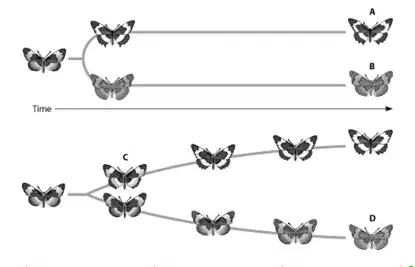
Which butterfly has changed gradually but significantly from its ancestor through microevolutionary events that were not part of a speciation event?
A
B
C
D
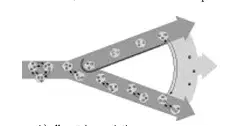
If the divergence illustrated here is based on some female insects preferring large males and others preferring small males, then this would be an example of
allopatric speciation.
hybrid inviability.
sexual selection.
temporal isolation.
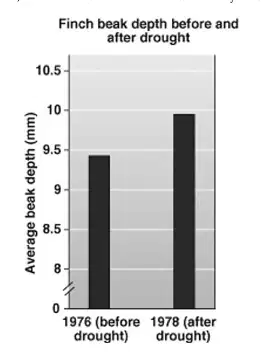
These data collected from the finches studied by the Grants show that
after the drought the average bird had a deeper beak.
all birds surviving after the drought had deeper beaks than those existing before the drought.
before the drought all birds had beaks between 9 and 9.5 mm deep and after the drought all birds had beaks between 9.5 and 10 mm deep.
most birds died as a result of the drought.
Which of these is the best hypothesis about what led to the change seen in the data?
Birds with deeper beaks were more likely to survive the drought.
Birds with deeper beaks were better able to defend their territories and therefore had more food sources than those with shallower beaks.
During the reproductive season, each bird with a deep beak laid more eggs than each bird with a shallower beak.
most birds died as a result of the drought.In conflicts over individual seeds, birds with deeper beaks were better competitors.
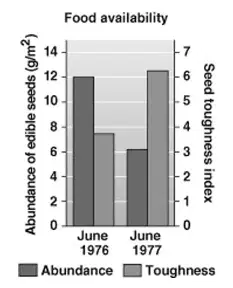
The data in this graph indicate
there were fewer total tough seeds in 1976 than in 1977.
seed abundance in 1977 was severely reduced by finch feeding.
plants that produced soft seeds in 1976 produced tougher seeds in 1977.
available seeds were generally tougher in 1977 than in 1976.
In the North Pacific Ocean, two groups of the same species of killer whales (Orcinus orca) appear to be forming two different species based on what they eat. One group eats fish and the other eats mammals such as seals. Scientists can tell what they eat based on their teeth, because whales that feed on fish have significantly different wear patterns.
Which procedure would be the least useful to perform in determining whether or not this speciation has occurred?
Compare body shape of whales from each population.
Compare DNA samples from fish eaters and mammal eaters.
Compare stomach contents of whales from each of the two populations.
Compare teeth of whales alive today to teeth of whales in ancient samples.
In the North Pacific Ocean, two groups of the same species of killer whales (Orcinus orca) appear to be forming two different species based on what they eat. One group eats fish and the other eats mammals such as seals. Scientists can tell what they eat based on their teeth, because whales that feed on fish have significantly different wear patterns.
Which type of speciation is occurring in these whales?
geographic speciation
sympatric speciation
punctuated speciation
allopatric speciation
In the North Pacific Ocean, two groups of the same species of killer whales (Orcinus orca) appear to be forming two different species based on what they eat. One group eats fish and the other eats mammals such as seals. Scientists can tell what they eat based on their teeth, because whales that feed on fish have significantly different wear patterns.
Another difference between the two groups is in how they hunt. Whales that hunt fish tend to travel in large pods (groups of whales) and vocalize often. Whales that hunt seals, however, tend to travel in very small groups and vocalize very little, likely because of the excellent hearing ability of seals. If these differences brought about speciation, the separation would be considered
mechanical isolation.
temporal isolation.
behavioral isolation.
habitat isolation.

