
 Worksheets
PERIOD 6 Plate Tectonics
Total questions: 67
Worksheet time: 1hrs 24mins

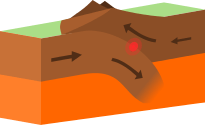
Which of the following is the name of the ancient supercontinent formed 280 Million Years ago.
Pangea
Gondwanda
Laurasia
Neverland

Rocky or rigid outer part of Earth consisting of the brittle crust and the top part of the upper mantle
Lithosphere
Oceanic Crust
Continental Crust
Asthenosphere
Mantle convection is the very slow creeping motion of Earth’s solid silicate mantle caused by convection currents carrying heat from the interior to the planet's surface.
Lithosphere
Earthquake
Convection Currents
Core
Solid, outer layer and is made of both the oceanic and continental crust.
Hydrosphere
Core
Mantle
Crust
The thick part of the earth's crust that forms the large landmasses. It is generally older and more complex than the oceanic crust.
Oceanic Crust
Continental Crust
Magma
Inner Core
Crustal plates that pull apart from one another MOST likely form
volcanic island arcs
strike-slip faults
oceanic trenches
rift zones
Which two plates collided with each other to form the Himalayan Mountains?
Nazca and Eurasia
Indo-Australian and Eurasian
North America and Antarctic
South American and Indo-Australian
Which of these tectonic plate boundaries is most likely to form a volcano.
a continental plate colliding with a continental plate
an oceanic plate sliding past a continental plate
a continental plate sliding past a continental plate
an oceanic plate colliding into a continental plate
What causes the tectonic plates to continually to move?
Convection currents
Volcanic and seismic activity
Strong winds and storms
Rotation of the solid core
Which statement best describes why fossils of the same land-dwelling species have been discovered in both South America and Africa?
The organism migrated to two continents
The organisms were separated by the formation of new mountain ranges
The organisms became extinct due to climate change on these continents
These organisms once lived on one large landmass that later split into two continents


Which portion of the Earth can S waves NOT travel through?
Crust
Mantle
Core

This model demonstrates a
P wave shadow zone
S wave shadow zone
Surface wave shadow zone
Convection currents

This model represents a
P wave shadow zone
S wave shadow zone
Surface wave shadow zone
Convection currents
Measures how much an energy an earthquake releases, which is shown by the amplitude of seismic waves
Magnitude
Epicenter
Focus
L-wave
What is a fracture in bedrock along which blocks of rock on opposite sides of the fracture move?
focus
epicenter
intensity
fault
What is a series of sea waves caused by underwater earthquakes called?
storm surge
rip current
tsunami
massive flooding
What is the zone of intense earthquake and volcanic activity called?
Circle of Fire
Oval of Fire
Ring of Fire
Earthquake Central
A zone of intense earthquake and volcanic activity encircles the _________ Ocean.
Arctic
Indian
Atlantic
Pacific

Which City is closest to the epicenter of an earthquake?
City A
City B
City C
How many cities do scientists read seismograms from to determine the epicenter of an earthquake?
1
2
3
4
Select all that apply for a p-wave
fastest wave
slowest wave
wave that comes after the primary wave
weakest wave
strongest wave

