
 Worksheets
PMA End of year review CSIII
Total questions: 100
Worksheet time: 58mins

The table shows the number of neutrons, protons, and electrons for two atoms. How are the two atoms alike?
They have the same charge.
They have the same mass number.
They have the same atomic number
They are atoms of the same element.

The diagram shows the arrangement of electrons in a neon atom. How many protons are present in this atom's nucleus?
10
8
2
There is not enough information to answer this question.

In the diagram, the arrows labeled III point to the atom's ______________.
Protons
Neutrons
Nucleus
Electrons
Elements with seven valence electrons —
are highly reactive
are highly stable
have a high mass
have a low mass
The atoms of a certain element each contain 11 protons and 1 valence electron. Which statement correctly identifies this element and describes its chemical reactivity?
The element is sodium, and it is highly reactive
The element is fluorine, and it is highly reactive
The element is sodium, and it is not very reactive
The element is fluorine, and it is not very reactive

Sulfur is a nonmetal. Of the following, the physical characteristic that is most
likely to describe a sample of sulfur is —
a shiny appearance
brittleness
malleability
ductility

How many of each atom are in the compound above?
1 magnesium atom, 2 iron atoms, and 4 oxygen atoms
3 magnesium atoms, 2 iron atoms, and 4 oxygen atoms
6 magnesium atoms, 6 iron atoms, and 12 oxygen atoms
3 magnesium atoms, 6 iron atoms, and 12 oxygen atoms
Which of the following is the best clue that a chemical reaction has taken place?
Change in color
Change in state
Change in particle size
Change in volume

In this model, which particle determines the reactivity of this atom?
Particle W
Particle X
Particle Y
Particle Z
Which table is correct? (use your periodic table and notes slides)


How do folded mountains form?
They form when plate boundaries diverge.
They form on the continent side of convergent boundaries.
They form when plates collide or push against each other.
They can form several different ways.
conclusion can be drawn.
true?
scientists.
a hypothesis.
plants grow better. You divide the
plants into four groups.
Plant Groups Group Music Type
A jazz
B classical
C rock
D none
What is group D called??

Leticia is a space scientist who made this diagram of the Moon and Earth as seen from above (top view), with sunlight coming from the left, as shown by the arrows. Why does Leticia’s diagram show that it’s brighter on the left half of the Moon?
Because Leticia’s diagram is showing that the half of the Moon
that is facing the sun is lit by the sun, and the other half is dark.
Because the Moon has some lighter-colored rock and some darker-colored rock, and Leticia’s diagram is showing that the half of the Moon with the lighter-colored rock has rotated to the left.
Because as the Moon gets closer to the sun more of it is lit by the sun, so Leticia’s diagram is showing sunlight on half of the Moon.
Because there is a shadow from Earth falling on half of the Moon, and Leticia’s diagram is showing that shadow on the right half of the Moon.

Tania went outside and made two observations of the Moon that were several days apart. Her observations are shown in the diagram above. The light part of the Moon appeared to get larger over time. Why did this happen?
Between the first observation and the second observation, the Moon moved so that Tania was able to see more of the half that faces the sun.
Between the first observation and the second observation, the Moon moved closer to the sun so more sunlight reached the Moon’s surface.
Between the first observation and the second observation, the Moon rotated so that more of the light-colored rock on the Moon’s surface faced Earth.
Between the first observation and the second observation, Earth’s shadow moved and was blocking less of the Moon so Tania was able to see more of it.

The diagrams above show Earth and the Moon in different positions, as seen from above (top view). Sunlight is coming from the left, but these diagrams do not show what parts of Earth or the Moon are light or dark.
Could the half of the Moon that faces Earth ever be completely dark in any of these diagrams?
No, the Moon is always lit by the sun.
Yes, always in Diagrams 2 and 3, but never in Diagram 1.
Yes, always in Diagram 2, but never in Diagrams 1 or 3.
Yes, always in Diagram 2 and sometimes in Diagram 3.

A student astronomer went out and took photographs of the Moon that were several days apart. Images that look like her photographs are shown above. The light part of the Moon appeared to get smaller over time. Why did this happen?
Between the first photograph and the second photograph, the Moon moved farther away from the sun so less sunlight reached the Moon’s surface.
Between the first photograph and the second photograph, Earth moved so its shadow was blocking more of the Moon so the student astronomer was able to see less of it.
Between the first photograph and the second photograph, the Moon rotated so that less of the light-colored rock on the Moon’s surface faced Earth.
Between the first photograph and the second photograph, the Moon moved so that the student astronomer was able to see less of the half that faces the sun.
What keeps the planets in orbit around the sun?
gravity
friction
density
distance
What two things determine the gravity of an object?
mass & weight
mass & distance
density & mass
volume & distance
What is gravity?
Gas
A force
A mass
The atmosphere
A measure of how much matter is in an object
Force
Matter
Gravity
Mass

What two things determine the gravity of an object?
mass & weight
mass & distance
density & mass
volume & distance
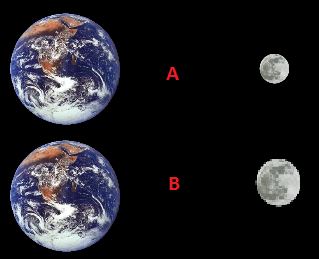
Which system has the greater gravitational attraction between the two objects?
System A
System B
It is the same
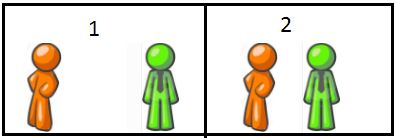
Which System has the greater gravitational pull between the two objects?
System 1
System 2
Same
There is no gravitational force between them.
Hydroelectric energy uses movement of
Wind
Rain
Sun's rays
Water
These are the basic building blocks of ordinary matter
atoms
protons
stuff
electrons
Subatomic particles include
wind, water, fire and earth
all the matter on planet Earth
protons, electrons, and neutrons
any particle with a positive charge
The nucleus of an atom is made up of
electrons only
protons only
protons and neutrons
neutrons only
What type of charge do protons possess?
Positive
Negative
Neutral
The atomic number of an element is determined by the
number of electrons in the first shell
how reactive the element is
number of protons in the nucleus
placement on the periodic table
This scientist created our modern day Periodic Table of the Elements
Chewbacca
Charles Darwin
Albert Einstein
Dimitri Mendeleev
The elements farthest to the right are known as the
alkali metals
noble gases
metalloids
halogens
Water is matter and we know that matter cannot be created or
identified
destroyed
infiltrated
cycled
Darwin is considered to be the Father of
Evolution
Biology
Ecology
Geology
This is key to species survival
Genetic abnormality
Genetic variation
Genetic modification
Genetic fluctuation
Eukaryotes are cells that have a distinct and clearly defined
cell membrane
cell wall
nucleus
purpose
Examples of Prokaryotes are
archaea and bacteria
plants and animals
amoeba
fungi
The relationship between cellular respiration and photosynthesis is Photosynthesis makes the glucose that is used in cellular respiration to make ATP. The glucose is then turned back into carbon dioxide, which is used in photosynthesis.
True
False
A community is a
the diet of a species
a place where one species lives
the same as habitat
an interacting group of various species in a common location
A tertiary consumer gets its nutrition by consuming
primary and secondary consumers
other tertiary consumers
plants that get their energy from the sun
A carnivore only consumes
plants
chili con carne
meat
vegetables
A plastic stick is attracting small pieces of brightly colored paper. If the stick has a positive charge, then the paper that sticks to it must have
A smaller charge
A greater charge
A negative charge
A positive charge

There are many forces acting on this car. Two of them are shown. What is the net (resulting) force?
Which claim is correct? The Net Force is...
30 N to the left
30 N to the right
70 N to the left
70 N to the right
Which of the following discoveries is evidence supporting the idea of continental drift?
the discovery of matching plant and animal fossils found on different continents
the discovery of sea-floor rock patterns due to magnetic reversals
the discovery that most earthquakes are near plate boundaries
the discovery that rock age increases as distance from mid-ocean ridges increases

Using the model in the picture, which layer of the Earth is represented by the Cork?
Mantle
Lithosphere
Core
Crust

Using the model in the picture, which layer of the Earth is represented by the Water?
Mantle
Core
Lithosphere
Crust

Using the model in the picture, which layer of the Earth is represented by the Heat Source?
Mantle
Core
Lithosphere
Crust
Which of the following does NOT preserve fossils?
Amber (tree sap)
Ice
Asphalt (tar)
Magma

The map shows the boundaries of tectonic plates in the South Pacific. Several cities on the map are labeled. A company wants to build skyscrapers in all of these cities.
Name the three cities where earthquake-resistant technology would be most important in building these skyscrapers. Then explain why you chose these cities. Select the best answer
Perth, Sydney and Osaka would need the earthquake-resistance technology because they are close to the water. Earthquakes usually happen on the boarder of the land and water.
Shanghai, Perth and Sydney because they are all on the coast and most happen on the coast.
Earthquake-resistant technology would be most important in Wellington, Osaka, and Shilong. The reason why I chose these cities was because they were closer to the plate boundary than the other cities. Earthquakes tend to happen closer to the plate boundaries therefore, these cities would most benefit from the earthquake-resistant technology.
The cities that would need to earthquake-resistant technology would be Shilong, Osaka and Wellington. The reason I chose these cities was because they are the ones that are closer to the middle of the land. Earthquake tend to occur in the middle of land and those cities are the closest to the middle of land.

During a severe drought a dry lake was explored for fossils. The diagram represents the fossils uncovered and the layers they were in. According to this information, this area was once a
Forest that was replaced by a fresh water lake.
Saltwater sea that was replaced by a forest.
Freshwater lake that was replaced by a desert.
Freshwater lake that was replaced by a forest.

Location 1 represents
Convection Currents
Divergent Boundary
Rift Valley

What is represented at location 2
Convection currents
Divergent Boundary
Rift Valley

What is represented at location 3
Convection current
Divergent Boundary
Rift Valley
The scientist Alfred Wegener hypothesized that all the continents were once joined together in a single landmass and have since drifted apart. This theory became known as
continental drift.
continental mass.
land drift.
land movement.
Why does a red tomato appear red?
It absorbs red wavelengths of light.
It reflects red wavelengths of light.
It refracts red wavelengths of light.
It transmits red wavelengths of light.

The diagram shows the waveforms for two sounds. Which statement about sound A and sound B is correct?
Sound A is louder because its frequency is greater.
Sound A is louder because its amplitude is greater.
Sound B is louder because its frequency is greater.
Sound B is louder because its amplitude is greater.
When a light wave hits a surface, part of the wave bounces back in a process called
reflection.
refraction.
resonance.
repulsion.
Which experimental observation would demonstrate the uniformity of gravitational force on an object at Earth’s surface?
the constant downward displacement of a falling body
the constant downward velocity of a falling body
the constant downward acceleration of a falling body
the increasing downward acceleration of a falling body
You are planning an experiment to observe the relationship between magnetism and electricity. What question will least help you focus your research?
How can I use electricity to change the strength of a magnetic field?
What is needed to make Earth’s most powerful electromagnet?
Can an electrical charge reverse the direction of a magnetic field?
What happens to the magnetic field if I turn off the electricity?
A sound wave is an example of a mechanical wave because a sound wave requires
a mechanical device to be heard.
a medium through which to travel.
empty space through which to travel.
a standing wave to be produced.
Imagine an object is at rest. If two forces push on the object in the same direction, what must be true about the motion of the object?
The object must remain at rest.
The object must move at constant velocity.
The object must accelerate in the direction of the forces.
The object must accelerate in the direction opposite the forces.
Suppose you throw a ball across a field, and the ball lands 10 m away from you. If you throw the ball again but with a much greater force you can expect
the ball will travel the same distance.
the ball will travel a shorter distance.
the ball will travel a greater distance.
the ball will travel half the distance.
A fossil record can provide evidence of all the following except the
environments in which organisms lived.
genes of past life forms that are now extinct.
past climates of different regions.
extinctions of many kinds of organisms.
An electric current produces
a magnetic domain.
a magnetic field.
an electrical resistance.
a permanent magnet.
What are fossils?
molds and casts of organisms that live today
soft parts of ancient animals and other organisms
footprints or burrows of small animals that live today
the preserved remains or traces of organisms that lived in the past
What is the movement of rock particles by ice, wind, water, or gravity called?
abrasion
erosion
weathering
uniformitarianism
Which of the following statements is true?
The revolution of Earth around the sun explains the occurrence of eclipses.
Earth’s rotation in relation to the positions of the sun and moon are responsible for the occurrence of tides.
The moon’s revolution around Earth explains the apparent movement of constellations in the night sky.
The moon’s elliptical orbit is responsible for the occurrence of tides.
Metamorphic rock changes to igneous rock by first going through which process?
deposition
crystallization
erosion
melting
The thick fluid region of a cell located inside the cell membrane or between the cell membrane and nucleus:
cytoplasm
cell wall
organelle
golgi apparatus


Plant cells and animal cells
are both prokaryotic
are both eukaryotic
do not have a nucleus
do not have DNA

Check the three major differences between a plant cell and an animal cell.
cell wall
mitochondria
large central vacuole
chloroplasts
Small structures in the cytoplasm that do special jobs.
Nucleus
Ribosomes
Organelles
Vacuoles
What 2 structures only exist in plant cells?
Cell wall and Chloroplasts
Cell Membrane and Chloroplasts
Lysosomes and Cell wall
Vacuole and Mitochondria
This type of cell is lacking a nucleus
prokaryotic
eukaryotic
both prokaryotic and eukaryotic
neither prokaryotic nor eukaryotic
Powerhouse of the cell, organelle that is the site of ATP ( energy production ) and cellular respiration in plants and animals.
Nucleus
Ribosomes
Mitochondria
Vacuoles
Small structures in the cytoplasm that do special jobs.
Nucleus
Ribosomes
Organelles
Vacuoles
Which organelle only exists in plant cells?
Cytoplasm
Chloroplasts
Mitochondria
Cell Membrane
This organelle is the site of photosynthesis
Cell wall
Mitochondria
Chloroplast
Cell membrane
Which of the following functions do all organisms share?
They make their own food
They must get rid of waste material
They must hunt and chase their food
They hibernate in the winter
Joe is examining a cell under a microscope. Some of the structure Joe can see are a cell wall, mitochondria, a nucleus and chloroplasts. Based on what he can see, what type of cell is Joe most likely looking at?
An animal cell
A plant cell
The total amount of energy in a system
will stay the same.
will change depending on its surroundings.
What is the name when heat energy is released during a reaction?
endothermic reaction
physical change
exothermic reaction
chemical change
What is the name when heat energy is absorbed during a reaction?
endothermic reaction
physical change
exothermic reaction
chemical change
Emily slid down a sliding board. Where did Emily have the most potential energy? Kinetic energy?
Emily had the most potential at the bottom and the most kinetic at the top.
Emily had the most potential at the bottom and the most kinetic in the middle.
Emily had the most potential at the top and the most kinetic near the bottom.
Emily had no potential energy just kinetic during the entire slide ride.
Frank jumps onto a raft in his pool. As he jumps, he moves forward as the raft moves in the opposite direction. Which one of Newton's Laws does this best demonstrate?
First
Second
Third
Fourth

