wayground logo

Free Printable Worksheets

Font size

S
M
L
XL
Worksheets

Weather & Climate Test Review

Total questions: 60

Worksheet time: 1hrs 3mins

Name
Class
Date
1.
What causes winds to form on Earth?
a)
solar energy
b)
ocean currents
c)
elevation differences
d)
uneven heating of the Earth by the sun
2.
A student states the weather is the same as the climate. Which response BEST tells the student the difference between weather and climate?
a)
Weather is about the wind and the rain, but climate is about the clouds.
b)
Weather is the conditions in one day, but climate is the conditions over a long time.
c)
Weather is measured with tools like thermometers, but climate is measured with tools like forecasts.
d)
Weather is recorded on charts, but climate is recorded on world maps.
3.
Which observation describes a change in climate rather than a change in weather?
a)
The thunderstorm dropped about three centimeters of rain today.
b)
The average summer temperatures have increased over the last ten years.
c)
 The snowfall in this area was more this week than it was last week.
d)
The average wind speed in April was less than it was in March.
4.
Which statement about Hawaii refers to its climate?
a)
A blizzard occurs on one of Hawaii’s tallest mountain peaks.
b)
A high temperature of 37.8°C was recorded earlier today in Hawaii.
c)
The mountains were shaded by cumulus clouds on a Tuesday afternoon.
d)
The coolest months are February and March.
5.

Which of the following best describes the difference between weather and climate?

a)

Weather happens in your state, and climate happens in your country.

b)

Weather includes the wind and rainfall, whereas climate only describes the temperature.

c)

Weather can be predicted but climate cannot.

d)

Weather describes conditions such as wind and rain at a particular time, whereas climate describes typical seasonal conditions.

6.

What is the main cause of deepwater ocean currents?

a)

freshwater rivers and streams flowing into the ocean.

b)

wind, caused by variations in air pressure, blowing on water.

c)

differences in water density because of variations in water temperature and salt concentration.

d)

the Coriolis effect: Earth's rotation causing the water in the oceans to move.

7.

Which one of the following factors does NOT influence climate?

a)

ocean currents

b)

the Sun's energy

c)

global wind patterns

d)

soil composition

8.

The rotation of the Earth causes winds to bend due to the...

a)

coriolis effect

b)

doldrums

c)

trade winds

d)

westerlies

9.

what is the main cause of the coriolis effect?

a)

earth’s rotation

b)

trade winds

c)

the sun and ocean

d)

temperature

10.
In which direction do prevailing westerlies flow?
a)
from east to west
b)
from west to east
c)
from north to south
d)
from south to north
11.
Steady winds that flow from east to west between 30°N latitude and the equator and 30°S latitude and the equator.
a)
Prevailing westerlies
b)
Horse latitudes
c)
Trade winds
d)
Polar easterlies
12.
Cold winds that blow from east to west between latitude lines 60°N and the North Pole and 60°S and the South Pole.
a)
Prevailing westerlies
b)
Trade winds
c)
Horse latitudes
d)
Polar easterlies
13.
Which global winds have the greatest impact on the weather in the US?
a)
trade winds
b)
prevailing westerlies
c)
doldrums
d)
polar easterlies
14.
What type of winds blow constantly, predictably, and over long distances?
a)
land breezes
b)
mountain breezes
c)
global winds
d)
land breezes
15.

What is the initial source for global winds and convection in the atmosphere?

a)

heat from the Earth's core

b)

the rotation of the Earth

c)

Moon's gravity

d)

unequal heating of the Earth by the sun

16.
In which direction do prevailing westerlies flow?
a)
from east to west
b)
from west to east
c)
from north to south
d)
from south to north
17.
The tropical winds running from 0 to 30 degrees latitude are called:
a)
subtropical westerlies
b)
polar westerlies
c)
trade winds
d)
polar winds
18.

Winds occur because hot air rises and cool air sinks in a process called...

a)

conduction

b)

convection

c)

radiation

d)

magnetism

19.

Which global winds move FROM the east to the west?

a)

Doldrums

b)

Cauldrons

c)

Westerlies

d)

Easterlies

20.

Winds always blow from areas of _________ pressure to areas of _________ pressure.

a)

high, high

b)

low, low

c)

high, low

d)

low, high

21.

Which statement correctly defines wind?

a)

Wind is the movement of air from areas of low pressure to areas of high pressure

b)

Wind is the movement of air from areas of high pressure to areas of low pressure.

c)

Wind is the movement of air to a colder area in the atmosphere.

d)

Wind is the movement of air pushed around and bouncing off Earth's surface.

22.

Why does warm air rise?

a)

Warm air is more dense than cooler air.

b)

Warm air is less dense than cooler air.

c)

Warm air has more pressure than cooler air.

d)

Warm air has a higher dew point than cooler air.

23.

Rising air creates what type of air pressure?

a)

high

b)

low

24.

This Image represents...

a)

Downwelling

b)

Upwelling

c)

Thermohaline circulation

d)

Rip Current

25.
Due to the Coriolis Effect, water in the northern hemisphere moves
a)
clockwise
b)
counter clockwise
c)
both
d)
neither
26.
Due to the Coriolis Effect, water in the southern hemisphere moves
a)
clockwise
b)
counter-clockwise
c)
both
d)
neither
27.
Warm ocean currents generally come from
a)
The North Pole
b)
The South Pole
c)
The Equator
d)
Both A and B
28.
Deep Ocean currents are a result of
a)
Global Wind Patterns
b)
Earth's Rotation
c)
Density
d)
All of the above
29.

______ causes surface currents.

a)

The Coriolis Effect

b)

gravity

c)

density differences

d)

wind

30.
The large, circular surface-current pattern found in each ocean.
a)
California Current
b)
Surface Current
c)
Gyre
d)
Global Conveyor Belt
31.

The __________ is a surface current that flows along the eastern US and brings warm water to Europe.

a)

California Current

b)

Gulf Current

c)

North American Gyre

d)

Arctic Current

32.

Currents change direction by hitting the continents or other large landmass.

a)

Ocean Currents

b)

Continental Deflections

c)

Coriolis Effect

d)

Upwelling

33.
Cold air is ________ than warm air.
a)
Less dense
b)
Lighter
c)
More dense
d)
more energetic
34.
Upwelling provides _________ for many sea organisms.
a)
Water
b)
Nutrients
c)
Air
d)
Heat
35.
What is the process where cold, deep water rises to the surface with nutrients?
a)
Upwelling
b)
Downwelling
c)
Swelling
d)
Tides
36.
Ocean currents bring warm water from the equator towards Earth's
a)
Southern Hemisphere
b)
Continents
c)
Equator
d)
Poles
37.

What is the effect of warm ocean currents on coastal areas?

a)

Warmer, more humid climate than you'd expect

b)

Cooler, drier climate than you'd expect

c)

Warmer, drier climate than you'd expect

d)

Cooler, more humid climate than you'd expect

38.

What is the effect of cool ocean currents on coastal areas?

a)

Warmer, more humid climate than you'd expect

b)

Cooler, drier climate than you'd expect

c)

Warmer, drier climate than you'd expect

d)

Cooler, more humid climate than you'd expect

39.
During __________ the Southeast Trade Winds weaken.
a)

Normal Conditions

b)

El Nino

c)

La Nina

40.

During __________ the Southeast Trade Winds strengthen.

a)

Normal Conditions

b)

El Nino

c)

La Nina

41.
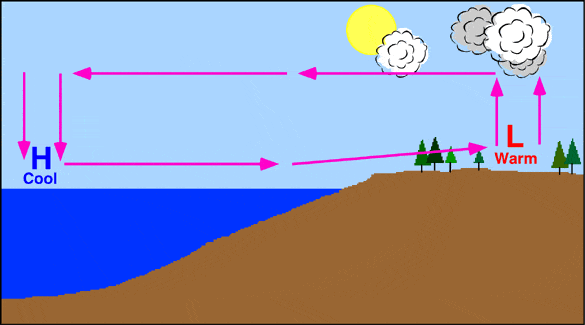
How does the air move in a sea breeze?
a)
wind moves from north to south
b)
wind moves from ocean to the land
c)
wind moves from the land to the ocean
d)
wind moves from south to north
42.
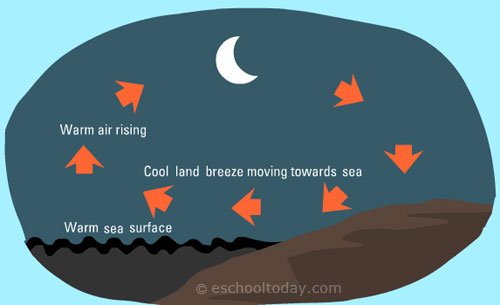
Is this a land or a sea breeze?
a)
land breeze
b)
sea breeze
43.
Is this a land or a sea breeze?
a)
land breeze
b)
sea breeze
44.
The strength of a sea breeze depends on
a)
the heat of the day
b)
the difference between the temperature of the sea and the land
c)
the wind speed
d)
the amount of precipitation that day
45.
How does the air move in a land breeze?
a)
From east to west
b)
From west to east
c)
From the land to the ocean
d)
From the ocean to the land
46.
This local wind happens during the day.
a)
land breeze
b)
global wind
c)
Coriolis effect
d)
sea breeze
47.
This local wind happens during the day when the air over the ocean is cooler than the air over the land. The cool air flows FROM the SEA to the land producing this:
a)
land breeze
b)
global wind
c)
Coriolis effect
d)
sea breeze
48.
This local wind happens at night when the air over the ocean is warmer than the air over the land. The cool air moves FROM the LAND toward the ocean creating a
a)
El Nino
b)
sea breeze
c)
land breeze
d)
transpiration
49.

Name that breeze

a)

Sea Breeze

b)

Land Breeze

c)

Valley Breeze

d)

Mountain Breeze

50.

Name that breeze

a)

Sea Breeze

b)

Land Breeze

c)

Valley Breeze

d)

Mountain Breeze

51.

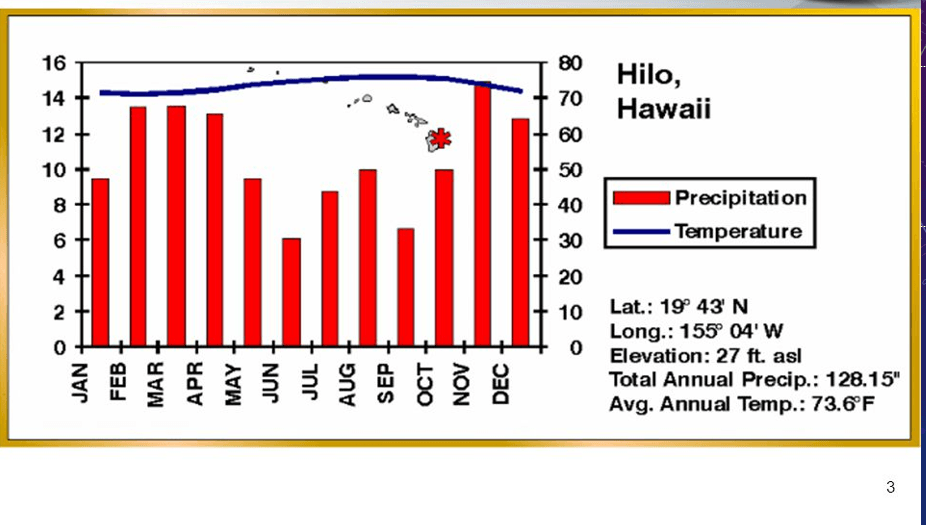
In which month do they get the most precipitation in this location?

a)

January

b)

May

c)

August

d)

November

52.

How much precipitation does this location get in August?

a)

30 mm

b)

200 mm

c)

375 mm

d)

37 mm

53.

Which months have the warmest temperatures?

a)

December, January, February

b)

March, April, May

c)

June, July, August

d)

September, October, November

54.

What is the temperature in December?

a)

400 degrees Celsius

b)

14 degrees Celsius

c)

2 degrees Celsius

d)

14 degrees Fahrenheit

55.

Which month has the coldest temperature?

a)

January

b)

April

c)

September

d)

March

56.

When does the least precipitation occur?

a)

February - March

b)

April - May

c)

June - July

d)

November - December

57.

How would you describe this climate? (Pick 2)

a)

Warm

b)

Cold

c)

Dry

d)

Wet

58.

When is there the most precipitation & highest temperatures?

a)

February

b)

July

c)

September

d)

December

59.

Which is the climograph most likely to represent a desert?

a)

A

b)

B

c)

C

d)

D

60.

In the Skittles Weather & Climate lab, the individual Skittles you dumped out represented the _______. When you dumped out the whole bag to find the percentage of each color, you represented the _______.

a)

Climate, Weather

b)

Weather, Climate

c)

Wind, Ocean Currents

d)

Ocean Currents, Wind