wayground logo

Free Printable Worksheets

NEW

Font size

S
M
L
XL
Worksheets

Unit 7 quiz 1

Total questions: 45

Worksheet time: 25mins

Name
Class
Date
1.

The main conclusion Darwin reached after his return from the Galapagos Islands was that

a)

Species change over time

b)

The animals on the islands were the same as those on the mainland

c)

Populations do not change over time

2.

Two different species may have similar features because of

a)

descent from a common ancestor.

b)

fossil record

c)

genetic drift

3.

The origin of numerous species of Galápagos finches from one original species is an example of

a)

gene cascades.

b)

genetic drift and emigration.

c)

adaptation and speciation.

d)

mass extinctions.

4.

Individual organisms evolve, not populations.

a)

True

b)

False

5.
Who was the naturalist that traveled the world to study plants and animals?
a)
Albert Einstein
b)
Charles Darwin
c)
Charles Barkley
d)
Isaac Newton
6.
the hind leg bones in a whale are examples of
a)
homologous structures
b)
analogous structures
c)
fossils
d)
vestigals
7.
Which layer is the oldest?
a)
1
b)
2
c)
3
d)
4
8.

Which is artificial selection?

a)

Breeding dogs for specific traits.

b)

Coyote species diverging from the wolves.

9.

An animal has several inherited characteristics that makes it much fitter than its rivals. According to Natural Selection it should:

a)

Help the others that are less fortunate

b)

Survive longer, have more and better babies.

c)

Be equals with its kin

10.
Remains of ancient organisms are called
a)
Extinctions
b)
Fossils
c)
Mutations
d)
Variations
11.


Of all the places he visited, the ___________________ Islands influenced Darwin’s ideas about evolution the most.

a)

Galapagos

b)

Hawaiian

c)

Bora Bora

d)

Aleutian

12.

Studying embryology helps scientists understand __________.

a)

how a species makes food through photosynthesis

b)

the early stages of an organism's growth

c)

where organisms migrate during their lives

d)

how a species reproduces

13.

Scientists compare DNA from living organisms to identify _________.

a)

geographic isolation

b)

similarities between species

c)

a fossil's location

d)

natural selection

14.

Which would be considered homologous structures?

a)

a permineralized bone of a wooly mammoth and original material of a wooly mammoth

b)

the wing of a bat and the wing of an insect

c)

bones in a bird's arm and bones in a frog's arm

d)

a specific protein in yeast also found in rhesus monkey

15.

Examples of analogous structures include

a)

the wings of a bat and the wings of a butterfly

b)

the wings of a bat and the limbs of a cat

c)

the limbs of a cat and the limbs of a dog

d)

all of the above

16.

Why are advantageous traits more likely to be passed onto offspring?

a)

because they are more likely to survive and reproduce

b)

because they come from recessive alleles

c)

because they come from dominant alleles

d)

because the trait is an acquired phenotype

17.

Individuals in a population that have a variation which gives them an advantage in their environment are more likely to

a)

move to a different environment

b)

die and not reproduce

c)

survive and reproduce

d)

change their characteristics to fit their environment

18.

Darwin called the ability of an organism to survive

a)

variation

b)

overproduction

c)

fittness

d)

adaptation

19.

According to Darwin's theory of natural selection, the individuals that tend to survive are those that have

a)

variations best suited to their environment

b)

the best luck

c)

the ability to change their bodies to fit their environment

d)

the biggest and strongest body

20.

Differences among individual members of the same species are referred to as

a)

natural selection

b)

fitness

c)

variation

d)

adaptation

21.

Natural selection causes evolution

a)

True

b)

False

22.

A trait that makes a species better suited for its environment is called

a)

evolution

b)

adaptation

c)

variation

d)

natural selection

23.

Structures that are similar (different functions) and develop in different organisms.

a)

Homologous Structures

b)

Analogous Structures

c)

Vestigial Structures

d)

Identical Structures

24.

Structures that loose function over time because they are no longer useful to an organism are called

a)

Homologous Structures

b)

Analogus Structures

c)

Vestigal Structures

d)

Useless Structures

25.
Studying the similarities in organisms development 
a)
DNA
b)
Embryonic 
c)
Vestigial 
d)
Homologous 
26.
The arrangements of DNA and Amino Acids can determine how close organisms are. 
a)
DNA and Amino Acid squence
b)
Analgous
c)
Homologous 
d)
Vestigial 
27.
The changes of species over time
a)
Embryonic 
b)
Natural selection 
c)
Mimicry 
d)
Evolution 
28.
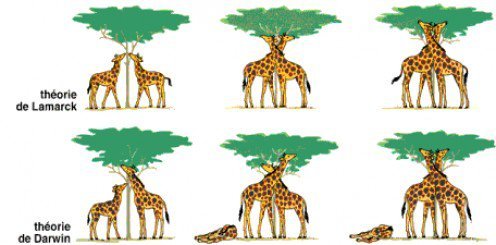
What would happen if the Giraffes never evolve?
a)
they would survive
b)
They would thrive
c)
They would become extinct
d)
They will find another source of food
29.
What is a homologous structure?
a)
having a body part that has no known function
b)
similar structures in more than one organism because they evolved from a common ancestor
c)
similar structures that evolved independently in two living organisms to serve the same purpose
d)
a structure that evolved to help an organism survive in their environment
30.
Whales live in the ocean. They do not have legs, but they do have a pelvis with small leg bones attached to it. This is evidence that:
a)
Whales are not well adapted to ocean life.
b)
Whales do not have homologous structures
c)
Whales evolved from animals that once lived on land
d)
Whales evolved from some type of fish
31.
This fossil trilobite and this living blue crab both have a limb structure called a biramous limb. What best explains why both species have biramous limbs?
a)
It is impossible to say. Fossils are very old, so we cannot make observations of the trilobite’s ancestors, and we cannot explain its body structures.
b)
The trilobite and blue crab both share the same ancestor population that had a biramous limb. They inherited this structure from the ancestor population.
c)
All species have their own specific body structures, so it is a coincidence that this trilobite and blue crab each happen to have the biramous limb structure.
d)
The trilobite and blue crab are different species, so they must not share an ancestor population. They inherited their biramous limb structure from separate ancestor populations.
32.
Which of the following is NOT a vestigial structure?
a)
appendix
b)
lungs
c)
coccyx
d)
ear muscle
33.
This red kangaroo and this alpine newt both have a femur bone in their back limbs. However, their femur bones are very different. The red kangaroo has long femur bones that help it jump very far. The alpine newt has short femur bones that help it swim. What most likely explains why both have back limbs with a femur and why the femur bones are different?
a)
The red kangaroo and alpine newt are different species, so they do not share an ancestor population. These species had separate ancestor populations, and each evolved femur bones that help it survive in its environment.
b)
It is impossible to explain the structures of different species. The way that structures change over time is very complex, and no one has ever observed these changes occurring.
c)
The red kangaroo and alpine newt both inherited femur bones from a shared ancestor population, but this population separated into different environments. In each environment, different types of femur bone evolved, which helped the populations survive.
d)
All species have their own specific body structures, so it is a coincidence that the red kangaroo and alpine newt each happen to have femur bones that are different.
34.
Dorsal fins in sharks and dolphins are an example of
a)
homologous structures
b)
vestigial structures
c)
water to land evolution
d)
analogous structures
35.
In a meadow, there are two colors of coneflowers: Pink and yellow. The bees and other pollinators seem to be more attracted to the pink flower and visit the pink flowers more often than the yellow flowers. Over time there are more pink flowers in the meadow than yellow. What principle is at work here?
a)
speciation
b)
environmental pressure
c)
natural selection
d)
homologous structures
36.
What evidence do similarities between fossil bones and modern organisms provide?
a)
species that face similar environmental pressure will develop similar traits.
b)
homologous structures are evidence that the two species are related or shared a common ancestor
c)
natural selection
d)
adaptive structures help organisms survive in their habitat
37.
This octopus and this fossil ammonite both have a body structure in their mouths called a radula. The radula is a structure used for eating. What best explains why both species have a radula?
a)
All species have their own specific body structures, so it is a coincidence that this octopus and ammonite each happen to have a radula structure.
b)
The octopus and ammonite both share the same ancestor population that had a radula. They inherited this structure from the ancestor population.
c)
It is impossible to say. Fossils are very old; therefore, we cannot make observations of the ammonite’s ancestors, and we cannot explain its body structures.
d)
The octopus and ammonite are different species, so they must not share an ancestor population. They must have inherited radulas from separate ancestor populations.
38.
Human beings are taller than they used to be. Over the last 150 years, humans have on average increased in height of about 10 centimeters. What principle does this provide evidence for?
a)
species change over time
b)
extinction occurs when the species cannot adapt to rapid change in environmental pressures
c)
homologous structures
d)
camouflage is an adaptive change
39.
The Emu and Ostrich evolved on different continents but they both have similar body structures. They are both long-legged and flightless birds. What is this an example of?
a)
homologous structures
b)
vestigial structures
c)
natural selection
d)
analogus structures
40.
What is this an example of?
a)
vestigial structures
b)
embryology
c)
homologous structures
d)
fossil record
41.
Darwin wrote that organisms with traits that are best suited to the environment will ________________
a)
increase in number
b)
become extinct
42.
The opossum and kangaroo both incubate their young in a pouch. This provides evidence that they---
a)
are descended from a common ancestor
b)
Have very similar skeletal structures
c)
belong to the same species
d)
must range great distances to eat
43.
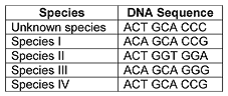
According to this data, the unknown bacterial species is most closely related to: 
a)
Species I
b)
Species II
c)
Species III
d)
Species IV
44.

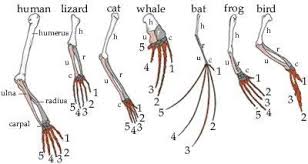
What type of structure does this image illustrate?

a)

Homologous structures

b)

Analogous structures

c)

Vestigial structures

45.
When all individuals in a species have died, it is called
a)
evolution
b)
extinction
c)
adaptation
d)
natural selection