
NEW
Font size
 Worksheets
Science Benchmark 2 Review #1
Total questions: 61
Worksheet time: 5hrs 5mins
A measure of how much MATTER an object has is called ____________.
weight
gravity
mass
volume
Mass, relative density, solubility, color, texture, state of matter, boiling point, melting point, and freezing point are all examples of _____________.
Physical state
Insulators
Physical Properties
Inferences
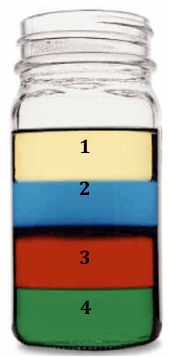
Which liquid is the MOST DENSE?
4
3
2
1
All of the following are poor insulators of electricity EXCEPT ___________.
Penny
Nail
Eraser
Paperclip

What describes the ability of a solid to dissolve in water?
Example: Solid-Salt/Liquid-Water
melt
dissapear
solubility
evaporate
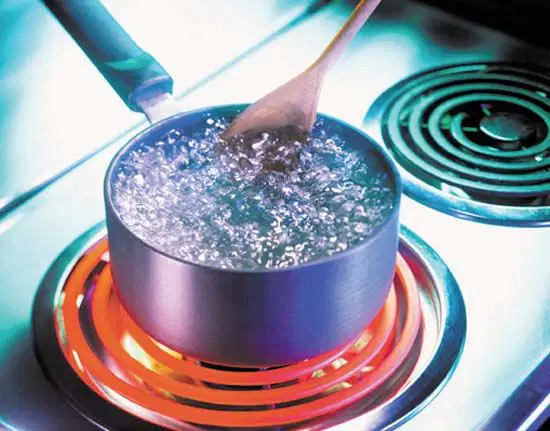
What is the BOILING POINT of water?
0° C
100° F
32° C
100° C

What temperature would the air around a cup of water have to reach in order to FREEZE water?
0° C
32° C
100° C
0° F
You are taking a cold soda on a field trip. You must choose from four containers in which to carry the soda. The four containers are made of different materials.
Which container will most likely INSULATE the soda the best?
Metal
Styrofoam
Glass
Plastic

A student placed a pencil in a cup of water. The pencil appears broken because light ______.
Always travels in a straight line.
Bends when it passes through water.
Makes the water in the glass evaporate.
Reflects the pencil on the water's surface.
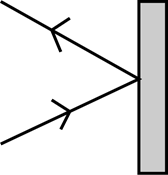
The illustration shows a light ray striking an object. In the illustration, the light ray striking the object is_________________.
Absorbed
Stopped
Reflected
Refracted

The correct order of the planets is:
Mars,Venus, Earth, Mercury, Saturn, Jupiter, Uranus, Neptune
Earth, Venus, Mars Jupiter, Neptune, Mercury, Saturn, Uranus
Mercury, Venus, Earth Mars, Jupiter, Saturn, Uranus, Neptune
Rain washing away soil from a hillside is called ___________.
Weathering
Erosion
Deposition

What is a DELTA?
A landform that is made of sediment when a river flows into a larger body of water and deposits sediments in a triangular shape.
A narrow strip of water.
A deep narrow valley with steep sides.
A constructed channel filled with water used for navigation, irrigation, or drainage.
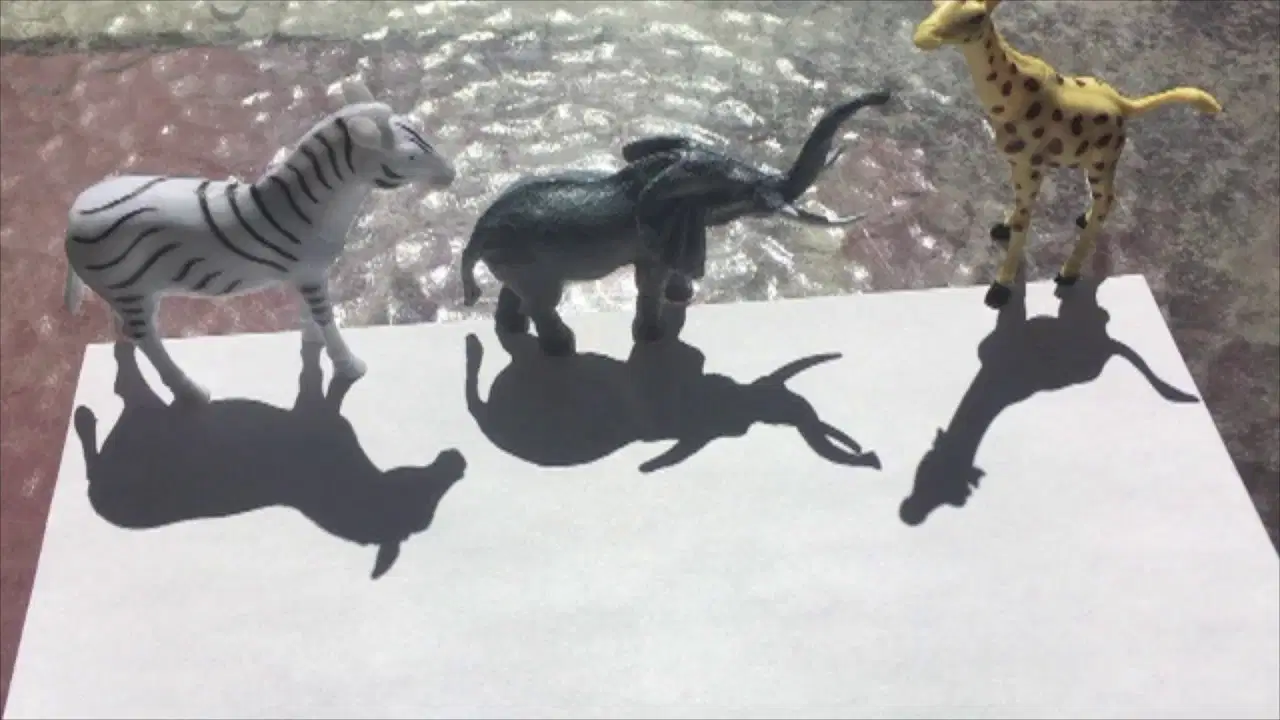
What causes shadows?
An object blocking the light source
The water cycle
An object letting the light source through
The moon
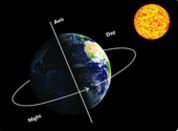
Day and night are caused by the ______________ of Earth on its axis.
revolution
orbit
rotation
tilt of the axis

The SUN appears to move across the sky because _______________.
It is rising and falling
The sun revolves around the Earth
The Earth revolves around the sun
The Earth rotates on its axis

Which picture shows how the tree’s shadow most likely looked at 9:00 A.M.?
A
B
C
D

Which is the best explanation for how fossil fuels form?
Dead organisms are buried beneath sediment and exposed to heat and pressure over millions of years.
Dinosaurs are buried in hot tar, adding their bodies to the mass of fossil fuel.
Plants die in swamps and their bodies change into fossil fuels.
Ocean water turns dead plants and animals into fossil fuels.
Which organism below is the only organism that does NOT depend on other organisms for energy?
Vine > butterfly > bird > fox
butterfly
bird
vine
fox
Coal, oil and natural gas formed over millions of years are called __________.
rare
fuel energy
fossil fuels
ancient fuels
Which relationship describes predator/prey?
hawks and shrubs
mountain lion and deer
frogs and trees
What is the producer's role in a food chain?
To make their own food using the sun's energy (Photosynthesis).
To hunt other animals for food.
To break down waste and dead plants.
To eat both plants and animals.
Which one of these is NOT a planet?
Mercury
Venus
Moon
Earth
Which of the following is an examples of CLIMATE?
Today it is hot and sunny in Phoenix, Arizona.
Summers are usually mild in Lansing, Michigan.
Last week it rained every day in San Antonio, TX.
Yesterday was cold and windy in Anchorage, AK.
Which is true about the formation of a U-shaped valley?
A glacier weathers and erodes the surface of the land.
Wind erodes the surface of the land.
A river deposits sediment where it meets the ocean.
Wind deposits sediments.
Which process will separate the sugar from mixture of sugar and water?
Stirring the mixture
Evaporating the water
Adding more water
Adding more sugar
Which of the following is a GOOD CONDUCTOR of electricity?
glass rod
cotton string
plastic tubing
copper penny
Which of these is NOT soluble in water?
oil
salt
honey
sugar

Put the liquids in order from most dense to least dense?
4, 3, 2, 1
1, 2, 3, 4
3, 4, 2, 1,
4, 3, 1, 2

Density: Describe the picture.
A is less dense than B.
A and B have the same density.
B is less dense than A.
B has greater density than A.
Which of these describes how a living organism depends on another living organism to survive?
Mushrooms growing on the forest floor
Frogs laying their eggs in a pond
Dandelion seeds are carried long distances by the wind
Bees pollinate the flowers on apple trees

Which statement correctly describes the transfer of ENERGY in a food chain/food web in this ecosystem?
Energy is transferred from white-tail deer to mountain lions to wild hogs.
Energy is transferred from mountain lions to wild hogs to corn.
Energy is transferred from grass to white-tail deer to mountain lions.
Energy is transferred from corn to duck to wild hogs to white tail deer.
What breaks down dead organisms?
predators
decomposers
consumers
scavengers
What are some examples of decomposers?
earthworms, mushrooms, fungi, bacteria
Elephants, Giraffes, and Vultures
algae, phytoplankton
COAL is formed from ________________.
rocks
a factory
remains of small organisms that lived many millions of years ago in our oceans
plant remains along with heat and pressure

Why is electrical wiring usually made from COPPER?
Because copper is shiny
Because copper conducts electricity
Because copper is not magnetic
Because copper insulate electricity
You have the following solids in a lab: salt, sand, lemonade powder, and pepper.
Which solids will dissolve in water to create a SOLUTION?
pepper, sand, and salt
salt, lemonade powder, and sand
salt and lemonade powder
pepper and sand
Which set of procedures would be best to follow when separating a mixture of sand, salt, and water?
Evaporate the liquid to separate water
heat solid mixture to separate salt.
Pour mixture through filter to separate sand
evaporate liquid to separate salt.
Pour mixture into bowl to separate water
use hand lens to separate sand.
Heat mixture on hotplate to separate sand\
cool liquid to separate sand.
What tool do we use to measure volume?
Thermometer
Balance Scale
Graduated Cylinder
Meter Stick
How does light travel?
Through compression waves
Through solids
In a straight line
By vibrations

The diagram shows one container with oil and water and another with oil and a cork.
Which diagram below shows what most likely would happen if oil, water, and the cork were all put in the same container?


A student classifies the objects shown based on their physical properties. Which property CANNOT be used to classify these objects into more than one group?
Magnatism
Mass
Electrical Conductivity
Solubility in water

The picture shows COAL, one of Earth's energy resources.
Why is COAL a nonrenewable resource?
It is difficult to mine because it is deep inside Earth.
It is a resource that can easily be replaced as it is used.
It is a resource that cannot be replaced as fast as people use it.
It is the resource that fuels many power plants that make electricity.
Wind, water, and ice are involved in both weathering and erosion. However, weathering and erosion are two different processes.
Which sentence below states a difference between weathering and erosion?
Erosion moves rocks to a new location.
Weathering moves rocks from place to place.
Erosion breaks down rocks but doesn't move them.
Weathering moves rocks without breaking them down.
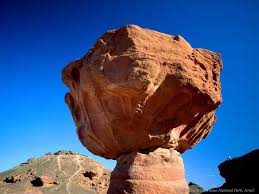
The process that breaks down rocks and other materials on Earth's surface is called ___________.
Weathering
Erosion
Deposition
Decomposition

Which of these was the major reason that this CANYON was formed?
Wind
Underground hot springs
Water
Ice

The diagram shows a fish being viewed from above the water. The fish appears to be closer to the surface than it really is.
What causes this difference? (5.6C)
Light is reflected.
Light is refracted.
Light is focused.
Light is blocked.

Which weather event would cause an increase in temperature?
A warm front passing over an area.
A stationary front passing over an area.
An occluded front passing over an area.
A cold front passing over an area.

About how long does it take for one rotation of Earth?
12 Hours
18 Hours
24 Hours
48 Hours
Which of the pictures is an example of an alternative energy source?


This turtle lives in the pond. While observing him in his ecosystem what would be one interaction with the turtle and a living factor?
The turtle swimming in the water slowly
The turtle laying in the sun and then sliding back into the water
The turtle swimming in the water to get some grass to eat
The turtle getting out of the water and walking across the bank of the pond
Which picture requires both electric and thermal energy to function?


Which home or building is heated by an alternative energy source?
An office building heated by solar panels
Heating run by a generator that is powered by gasoline
A factory that gets its power by coal
A home that has a furnace that is powered by natural gas

There are many state parks near coastal areas that contain sand dunes.
How are sand dunes formed?
Deposition and tornadoes
Erosion and landsides
Weathering and earthquakes
Erosion and strong winds
A student recorded the following information about a planet:
Sixth planet from the sun
No life
Made up of mostly gases
Surrounded by rings
Which planet is the student referring to?
Earth
Murcury
Saturn
Jupiter
Which of the following is NOT an inherited trait?
Shape and size of a leaf can vary from leaf to leaf
Color of leaves from dark to light
Holes in leafs from insects eating them
Leafs are rough on one side and smooth on the other
Living things that make their own food using energy from the sun, like green plants and algae, are called ___________________.
consumers
prey
producers
predators
Animals that eat both plants and animals are called _________________.
carnivores
omnivores
decomposers
herbivores
Animals that cannot make their own food are called __________________.
decomposers
herbivores
omnivores
consumers
The role of DECOMPOSERS in the food chain is to _____________.
Consume plants and animals.
Produce food using energy from the sun.
Eat decaying matter and return nutrients to the soil.
Hunt and eat prey.
When a lamp is turned on __________ energy is transformed into _______ energy.
light, electrical
electrical, light
light, heat
electrical, heat

