
 Worksheets
#4 Test Review Shadows, SME, Water Cycle, Weather Climate
Total questions: 61
Worksheet time: 3hrs 48mins

Today’s high temperature
was 98° Fahrenheit.
Weather
Climate

The spring season is wetter
in Oregon than it is in Utah.
Weather
Climate

The forecast called for rain
today, but sun tomorrow.
Weather
Climate

Average annual rainfall in
San Antonio is 31.96 inches.
Weather
Climate
An overnight freeze that damages orange crops in central Florida.
Weather
Climate
Today's "normal" (30 year average) high temperature has increased 3oF over the past 100 years.
Weather
Climate
Atlanta, GA receives an average of 49.71 inches of precipitation per year.
Weather
Climate
Long term (decades, centuries, millennia, etc.) atmospheric conditions at a particular place.
Weather
Climate
Houston, TX averaged 11 inches of rain last year.
weather
climate
A study of 30 years shows February averages the coldest temperatures.
weather
climate
A school measures the rainfall each year for 30 years.
weather
climate




Water is changing from a gas to a solid.

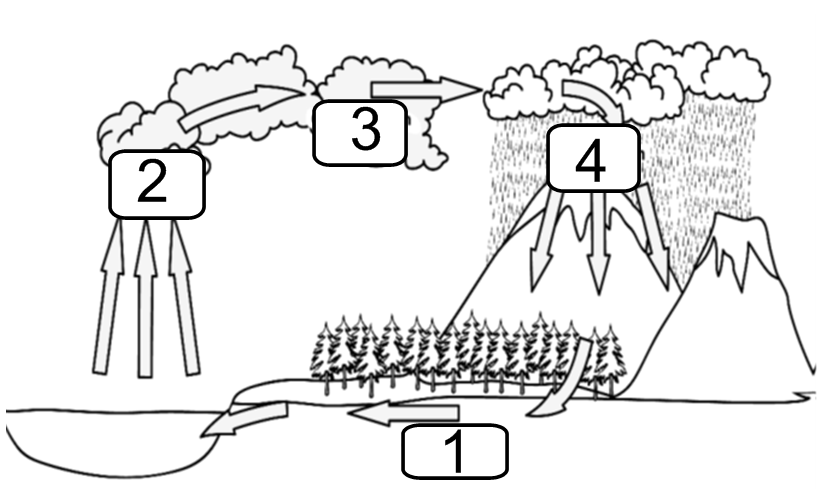
Which number represents TRANSPIRATION in the water cycle diagram?
1
2
3
4
Which number represents EVAPORATION in the water cycle diagram?
1
2
3
4

The water that falls from the sky can be _______ or collected, and stored in rivers, lakes, and oceans.
accumulated
runoff
ground water
transpiration

The Earth, Sun, and Moon all share a similar-
Size
Temperature
Atmosphere
Shape
Students are using balls to show size relationships between the Earth, Moon, and the Sun. They used a basketball to represent the Sun and a tennis ball to represent the Earth. What would best represent the Moon in their model?
Soccer Ball
Volleyball
Baseball
Ping-pong ball
The Moon's surface has many more craters than the Earth's. What best explains the difference in the number of craters on the surface of the Moon and the Earth?
The Moon rarely gets impacted by meteorites.
The Earth's atmosphere protects it from impacts.
The Moon's gravity attracts more meteorites that Earth's.
The Earth rotates on its axis more quickly than the Moon.
Which of the following lists the Earth, Sun, and Moon in order of size, from largest to smallest?
Earth, Sun, Moon
Earth, Moon, Sun
Sun, Earth, Moon
Sun, Moon, Earth
While they are different in some ways, the Earth and the Moon share many of the same characteristics. Both the Earth and the Moon-
rotate on an axis
have a thick atmosphere
support living organisms
experience wind and storms
Which of the following planets is closest to the Sun?
Venus
Jupiter
Mars
Neptune
The sun is made up of____.
solid rock
hot gases
lava
metal
Which planet in our solar system is the furthest from the Sun?
Mercury
Neptune
Earth
Jupiter

The motion that best explains day and night on Earth is
revoloution
gravity
rotation
orbit

There are how many moon phases?
12
4
6
8
Terrestrial Planets can be described by what TWO words.
rocky
inner
gas
outer

Which force keeps the planets orbiting the Sun?
Gravity
Magnetism
Wind
Electricity

What is the 6th planet from the Sun?
Mercury
Saturn
Earth
Venus


The sun is a
planet
star
When the sun gets higher in the sky, shadows get ______.
longer
gone
shorter
darker
When the sun gets lower in the sky, shadows get______.
longer
gone
shorter
darker

Where will the tree's shadow be?
A
B
C

Which position of the sun will make the longest shadow?
A
B
C

the imaginary line running through the earth from the north pole to the south pole
axis
equator
prime meridian
If it is summer in the northern hemisphere, what season is it in the southern hemisphere?
spring
winter
fall
summer

When the sun is just above the East horizon, which of the following is true?
Sunset will occur in less than 2 hours.
Sunrise occurred within the last 6 hours.
Sunrise will occur in less than 2 hours.
Sunset occurred within the last 6 hours.
A student pointed a flashlight modeling the Sun toward a globe modeling Earth. The student spun the globe. What was the student most likely demonstrating?
The moon's rotation on its axis causing day and night.
Earth's orbit around the Sun causing day and night
The sun's orbit around Earth causing day and night
The Earth rotation on its axis causing day and night.

A lab team records the change of a shadow's length through the day in the table below.
The shadows length changes because---
the Sun appears to move across the sky as Earth rotates.
the Sun orbits Earth.
The Sun blocks the light, forming a shadow.
Earth revolves on its axis.

What time of day is it according to the shadow model?
Morning
Exactly noon
Afternoon

A student wants to use a spinning basketball to model the day-and-night cycle on Earth.
What should the student do in order to best model the cause of the day-and-night cycle?
Spin the ball in different directions
Tilt the ball while it is spinning
Paint one half of the ball black and the other half white
Shine a bright light on one side of the ball


The star at the center of the solar system around which the Earth and other planets orbit.
Sun
Moon
Jupiter
Mars

What moon phase is shown?
Waxing Crescent
Waning Crescent
New Moon
First Quarter

What phase of the moon is shown?
New moon
Full moon
Wanning gibbous
First quarter

What moon phase is shown?
New Moon
Full Moon
Waning Gibbous
First Quarter

HINT: THE SUN WILL SET IN THE WEST.
F
G
H
J
Which graph best show the size of a shadow over time in one day?



