
NEW
Font size
 Worksheets
Electricity & Magnetism Review
Total questions: 73
Worksheet time: 2hrs 44mins
Atoms that have a positive charge will be ATTRACTED to atoms with a ___________ charge.
positive
negative
neutral
Which of these forces works only by combining electric and magnetic forces?
Magnetic
Electric
Electromagnetism
This force occurs when ions/atoms create attractive and repulsive forces.
Magnetic
Electric
Electromagnetism
This force occurs when there is an attractive and repulsive force between two poles.
Magnetic
Electric
Electromagnetism
In a magnet the opposite poles will ___________.
attract
repel
The magnetic field of a magnet is ____________ further away from the magnet.
stronger
weaker
Electric charges that DO NOT move through a current are known as
Magnetic
Electric
Electromagnetism
Static Electricity
What makes an electromagnet stronger?
greater number of loops
smaller number of loops
decreasing the current
decreasing the voltage
An example of an electromagnet
water bottle
paper
motor
glass
two type of charges in electric and magnetic forces are
north and south
east and west
positive and negative
beyonce
when electrons all spin in the same direction, they create an invisible force known as
electricity
magnetism
motor
electrons
When your hair stands on end, each strand repelling the other, you are experiencing
magnetism
ghosts
static electricity
when the number of electrons matches the number of protons, the atom's charge is...
positive
negative
neutral
The Law of Electric Forces states that opposite charges __________ and like charges ______________.
repel , attract
attract , repel
attract , attract
I do not know and do not want to guess.
Materials that easily give up or accept electrons are known as
Electron Acceptors
Conductors
Insulators
I do not know and do not wish to guess.
Materials that resist the charges flowing through are
Electron Resistors
Conductors
Insulators
I do not know and do not wish to guess.

This picture is an example of a
series circuit
parallel circuit
Alternating current
I do know and do not wish to guess.

The above picture is an example of a
series circuit
parallel circuit
direct current
I do not know and do not wish to guess.
Magnetism is caused by
magic
the movement of electrons within the atom
the vibration of particles
the movement of protons within the atom
I do not know and do not wish to guess.
Regions where magnets are the strongest are known as the
Strong ends
Magnetic Poles
Central Point
Magnetizers
I do not know and do not wish to guess.
A magnet can exert force over a distance because the magnet is surrounded by
air
electrons
magnetic poles
magnetic fields
I do not know and do not wish to guess.
If you were to break a magnet in half,
you would be left with two pieces that are no longer magnetic.
you would have one working magnet with a N and S pole,.
you would have two working magnets, both with a N and S pole
I do not know and do not wish to answer.

How will the two magnets above interact with each other?
Repel or move away from each other
Attract or come together
The magnets will not be magnetic.
I do not know and do not wish to answer.

The above picture is an example of a/an
good time
electromagent
battery solenoid
I do not know and do not wish to guess.
A device that changes kinetic energy to electrical energy is known as a/an
electromagnet
electric generator
electric motor
I do not know and do not wish to guess.

Opposite charged particles, a positve and a negative particle, will
attract
repel or push away
do nothing.
i do not know.

Magnetic fields are caused by —
dizzy atoms
spinning electrons
protons
neutrons

What causes electric current?
static electric charge
moving electric charge
electric shock
metal objects

What is the name of the circuit in which current can only take one path?
series circuit
parallel circuit

What is the name of the circuit in which current can take multiple paths?
series circuit
parallel circuit
Current only flows when there is a complete and unbroken path, or a(n)
open circuit
closed circuit
magnetic circuit
broken circuit

In a parallel circuit, what happens to the brightness of the bulbs when more bulbs are added?
brightness remains the same
the bulbs appear brighter
the brightness decreases
the bulb burns out

In a series circuit, what happens to the brightness of the bulbs when more bulbs are added?
brightness remains the same
the bulbs appear brighter
the brightness decreases
the bulb burns out

Which of the following is the formula for voltage?
V = I × R
V = I + R
V = D × T
V = I / R

If the balloon has a negative charge, the hair must have what charge?
negative
positive
neutral
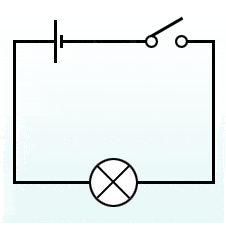
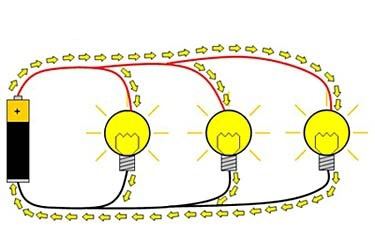
What type of circuit is shown in the picture?
Series Circuit
Broken Circuit
Parallel Circuit
Open Circuit
resistance is
a force that attracts metal
a force that allows electricity to pass easily
a force that opposes the flow of electricity


Which statement is true?
The light bulb will light up because the circuit is complete.
The light bulb will light up because the circuit is broken.
The light bulb will not light up because the circuit is complete.
The light bulb will not light up because the circuit is open.

The resistance of a light bulb is 30 ohms. If the current must double but the battery is remaining the same, the light bulb must be replaced by one with ____ ohms.
60 ohms
30 ohms (the light bulb resistance will not change)
15 ohms
More information is needed
Which two changes to a metal wire both increase resistance?
decreasing its length and increasing its temperature
increasing its length and decreasing its temperature
decreasing its thickness and increasing its temperature
increasing its thickness and decreasing its temperature
If there is a current of 2A and a resistance of 24 ohms, what voltage will there be?
26 V
48 V
12 V
22 V

If a toaster produces 12 ohms of resistance in a 120-volt circuit, what is the amount of current in the circuit?
5A
10A
15A
20A
Copper is a metal commonly used for electrical wiring in houses. Which metal conducts electricity better than copper at 20oC?
nichrome
gold
silver
aluminum
The resistance of a circuit remains constant. Which graph best represents the relationship between the current in the circuit and the potential difference provided by the battery?


The voltage of a circuit that has a resistance of 10 ohms and a current of 1.5 A is
15 V
0.15 V
6.7 V
None of these


Electrons flows from
detect electric current
negative terminal to positive terminal
positive terminal to negative terminal
the flow rate of electric charges through a conductor
Galvanometer is used to
detect electric current
negative terminal to positive terminal
positive terminal to negative terminal
the flow rate of electric charges through a conductor

