wayground logo

Free Printable Worksheets

NEW

Font size

S
M
L
XL
Worksheets

Final Review (part 2)

Total questions: 68

Worksheet time: 17hrs 0mins

Name
Class
Date
1.

How much work is being done with 200 N of force to the right on object that moves 426 meters to the right? (assume the force and displacement are in the same direction)

a)

85,200 J

b)

45,620 J

c)

90,480 J

d)

62,329 J

2.
When you release a stretched rubber band, the rubber band has ________ energy. 
a)
kinetic 
b)
potential
c)
none of the above
d)
all of the above 
3.

Fill in the blank:

The formula for Work is....W = F x ___

a)

D, depends

b)

D, depth

c)

D, diameter

d)

D, distance

4.

The formula for Work is....W = F x D, what does F stand for?

a)

Fight

b)

Force

c)

Forward

d)

Foreign

5.
What is a closed path for electrons to flow through?
a)
static electricity
b)
circuit
c)
amperes
6.
Identify the conductor below.
a)
cloth rag
b)
plastic bottle
c)
gold ring
7.
Identify the insulator below.
a)
aluminum foil
b)
paperclip
c)
rubber eraser
8.
As the resistance in a circuit increases, the electric current __________.
a)
increases
b)
decreases
c)
stays the same
9.
Electricity is the flow of _________.
a)
protons
b)
neutrons
c)
electrons
10.
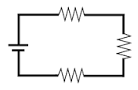
What type of circuit is pictured?
a)
series
b)
Parallel
11.
What type of circuit is pictured?
a)
series
b)
parallel
12.

is the opposition to the flow of charges in a material.

a)

Resistance

b)

Voltage

c)

Time

d)

Current

13.

What would happen if in a circuit the voltage is increase?

a)

The time would increase

b)

The current would increase

c)

The current would decrease

d)

The current would stay the same

14.

What would happen if in a circuit, the resistance increases but the voltage stays the same?

a)

The current would decrease

b)

The current would increase

c)

The voltage would decrease

d)

The voltage would increase

15.

What unit is used to measure current?

a)

Ohms

b)

Omega

c)

Volts

d)

Amps

16.

What unit is used to measure resistance?

a)

Ohms

b)

Omega

c)

Volts

d)

Amps

17.

What is the resistance of a lightbulb that experiences 9 Volts and 3 amps of current?

a)

1/3 ohms

b)

3 ohms

c)

27 ohms

d)

9 ohms

18.

What is the voltage of a circuit with 4 ohms of resistance and 3 amps of current?

a)

12 V

b)

21 V

c)

4/3 V

d)

3/4 V

19.
Where is the strongest attraction force of the magnet?
a)
at the poles
b)
in the middle
c)
above the magnet
d)
below the magnet
20.
What kind of magnet can be turned on and off?
a)
refridgerator magnet
b)
electromagnet
c)
magnetite
d)
iron
21.
The two poles on a magnet are
a)
north and east
b)
north and west
c)
south and north
d)
south and west
22.
Electricity can be used to create a magnet
a)
True
b)
False
23.

ALL metals are attracted to magnets?

a)

True

b)

False

24.
In the modern periodic table elements are arranged by:
a)
atomic mass
b)
atomic number
c)
valence electrons
d)
number of isotopes
25.
An element's identity is determined by the number of
a)
electrons.
b)
protons.
c)
neutrons.
d)
valence.
26.
Most of the mass of an atom is found it its _____.
a)
electron cloud
b)
nucleus
c)
atomic number
d)
empty space
27.
An element is made up of only one kind of _____.
a)
isotope
b)
plastic
c)
atom
d)
metal
28.
What subatomic particles are located in the electron cloud?
a)
quarks
b)
protons
c)
electrons
d)
neutrons
29.
Which subatomic particle has a negative charge in the atom?
a)
proton
b)
neutron
c)
electron
d)
quark
30.
Which is an electron?
a)
A
b)
B
c)
C
31.
Which is a proton?
a)
A
b)
B
c)
C
32.
Which item on this element square is the chemical symbol?
a)
Copper
b)
29
c)
Cu
d)
63.546
33.
Which item on this element square represents the atomic number?
a)
13
b)
Al
c)
Aluminum
d)
26.981538
34.
What is the number of protons that the element in this image contain?
a)
14
b)
7
c)
15
d)
18
35.
What is the atomic mass of "F"
a)
9
b)
18
c)
17
d)
19
36.
A charged particle that has gained or lost electrons is called a _____.
a)
molecule
b)
ion
c)
isotope
d)
element
37.
A cation is a ____ ion.
a)
negative
b)
positive
c)
neutral
d)
ficticious
38.
A anion will be a ____ ion.
a)
negative
b)
positive
c)
neutral
d)
ficticious
39.

Nitrogen, N, will form which of the following ions?

a)

N

b)

N-3

c)

N-5

d)

N+5

40.

Beryllium, Be, will ____ valence electrons when forming an ionic bond.

a)

lose 4

b)

gain 4

c)

lose 2

d)

gain 2

41.
In the compound aluminum oxide, which is the cation?
a)
Al+3
b)
Al
c)
O-2
d)
O
42.
Ionic bonds form between metals and ____.
a)
metalloids
b)
metals
c)
nonmetals
43.

Sulfur, S, will ____ valence electrons when forming an ionic bond.

a)

gain 1

b)

lose 1

c)

gain 2

d)

lose 2

44.
In the chemical formula for an ionic compound, which item is written first?
a)
positive ion
b)
negative ion
c)
subscript
d)
the female
45.
Write the formula for barium + nitrogen
a)
Ba2N3
b)
Ba3N2
c)
BaN
d)
BaN3
46.
Write the correct chemical formula for Ag  and  Br -
a)
AgBr
b)
silver bromide
c)
Ag2Br2
d)
gold bromide
47.
Write the correct formula for an ionic compound formed from S2- and Rb1+.
a)
SRb2
b)
SRb
c)
Rb2S
d)
RbS2
48.

What will be the charge of a bromine ion?

a)

+7

b)

-7

c)

-1

d)

+1

49.

Name the ionic compound, LiCl

a)

lithium chlorine

b)

lithium chloride

c)

lithium chlorate

d)

lithium monochloride

50.

Name the ionic compound, CaCO3

a)

calcium carbide

b)

calcium carbon trioxide

c)

calcium carbon oxide

d)

calcium carbonate

51.

Name the ionic compound, FeBr3

a)

Iron (II) bromide

b)

Iron (III) bromide

52.
K20 - name?
a)
potassium dioxide
b)
potassium oxide
c)
potassium oxygen
d)
dipotassium dioxide
53.

What is the formula for diphosphorus pentoxide?

a)

P2O5

b)

PO5

c)

P5O2

d)

Po2O5

54.

What is the name for SiCl4?

a)

silicon tetrachloride

b)

silicon quadchloride

c)

monosilicon tetrachloride

d)

silicon chloride

55.

What is the chemical formula of sulfur hexabromide?

a)

SBr₆

b)

S₆Br

c)

S(VI)Br

d)

SBr4

56.
Always starts with a Hydrocarbon that reacts with oxygen and produces carbon dioxide and water. 
a)
Decomposition
b)
Synthesis
c)
Combustion
d)
Single Replacement
57.
One reactant into several products.
a)
Decomposition
b)
Synthesis
c)
Combustion
d)
Single Replacement
58.
One element replaces another in a compound.
a)
Synthesis
b)
Combustion
c)
Single Replacement
d)
Double Replacement
59.
Ions in two compounds switch. 
a)
Synthesis
b)
Combustion
c)
Single Replacement
d)
Double Replacement
60.
The reactants are on the left side of the chemical equation.
a)
True
b)
False
61.
How many Oxygens are in this molecule? 
(OH)2
a)
4
b)
1
c)
2
d)
3
62.
What are the smaller numbers that you CANNOT change in a chemical equation? 
a)
Coefficient
b)
Products
c)
Reactants
d)
Subscript
63.
What are the larger numbers that you CAN CHANGE in a chemical equation? 
a)
Coefficient 
b)
Products
c)
Reactants
d)
Subscripts
64.
How many HCl molecules do you need to balance this equation? 
Mg +  __HCl --->  MgCl2 + H2
a)
1
b)
2
c)
3
d)
4
65.
Pb(NO3)2  +  KI --> PbI2 + KNO3
What type of reaction is this? 
a)
Synthesis 
b)
Decomposition 
c)
Single Replacement
d)
Double Replacement 
66.
__Na  +  O2 ----->  __Na2O
Type of reaction? 
Balance it too. :)
a)
Synthesis, 2Na /  4Na2O
b)
Decomposition, 4Na /  2Na2O
c)
Synthesis, 4Na /  2Na2O
d)
Decomposition, 2Na /  4Na2O
67.
Which problem is balanced?
(Check ALL answers)
a)
PbO2 + 2H2
b)
SO2 + H20 --> H2SO4
c)
2Na + 2H2O --> 2NaOH + H2
68.
Element or compound?
H2O
a)
element
b)
compound