wayground logo

Free Printable Worksheets

NEW

Font size

S
M
L
XL
Worksheets

2nd Grading Reviewer for Adv. Chem

Total questions: 64

Worksheet time: 1hrs 23mins

Name
Class
Date
1.
An isotope has a different number of
a)
electrons
b)
neutrons
c)
protons
d)
positrons
2.
A nuclear reaction where a nucleus splits into two smaller nuclei is... 
a)
Fission
b)
Fusion
c)
Gamma decay
d)
Beta decay
3.
What element is the ?
a)
Ag-115
b)
Cd-115
c)
Pd-115
d)
Not Listed
4.
Which type of nuclear radiation is being emitted here?
a)
alpha
b)
beta
c)
gamma
d)
none
5.
Which type of nuclear radiation is being emitted here?
a)
Alpha
b)
beta
c)
gamma 
d)
none
6.
Balance the following equation:
146C --> 0-1e + ________
a)
145B
b)
146C
c)
147N
d)
42He
7.
Two or more nuclei combine to form one larger nucleus in the process of nuclear _____.
a)
Fusion
b)
Fission
c)
Tracing
d)
Decay
8.
This is an example of...
a)
Fission  reaction
b)
Fusion reaction
c)
Decomposition reaction
d)
Combustion
9.
Has the highest penetrating power.  Can penetrate our body.  Even several cm thick of lead or several meters thick of concrete cannot stop all of it.
a)
Alpha
b)
Beta
c)
Gamma
10.
Has the lowest penetrating power.  Can only penetrate 0.05 mm into the body and can be stopped by a piece of paper or clothing.
a)
Alpha
b)
Beta
c)
Gamma
11.
What type of nuclear reaction is this?
a)
alpha
b)
beta
c)
gamma
d)
hot
12.
The time needed for half of a radioactive sample to decay is called its __________.
a)
decay period
b)
period
c)
transmutation time
d)
half-life
13.

When the isotope 5024X releases a beta particle we get another element, Y, that looks like

a)

5023Y

b)

4622Y

c)

5025Y

d)

5024Y

14.

What is meant by the statement that 3215P has a half life of 14 days

a)

It takes 7 days to go down to 50% radioactivity each time

b)

It takes 14 days to go down to 50% radioactivity each time

c)

After 14 days it starts to become less radioactive

d)

It takes 14 days to go up by 50% radioactivity each time

15.
The half life of Thorium-234 is 24 days. What fraction of the element remains after 96 days
a)
1/2
b)
1/4
c)
1/8
d)
1/16
16.
Gamma rays have a _____ charge
a)
0
b)
+1
c)
-1
d)
+2
17.
What type of decay is this?
7534Se + 0-1e --> 7533As
a)
Electron Capture
b)
Positron Emission
c)
Alpha Decay
d)
Beta Decay
18.
The technetium-99 isotope has a half-life of 6.0 hours. If 100.0 mg were injected into a patient how much remains after 18 hours?
a)
33.0 mg
b)
12.5 mg
c)
.33 mg
d)
15.8 mg
19.
Scientist involved with discovery of radioactivity.
a)
Albert Einstein
b)
Ernest Rutherford
c)
Marie Curie
d)
Isaac Newton
20.
Why does an atom undergo beta decay?
a)
It has too many electrons.
b)
It has an atomic number greater than 83
c)
It has more neutrons than protons
d)
It has more protons than neutrons
21.
What happens to the atomic number during alpha decay?
a)
The atomic number decreases by 4
b)
The atomic number increases by 1
c)
The atomic number decreases by 2.
d)
The atomic number stays the same.
22.
What element is often used in nuclear reactions?
a)
Hydrogen
b)
Uranium
c)
Oxygen
d)
Mercury
23.
Most nuclear reactors use:
a)
Fission
b)
Fusion
24.
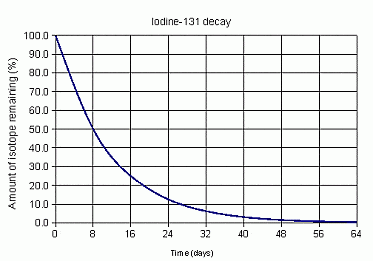
If 10 mg of iodine 131 is given to a patient, how much is left after 24 days? The half-life of iodine-131 is 8 days.
a)
1.25mg
b)
1.25g
c)
10g
d)
10mg
25.
What is the half-life of iodine-131?
a)
32 days
b)
8 days
c)
16 days
d)
24 days
26.

The force that holds the protons and neutrons together in the nucleus of an atom is called __________.

a)

Binding force

b)

magnetic force

c)

centripetal force

d)

electrostatic force

27.
The nuclear process occurring at a nuclear power plant.
a)
Nuclear fusion
b)
Nuclear fission
c)
Combustion
d)
Multiplication
28.
The technetium-99 isotope has a half-life of 6.0 hours. If 100.0 mg were injected into a patient how much remains after 18 hours?
a)
33.0 mg
b)
12.5 mg
c)
.33 mg
d)
15.8 mg
29.

Ionic bonds happen when valence electrons are

a)

shared

b)

too heavy

c)

transferred

30.

Which type of bond occurs between non metals?

a)

covalent bonds

b)

ionic bonds

c)

metallic bonds

d)

all types of bonds

31.

How many valence electrons does Oxygen have?

a)

0

b)

16

c)

6

d)

8

32.

What type of bond forms CaF2

a)

covalent bond

b)

ionic bond

c)

metallic bond

d)

all answers are correct

33.

Which type of bond is creates MgFe?

a)

covalent bond

b)

ionic bond

c)

metallic bond

d)

all the bonds

34.

Compounds that share specific valence electrons are formed by

a)

covalent bonds

b)

ionic bonds

c)

metallic bonds

d)

all types of bonds

35.

Compounds or elements that share their pooled valence electrons are

a)

covalent bonds

b)

ionic bonds

c)

metallic bonds

d)

all types of bonds

36.
What elements generally make an ionic bond?
a)
metal and nonmetal
b)
2 nonmetals
c)
metal
d)
none of the above
37.
What happens when an atom loses an electron?
a)
It becomes Negatively Charged
b)
It remains neutral because the proton also leaves.
c)
It becomes Positively Charged
d)
It stays the same.
38.

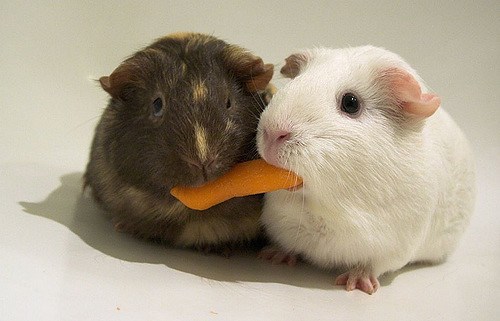
Which bond does this picture best represent?

a)

Metallic bond

b)

ionic bond

c)

covalent bond

d)

James Bond

39.
For carbonate ions, how many resonance structures can be drawn ?
a)
2
b)
3
c)
4
d)
5
40.
Define the term resonance structure
a)
Delocalization of electrons in an atom
b)
Delocalization of π electrons within a molecule
c)
Spread of π electrons in an atom
d)
Spread of π electrons within a molecule
41.
How many resonance structures for CH3COO- ion?
a)
1
b)
2
c)
3
d)
4
42.

According to the Octet Rule, atoms of elements react with each other in order to get ______ electrons in their outermost energy level or shell.

a)

2

b)

4

c)

8

d)

10

43.

What is the name for when more than one valid Lewis structure can be drawn for a molecule?

a)

coordinate covalent bond

b)

resonance

c)

endothermic

d)

structural formula

44.

How many valence electrons should Lithium have in its Lewis dot model?

a)

1

b)

2

c)

3

d)

4

45.

How many valence electrons should Oxygen have in its Lewis dot model?

a)

5

b)

6

c)

7

d)

8

46.

What is the formal charge on the oxygen atom at the top of this Lewis dot structure?

a)

0

b)

+1

c)

-1

d)

-2

47.
Calculate the Formal Charge for the Nitrogen
a)
-1
b)
+1
c)
0
d)
-2
48.
What is the formal charge for Selenium
a)
+1
b)
-1
c)
0
d)
-2
49.

What is the molecular geometry of BF3?

a)

bent

b)

trigonal planar

c)

tetrahedral

d)

trigonal pyramidal

50.

What is the formal charge on the phosphorus atom in this Lewis dot structure?

a)

0

b)

-1

c)

+1

d)

-3

51.

What is the formal charge on the bromine atom in this Lewis dot structure?

a)

-1

b)

+1

c)

-2

d)

+2

52.

What is the molecular geometry of PCl5

a)

trigonal bipyramidal

b)

seesaw

c)

square pyramidal

d)

square planar

53.
Choose the correct shape for this molecule:
a)
Bent
b)
Trigonal pyramidal
c)
Trigonal planar
d)
Linear
54.
Choose the correct shape for this molecule:
a)
linear
b)
Trigonal pyramidal
c)
Bent
d)
Tetrahedral
55.
 A lone pair is defined as
a)
A pair of bonding electrons
b)
One non-bonding electron
c)
A pair of non-bonding electrons
d)
A pair of electrons on the central atom
56.
What is the VSEPR theory used to predict?
a)
Bond Strength
b)
Polarity
c)
Molecular Shape
d)
Electronegativity
57.
Choose the correct shape for this molecule:
a)
Bent
b)
Linear
c)
Tetrahedral
d)
Trigonal pyramidal
58.

Which best describes a triple bond?

a)

3 shared pairs of electrons

b)

3 shared electrons

c)

a central electron with 3 atoms bonded around it

59.
Choose the correct shape for this molecule:
a)
Trigonal planar
b)
Trigonal pyramidal
c)
Bent
d)
Tetrahedral
60.
Choose the correct shape for this molecule:
a)
Tetrahedral
b)
Trigonal pyramidal
c)
Bent
d)
Trigonal planar
61.

The geometry of a molecule with 3 bonded pairs of electrons and 0 lone pairs of electrons, AB3

a)

Tetrahedral

b)

Trigonal Planar

c)

Bent

d)

Trigonal Pyramidal

e)

Linear

62.

The geometry of a molecule with 4 bonded pairs of electrons and 0 lone pairs of electrons, AB4

a)

Tetrahedral

b)

Trigonal Planar

c)

Bent

d)

Trigonal Pyramidal

e)

Linear

63.
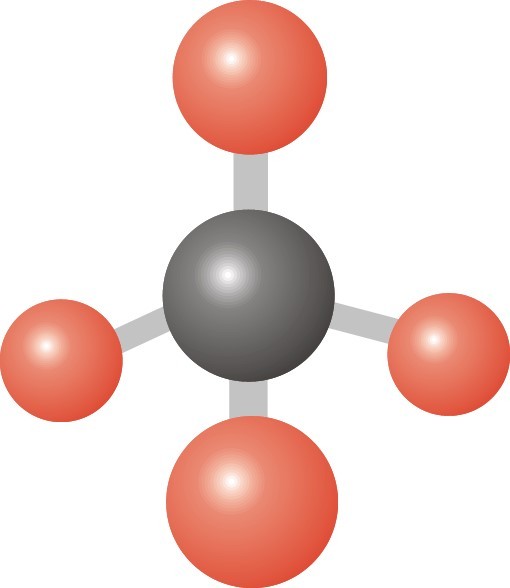
Who could this molecule be?
a)
CH4
b)
CO2
c)
PCl5
d)
BF3
64.

What is the molecular shape of the following?

a)

Hexahedral

b)

Square Pyramid

c)

Octahedral

d)

T-Shape