
 Worksheets
Ultimate Solutions Review
Total questions: 50
Worksheet time: 52mins
Ca(C2H3O2)2
soluble
insoluble
AgI2
soluble
insoluble
Which actions will cause Na2SO4 (s) to dissolve faster? Choose all that apply.
Stir the solution.
Crush the Na2SO4 into smaller pieces.
Heat the mixture.
Cool the mixture.
Why does agitating the solution affect the rate of dissolving?
Agitation moves the particles around more, leading to more solvent-solute attractions.
Agitation forces the solvent particles into a crystalline conformation.
Agitation leads to increased colligative properties, which speeds dissolving.

Why does changing the temperature affect the rate of dissolving?
Changing the temperature changes the average kinetic energy of the solution's particles. This changes their speed, leading to more or fewer solvent-solute interactions.
Changing the temperature changes the color of the solution's particles. This makes them more interesting to each other and draws them together.
Changing the temperature changes the number of moles of particles. More moles of particles dissolve faster.
Why does changing the solute surface area affect the rate of dissolving?
Changing the surface area changes how quickly the solvent particles can access the solute particles, which changes the speed of solute-solvent attractions forming.
Changing the surface area changes how light refracts on the solute, heating it up and speeding the dissolution.
Changing the surface area makes more space for new solute to be added, making it dissolve faster.
Surface tension of water is the cohesive force between water molecule and other molecule.
True
False
Surface tension of the water is the cohesive force between water molecule on the surface of water.
True
False

Which statement explains why water molecules stick together?
both sides are negative
one side has a partial positive charge and the other side has a partial negative charge
one side has a negative charge and the other side has a neutral charge
both sides are positive


How much KNO3 solute is saturated at 40 degrees?
75
55
65
85
How much C12H22O11 solute is saturated at 40 degrees?
240
220
230
250
How much Ce2(SO4)3 solute is saturated at 80 degrees?
20
15
30
2

At what temperature can you fully dissolve 140g of NaNO3?
62
73
81
You cannot determine this
At what temperature can you fully dissolve 60g of KNO3?
27
30
37
You cannot determine this
What type of a solution is 60g NaNO3 at 40ºC in 100g H2O?
Saturated
Unsaturated
Supersaturated
What type of a solution is 100g KNO3 at 40ºC in 100g H2O?
Saturated
Unsaturated
Supersaturated
What type of a solution is 260g sugar at 50ºC in 100g H2O?
Saturated
Unsaturated
Supersaturated

Which of the following refers to the substance that is being dissolved in a solution?
solvent
solute
mixture

A solution contains 14g of KCl in 100g of water at 40°C. What is the minimum amount of KCl that must be added to make this a saturated solution?
14g
19g
25g
44g
What happens when a crystal of a salt is dropped in an unsaturated solution of the same salt?
excess solute crystals form
the crystal dissolves
the crystal drops to the bottom, unchanged
the solution becomes colorless
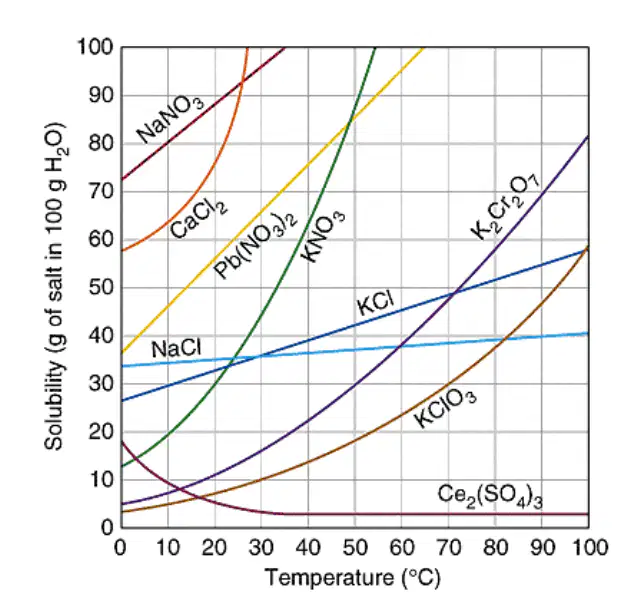
An unsaturated solution is formed when 80 grams of a salt is dissolved in 100 grams of water at 40°C. This salt could be
KCl
KNO3
NaCl
NaNO3
You need to make 200 mL of a 0.20 M aqueous solution of sodium chloride. The only available solution is 1.0 M. Determine how to make the needed dilution.
Add 160 mL to the initial volume
Add 160 grams to the initial volume
Evaporate 160 mL from the initial volume
the experiment cannot be conducted with the materials provided
A dilution is when
solute is added to the volume of stock solution
water is added to the volume of stock solution
solute is removed from the volume of stock solution
water is removed from the volume of stock solution
Calculate the Molarity in a solution containing 40.0 g of NaCl dissolved in 500.0 ml of H2O.
0.08 M
12.5 M
1.37 M
0.74 M
Calculate the grams of NaOH present in 10.0 mL of a 2.0 M NaOH solution.
0.8 grams
2000 grams
0.3 grams
5 grams
Molarity is ...
grams of solute/deciliters of solvent.
grams of solute/liters of solution.
moles of solute/liters of solution.
moles of solute/milliliters of solvent.
A solution is made by dissolving 0.50 mole of NaCl in enough water to give a final volume of 400.0 mL. What is the molarity of the solution?
0.10 M
0.40 M
1.25 M
2.33 M
The definition of a stock solution is ...
a highly concentrated solution that is meant to be diluted to some lower concentration.
moles of solute divided by liters of solvent
a solution used to make soup and is usually either chicken or beef flavor
a solution with less dissolved solute than a dilute solution.
A 0.500 M solution of NaOH, which contains 0.750 mole of solute, would have a volume, in milliliters
0.667 mL
1200 mL
1500 mL
2100 mL
If 0.775 L of 1.00 M NaOH is diluted to 1.00 L, the resulting solution contains
0.225 mol NaOH
0.775 mol NaOH
1.25 mol NaOH
2.45 mol NaOH
Which of the following solutions has a molarity of 2.0?
0.050 mole of solute in 0.0250 L of solution
2.0 moles of solute in 0.5000 L of solution
3.0 moles of solute in 1.5000 L of solution
none of the above
Calculate the moles in 1500 mL of a 2 M solution of BaI2
1.33 moles
2.25 moles
3.00 moles
3000 moles
CuCl2 + NaOH → Cu(OH)2 + NaCl
Which product is insoluble?
CuCl2(aq) + NaOH(aq) → Cu(OH)2(s) + NaCl(aq)

Which of the following reactions does NOT form a precipitate?
Pb(NO3)2 (aq) + 2KI (aq) → PbI2 (s) + 2KNO3 (aq)
Pb(NO3)2 (aq) + K2SO4 (aq) → PbSO4 (s) + KNO3 (aq)
AgNO3 (aq) + Na2S (aq) → Ag2S (s)+ NaNO3 (aq)
KCl (aq) + NaNO3 (aq) → NaCl (aq) + KNO3 (aq)
What is the result of this reaction?
2KBr(aq) + Na2S(aq) → K2S(aq) + 2NaBr(aq)
K2S precipitates
NaBr precipitates
KBr precipitates
No precipitate is formed
What is the correct net ionic equation for the reaction between HBr(aq) and LiOH(aq)?
2 H+(aq) + O2-(aq) → H2O(l)
2 H2 (aq) + O2(aq) → 2 H2O(l)
2 H2 (g) + O2(g) → 2 H2O(l)
H+(aq) + OH-(aq) → H2O(l)

