wayground logo

Free Printable Worksheets

Font size

S
M
L
XL
Worksheets

3rd Qtr. Bonus

Total questions: 100

Worksheet time: 2hrs 58mins

Name
Class
Date
1.
The time it takes for 50% of the nuclei in a radioactive sample to decay to its stable isotope is called _____.
a)
the daughter product
b)
geologic time
c)
the half-life
d)
the half-time
2.
Suppose you found a material in which 12.5% of the original radioactive atoms were still present.  If the half-life of an atom is 60 years, how old is the material?
a)
30 years old
b)
60 years old
c)
120 years old
d)
180 years old
3.

How long is the half life of carbon-14?

a)

5,730 years

b)

57,300 years

c)

573,000 years

d)

5,730,000 years

4.
According to the law of superposition, the oldest fossils are found 
a)
At the top of the rock layers
b)
Near the bottom of the rock layers
c)
In the middle of the rock layers
d)
Somewhat near the surface
5.

States that younger rocks lie above older rocks if the layers have not been disturbed

a)

Law of crosscutting

b)

Law of superposition

c)

Uniformitarianism

d)

Unconformity

6.
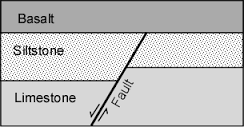
How does the law of crosscutting explain the age of a fault?
a)
The fault is younger than the rocks above it.
b)
The fault is younger than the rocks it cuts through.
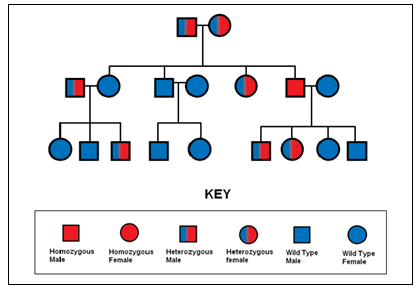
c)
The fault is older than the rocks above it.
d)
The fault is older than the rocks it cuts through.
7.
How do geologists use relative dating?
a)
Placing rocks in order from youngest to oldest
b)
Placing rocks in order by minerals they contain
c)
Classifying rocks by different textures
d)
Classifying rocks by different isotopes
8.
What are the relative ages of the features in order from oldest to youngest?
a)
Limestone, Basalt, Fault, Siltstone
b)
Siltstone, Fault, Basalt, Limestone
c)
Limestone, Fault, Basalt, Siltstone
d)
Limestone, Siltstone, Fault, Basalt
9.
Gaps in rock layers caused by erosion are called
a)
law of superposition
b)
unconformities
c)
uniformitarianism
d)
relative dating
10.
Which of the following is the oldest?
a)
Layer L
b)
Intrusion D
c)
Intrusion H
d)
Layer E
11.
What is the largest segment of geologic time?
a)
Eon
b)
Era
c)
Period
12.
The best index fossils have which two traits?
a)
widespread geographically, long lifespan
b)
widespread geographically, short lifespan
c)
specific place, long lifespan
d)
specific place, short lifespan
13.
Which fossil makes the best index fossil?
a)
Fossil 1
b)
Fossil 2
c)
Fossil 3
d)
None follow all of the rules
14.

What type of Genotype is this: AA?

a)

Homozygous

b)

Heterozygous

15.

What type of Genotype is this: Aa?

a)

Homozygous

b)

Heterozygous

16.

What type of Genotype is this: aa?

a)

Homozygous

b)

Heterozygous

17.
Alternative forms of a gene are called
a)
Alleles
b)
Homozygous
c)
DNA
d)
Genetics
18.
The physical appearance of an organism based on traits
a)
Genotype
b)
Phenotype
c)
Meiosis
d)
Genetics
19.
The allele combinations
a)
genetics
b)
mitosis
c)
genotype
d)
phenotype
20.
Mark is heterozygous. If B is for brown hair, and b is for blonde hair, what is Mark's genotype?
a)
BB
b)
bb
c)
Bb
d)
bB
21.

What do we call the table used to calculate the probability of an offspring's genotype?

a)

Punnett Square

b)

Venn Diagram

c)

Avogadro's Graph

d)

Circle of Life

22.
What is called when a organism has two identical alleles for a trait. TT or tt. RR or rr
a)
Heterozygous
b)
Homozygous
c)
Domozygous
d)
Thermozygous
23.
In a certain species of plant, the color purple (P) is dominant to the color white (p).
According to the Punnett Square, what is the probability of an offspring being purple?
a)
25%
b)
0%
c)
100%
d)
50%
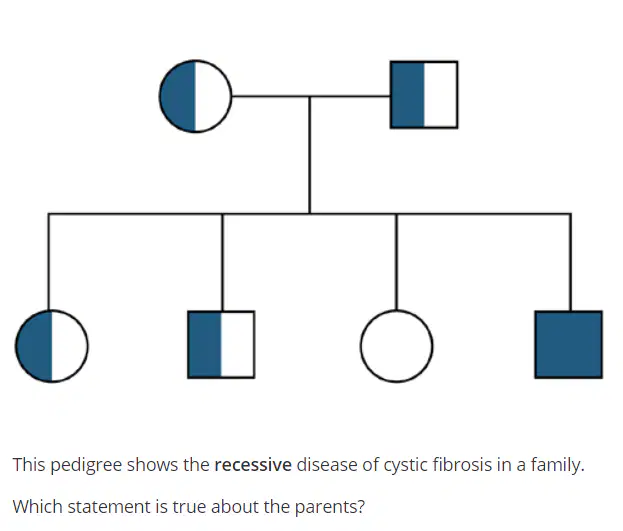
24.
a)

The parents are both homozygous recessive which means that they have the disease.

b)

The parents both are carriers for the disease. There is a 100% chance that they will pass it to the offspring.

c)

The parents have cystic fibrosis because they each have one allele for the disease.

d)

The parents are heterozygous which means that they are carriers for the disease.
25.
The supercontinent in the continental drift hypothesis was called ____.
a)
Pantry
b)
Pangaea
c)
Wegenerland
d)
Eurasia
26.

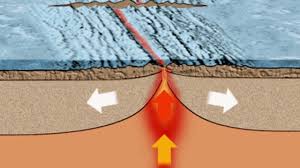
In sea-floor spreading, molten material rises from the mantle and erupts

a)

along the edges of all the continents.

b)

along mid-ocean ridges.

c)

in deep-ocean trenches.

d)

at the north and south poles.

27.

The process by which the ocean floor sinks beneath a deep-ocean trench and back into the mantle is known as _______

a)

convection.

b)

continental drift.

c)

subduction.

d)

conduction.

28.

Most geologists think that the movement of Earth’s plates is caused by _______

a)

convection.

b)

continental drift.

c)

subduction.

d)

conduction.

29.

A place where two plates slip past each other, moving in opposite directions, is known as a _______

a)

transform boundary

b)

divergent boundary.

c)

convergent boundary.

d)

rift valley.

30.
Mountains form from ...
a)
plates sliding past one another
b)
collision of plates
c)
plates moving away from each other
31.
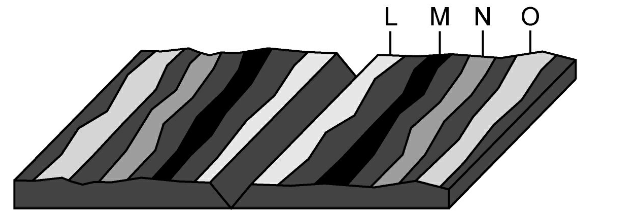
Where would the oldest rock be found?
a)
L
b)
M
c)
N
d)
O
32.

Which statement best describes the geologic process that is most likely responsible for the formation of mountains?

a)

They are along a transform plate boundary that is no longer active, so erosion is creating deep valleys.

b)

They are along a transform plate boundary in which plates are currently moving side by side, causing earthquakes and faults

c)

They are along a plate boundary in which plates are currently converging, causing uplift and steep slopes.

d)

They are along a plate boundary in which plates diverged in the distance past, allowing new rock to build up.

33.

A mid-ocean RIDGE is located at the boundary of two tectonic plates. Which diagram correctly models the relative plate motion on each side of a mid ocean ridge?

a)
b)
c)
d)
34.

According to geologist, the Hawaiian islands were formed by a........

a)

Hot spot

b)

plates

c)

atoll

d)

coral

35.
Who is the person credited with developing the theory of continental drift?
a)
Harry Hess
b)

Gregor Mendel

c)
Alfred Wegener
d)
Newton
36.
How does fossil evidence support Wegener's hypothesis of continental drift?
a)
Similar fossils are found along continental margins that appear to join together.
b)
Fossils are found in areas where the present-day climate could not have supported the organisms that made the fossils.
c)
Similar fossils of giant, land-dwelling dinosaurs are found on continents separated by oceans.
d)
all of the above
37.
What does the theory of continental drift state?
a)
The continents were once joined in a super-continent and have moved over time
b)
Continents are stationary and do not move
c)
The Earth is broken into lithospheric plates that move due to convection currents
d)
none of the above
38.

Two plates come together or collide at what boundary?

a)

Convergent

b)

Divergent

c)

Transform

39.

What two crustal features occur near every subduction zone?

a)

Volcanoes and Trenches

b)

Rift Valleys and Mid Ocean Ridges

c)

Volcanoes and Rift Valleys

d)

Mid Ocean Ridges and Trenches

40.

If an earthquake occurs at the bottom of the ocean floor what could form as result?

a)

Volcano

b)

Tsumani

c)

Tidal Wave

d)

Hurricane

41.

What is the only event associated with ALL plate boundaries?

a)

Volcanoes

b)

Earthquakes

c)

Subduction

d)

Deep Trenches

42.
Where is the force of attraction the strongest on a magnet?
a)
at the poles
b)
in the middle
c)
above the magnet
d)
below the magnet
43.

The entire region surrounding a magnet is known as the:

a)

Magnetic Domain

b)

Lodestone

c)

A Compass

d)

Magnetic Field

44.
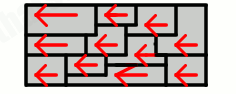
You know this substance is magnetized because
a)
all the domains have right angles
b)
the arrows are drawn in red
c)
the domains are aligned
d)
the domains are random
45.
This substance is
a)
magnetizecd
b)
unmagnetized
c)
positively charged
d)
negatively charged
46.

How can a neutral object become charged?

a)

by being dipped in water

b)

by being stuck to the desk with tape

c)

by allowing gravity to work on it

d)

by having electrons added or removed

47.

Based on the arrangement of the electric field lines in the diagram, what are the charges?

a)

both charges are the same

b)

the charges are opposite

c)

they are neutral; no charge

48.
As distance between two objects increase the pull of gravity 
a)
Increases
b)
Decreases
c)
Stays the same
49.
The force of gravity acting on an object is the object's ______.
a)
mass
b)
matter
c)
weight 
d)
terminal velocity 
50.
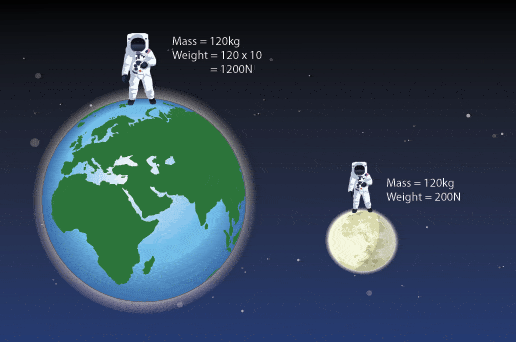
Which of the following will not change in different gravitational fields?
a)
weight
b)
force
c)
mass
d)
pounds
51.
A person would weigh more on Jupiter than on the Earth because . . .
a)
Jupiter has more mass, and therefore more gravity
b)
Jupiter has less mass, and therefore more gravity
c)
Jupiter has more mass, and therefore less gravity
d)
Jupiter has less mass and therefore less gravity
52.
The electrical force between charges is strongest when the charges are
a)
close together
b)
far apart
c)
 the electric force is constant everywhere.
d)
there is no pattern
53.

Static electricity is the buildup of charges between two objects. What best explains why a balloon is attracted to hair when the two have been rubbed together?

a)

The balloon and hair both have positive charges

b)

The balloon and the hair both have negative charges

c)

The balloon and the hair both have neutral charges

d)

The balloon and the hair both have opposite charges

54.

Who was named the "Father of Evolution?"

a)

Jean Baptiste Lamarck

b)

Mary Treat

c)

Alfred Russel Wallace

d)

Charles Darwin

55.

On what ship did Charles Darwin travel?

a)

HMS Beagle

b)

USS Nature

c)

LMS Finch

d)

The Mayflower

56.

On what islands did Charles Darwin study?

a)

Pagos Islands

b)

Green Islands

c)

Galapagos Islands

d)

Finch Islands

57.

The process by which species naturally adapt to fit their environment over time is called ______.

a)

artificial selection

b)

natural changing

c)

rapid selection

d)

natural selection

58.
What is the advantage of having different shaped beaks?
a)
To look different from other species.
b)
To be able to eat the food readily available in the environment.
c)
To protect itself against predators.
d)
To protect itself against prey.
59.
The difference in the physical traits of an individual from those of other individuals in a group is called a(n)
a)
change
b)
adaption
c)
species
d)
variation
60.

The more genetic variation a population has,

the more likely it is for some individuals to

a)

evolve

b)

migrate

c)

survive

d)

mutate

61.
Genetic variation can arise from a random change in the DNA of a gene.  The change is called a(n)
a)
mutation
b)
gene flow
c)
gene pool
d)
allele
62.

Fossil evidence can be used by scientists to prove which of the following?

a)

Organisms have been changing over time

b)

All of the organisms that have ever lived on Earth have been discovered

c)

Organisms of the past are identical to those living today

d)

Organisms with bones and shells are more common than those that lack ( do not have) these structures

63.

Why are advantageous traits more likely to be passed onto offspring?

a)

Because they are more likely to survive and reproduce.

b)

Because they come from dominant alleles.

c)

Because they come from recessive alleles.

d)

Because the organism knew it needed that trait, survives, and passes it on.
64.
Mutations are a change in what?
a)
DNA
b)
tRNA
c)
genotype
d)
phenotype
65.
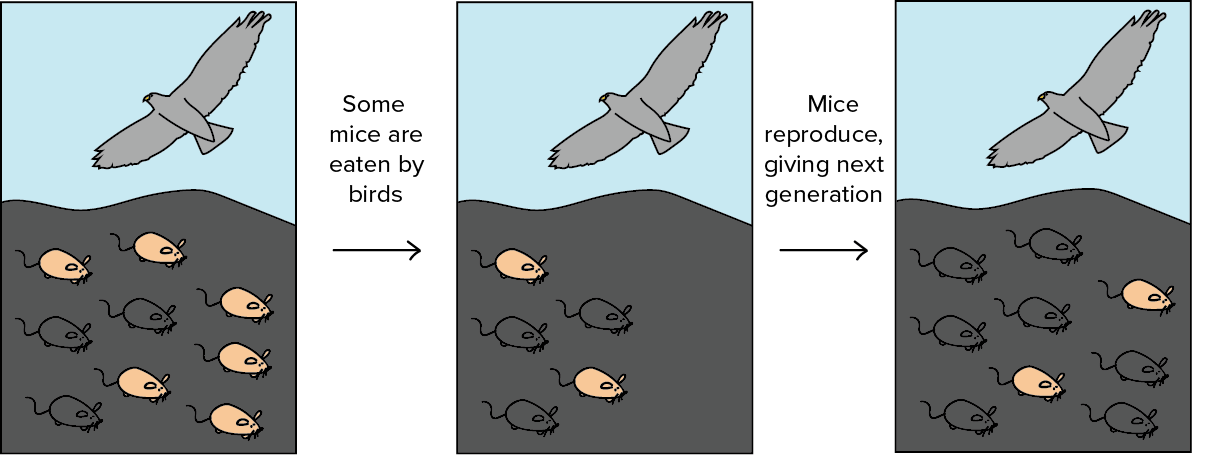
Why is the mouse population changing over time?
a)
The light mice can reproduce more successfully than the dark mice
b)
The hawks eat more dark mice than light mice because the dark mice taste better
c)
The hawks eat more light mice than dark mice because they can see the light mice more easily
d)
The hawks eat more dark mice than light mice because they can see the dark mice more easily
66.

The more genetic variation a population has,

the more likely it is for some individuals to

a)

evolve

b)

migrate

c)

survive

d)

mutate

67.
Which organisms are most likely to survive?
a)
the best adapted
b)
the fastest
c)
the strongest
d)
the most domesticated (tamed)
68.

Which of the following can be learned by using the fossil record?

a)

When organisms changed or evolved

b)

when organisms appeared on Earth

c)

when organisms became extinct

d)

All the above

69.
What you see, or the physical appearance.
a)
Genotype
b)
Phenotype
c)
Homozygous
d)
Heterozygous
70.
In a pedigree, what shape represents a male?
a)
circle
b)
square
c)
triangle
d)
diamond
71.
What does a filled in square represent?
a)
Not affected Female
b)
Not affected Male
c)
Affected Male
d)
Affected Female
72.
What do half colored symbols represent?
a)
The individual is a carrier (heterozygous).
b)
The individual expresses the trait.
c)
The individual has both recessive alleles.
d)
The individual has both dominant alleles.
73.
How many people in this whole pedigree have the trait/disease?
a)
2
b)
3
c)
4
d)
6
74.

If black and white are codominant in a chicken, then what is the phenotype of the offspring of a black chicken with a white chicken?

a)

black

b)

white

c)

grey

d)

black with white spots.

75.

The alleles of a gene pair in a heterozygote are both expressed with no blending.

a)

codominance

b)

incomplete dominance

c)

polygenic

d)

multiple alleles

76.

P waves travel faster than S waves

a)

True

b)

False

77.

When S waves leave the Mantle and enter the outer core, they...

a)

continue going straight

b)

refract as they go through the outer core

c)

reflect back to the surface

78.

Which waves will reach a seismic station first?

a)

P waves

b)

S waves

c)

Both reach at the same time

79.

What is a shadow zone?

a)

area where waves are not detected

b)

area where both p and s waves can be measured

c)

area where waves travel faster

d)

area where waves travel slower

80.

Which word means: to bend or change direction due to a change in speed?

a)

refraction

b)

reflection

81.
What kind of wave travels through the earth?
a)
Seismic Wave
b)
Ocean Wave
c)
Light Wave
82.
Which city is closest to the epicenter?  
a)
A
b)
B
c)
C
83.

Which seismogram represents a city that is far from the epicenter of an earthquake?

a)

New York, NY

b)

Nome, Alaska

c)

Guadalajara, Mexico

84.
How do geologists locate the epicenter of an earthquake?
a)
They measure the difference between seismic waves on three or more seismographs. The epicenter is where the circles intercept.
b)
They measure the difference between seismic waves on the first seismograph to receive the wave.
c)
They measure the largest surface wave to hit the surface.
d)
They add the total damage of the p wave, s wave and surface wave.
85.

This is known as the sudden shaking of the ground and known as the sources of seismic waves.

a)

earthquake

b)

tsunami

c)

flood

d)

typhoon

86.

Which classification of wave does the most damage?

a)

Body Waves

b)

Mega Waves

c)

Surface Waves (S-Waves)

d)

Primary Waves (P-Waves)

87.

The S-wave shadow zone shown in the figure exist because

a)

S-waves can travel through liquid medium

b)

Seismic waves cannot penetrate the mantle-core boundary

c)

The outer core is liquid

d)

The outer core is less dense

88.

Planetary differentiation is the idea that when the planet forms the layers are sorted by ____.

a)

color

b)

density

c)

weight

d)

mass

89.
Where the better adapted organisms survive to pass traits along to offspring.
a)
Evolution
b)
Natural Selection
c)
Extinction
d)
Artifical Selection
90.
Why are advantageous traits more likely to be passed onto offspring?
a)
Because they are more likely to survive and reproduce.
b)
Because they come from dominant alleles.
c)
Because they come from recessive alleles.
d)
Because the trait is an acquired phenotype.
91.

​Based on the fossil layers shown, what can you infer about the past environment at this location?

a)

The environment at this location has never changed

b)

The organisms at this environment became simpler over time

c)

The environment began as a dry land environment, then evolved into an ocean or water environment.

d)

The environment began as an ocean or water environment, then evolved into a dry land environment.

92.
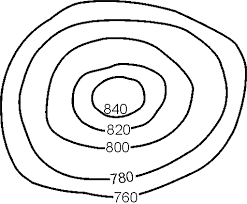
What is the elevation of Y?
a)
Between 120-140 meters
b)
Between 100-120 meters
c)
Between 140-160 meters
d)
Between 80-100 meters
93.
Determine the contour interval:
a)
5 m
b)
10 m
c)
15 m
d)
20 m
94.

The process by which rock and soil are moved from one place to another is called-

a)

Chemical weatherin

b)

Erosion

c)

Mechanical weathering

d)

Deosition

95.

The breaking down of rocks and other materials on the Earth's surface.

a)

Weathering

b)

Erosion

c)

Deposition

d)

Exfoliation

96.

This type of weathering in which rock is physically broken into smaller pieces.

a)

Chemical weathering

b)

Erosion

c)

Mechanical weathering

d)

Deposition

97.

What do we call the process in which rock is broken down by changes in its chemical makeup.

a)

Chemical weathering

b)

Mechanical weathering

c)

Erosion

d)

Deposition

98.

The grinding/scratching away of rock by other rock particles carried in water, ice, or wind

a)

Frost wedging

b)

Exfoliation

c)

Oxidation

d)

Abrasion

99.

The image above depicts the effects of chemical weathering breaking down limestone. Which type of chemical weathering causes this reaction?

a)

Acid rain

b)

Oxidation

c)

Exfoliation

d)

Abrasion

100.

What will happen to MOST of the sediment being transported by the river water when it first enters the ocean at Location T in the diagram?

a)

Most of the sediment will erode beaches.

b)

Most of the sediment will dissolve in the water.

c)

Most of the sediment will be evenly distributed throughout the ocean.

d)

Most of the sediment will collect near the mouth of the river near the shore.