
 Worksheets
Unit 1 CUA REVIEW 1
Total questions: 99
Worksheet time: 1hrs 21mins

Describe the motion in the graph:
Constant Speed (positive slope)
Stopped (at rest)
Acceleration (increasing speed)
Return Home (negative slope)

Describe the motion in the graph:
Constant Speed (positive slope)
Stopped (at rest)
Acceleration (increasing speed)
Return Home (negative slope)

Describe the motion in the graph:
Constant Speed (positive slope)
Stopped (at rest)
Acceleration (increasing speed)
Return Home (negative slope)
How do you find the speed from a distance-time graph?
Find the area under the graph
Find the gradient of the line
Read the height of the graph

Which line shows the slower pace?
dashed line
solid line

What is the speed of segment A?
0.5 m/s
2 m/s
3 m/s
0 m/s

What is the speed after 2 seconds?
40 m/s
20 m/s
10 m/s
40 m

Find the average speed from 30 to 60 minutes on this graph. (Hint: distance traveled during time range /divided by time)
0.03 km/min
0.05 km/min
0.67 km/min
0.07 km/min

What is this graph showing?
At rest
Acceleration
Constant speed of 1 m/s
Gradually speeding up
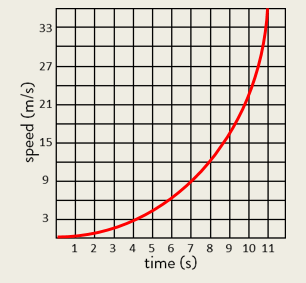
What is this graph showing?
Gradually slowing down
Gradually speeding up
Constant speed
Stopped

What is this graph showing?
Constantly slowing down
Constantly speeding up
Acceleration
Returning to starting point
Match the graph to the description:
"The car is stopped."
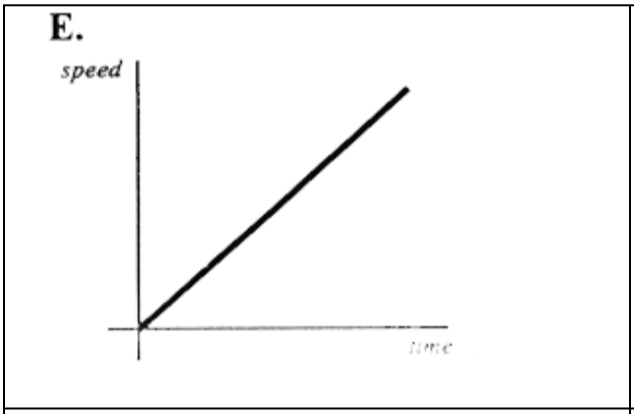
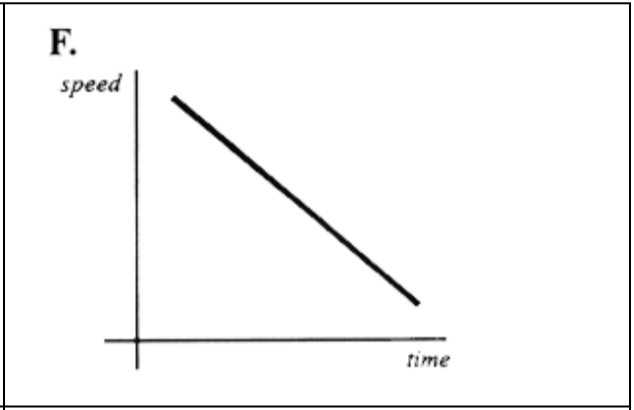
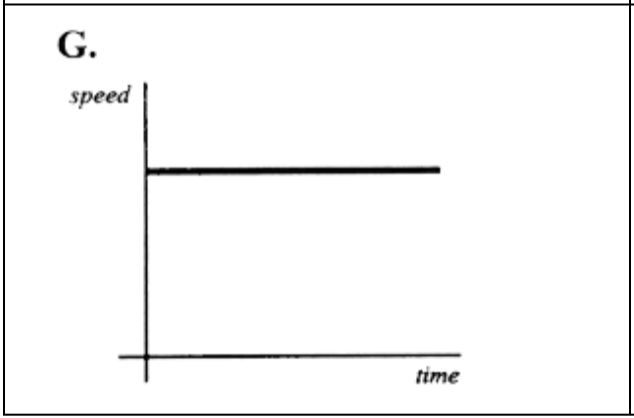
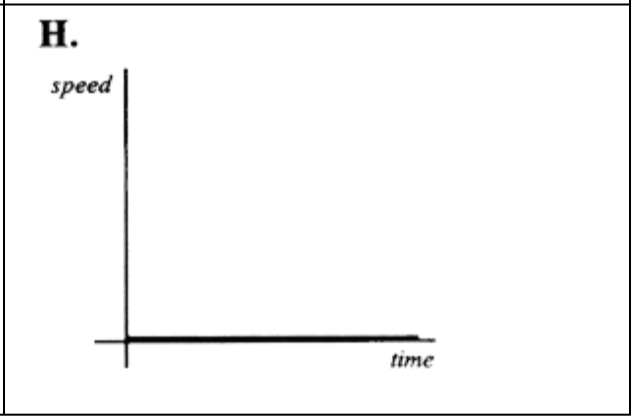
Match the graph to the description:
"The car is accelerating speeding up (positive acceleration)."
Match the graph to the description:
"The car is slowing down (negative acceleration)."
Match the description to the graph:
"The car is traveling at a constant speed."


Match the description to the graph:
"The car is coming back."

Segment A-B The bus is _________________.
at rest
returning (to original position)
moving forward
Segment O-A The bus is _________________.
at rest
returning (to original position)
moving forward

Which runner won the race?
Albert
Bob
Charlie
Which runner stopped for a rest?
Albert
Bob
Charlie
How long did Charlie stop for a rest?
2.5 seconds
2 seconds
3 seconds
5 seconds
What is a force?
the PUSH or PULL on an object
The MOTION an object creates
The objects HITTING one another
Going REALLY FAST
What is the unit for FORCE?
N (Newtons)
lbs (pounds)
g (grams)
m/s (meters per second)
If the net force is 0 the object will ...
CHANGE its motion
STAY the SAME, NOT Move
If the net force is 0 the object will ...
CHANGE its motion
STAY the SAME, NOT Move

What is the equation to calculate distance?
distance = speed/time
distance = time/speed
distance = speed/distance
distance = speed x time
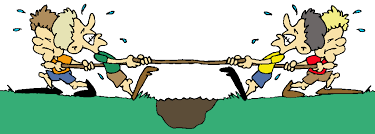
________ can be calculated if you know the distance an object traveled and the unit of time. (distance ÷ time)
Speed
Motion
Opportunity
Velocity
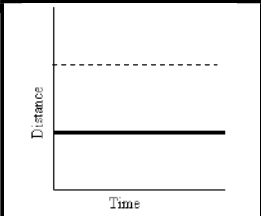
What does the solid line on this graph represent?
Constant speed
Acceleration
At rest
deceleration
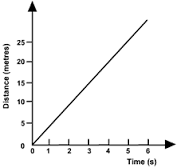
What is the line on this graph showing?
moving away from starting point at a constant speed
moving back towards the starting point at a constant speed
acceleration (getting faster)
deceleration (getting slower)

1st
Law of Motion
2nd
Law of Motion
3rd
Law of Motion
1st
Law of Motion
2nd
Law of Motion
3rd
Law of Motion

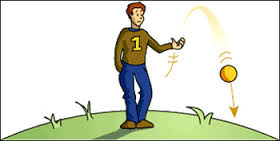

The Law of Inertia
Newtons 1st Law of motion
Newtons 2nd Law of motion
Newtons 3rd Law of motion


What does this motion map indicate?
Forward at a constant velocity
Backward at a constant velocity
Forward getting faster
Backward getting faster
Forward slowing down then backwards getting faster.

What does this motion map indicate?
Forward at a constant velocity
Backward at a constant velocity
Forward getting faster
Backward getting faster
Forward slowing down then backwards getting faster.

What does this motion map indicate?
Forward at a constant velocity
Backward slowing down forwards getting faster
Backwards getting faster forwards slowing down
Forwards getting faster backwards slowing down
Forward slowing down then backwards getting faster.

What does this motion map indicate?
Forward at a constant velocity
Backward slowing down forwards getting faster
Backwards getting faster forwards slowing down
Forwards getting faster backwards slowing down
Forward slowing down then backwards getting faster.

What does this motion map indicate?
Forward getting faster
Backward at a constant velocity
Forward slowing down
Backward getting faster
Backwards slowing down

What does this motion map indicate?
Forward at a constant velocity
Backward at a constant velocity
Forward slowing down
Forward getting faster
Backwards slowing down

What does this motion map indicate?
Forward at a constant velocity
Backward at a constant velocity
Forward slowing down
Forward getting faster
Backwards slowing down

What does this motion map indicate?
Forward at a constant velocity
Backward at a constant velocity
Forward slowing down
Forward getting faster
Backwards slowing down
Newton's Law of Inertia (first law) describes the motion of-
Objects that accelerate

Law of Inertia
Law of Acceleration
Law of Action-Reaction
Law of Gravitation

Law of Inertia
Law of Acceleration
Law of Action - Reaction
Law of Gravitation

Law of Inertia
Law of Acceleration
Law of Action - Reaction
Law of Gravitation

Law of Inertia
Law of Acceleration
Law of Action - Reaction
Law of Gravitation
An object at rest will remain at rest, and an object in motion will remain in motion, unless acted upon by an unbalanced force.
Law of Inertia
Law of Acceleration
Law of Action - Reaction
Force is directly proportional to acceleration but inversely proportional to an object's mass.
Law of Inertia
Law of Acceleration
Law of Action - Reaction
Law of Inertia
Law of Acceleration
Law of Action - Reaction

An automobile you are riding in suddenly stops, but you continue to go forward.
Law of Inertia
Law of Acceleration
Law of Action - reaction

You push against a wall and the wall is pushing back on you.
Law of Inertia
Law of Acceleration
Law of Action Reaction

As the fuel in a rocket ignites, the force of gas expansion and explosion pushes out the back of the rocket and pushes the rocket forward.
Law of Inertia
Law of Acceleration
Law of Action - Reaction
What is Newtons 1st law of motion?
Force = mass x acceleration
An object at rest stays at rest unless acted on an unbalanced force.
For every action there is an equal and opposite reaction
Weight=mass x gravity
Force =mass x acceleration
For every action there is a equal and opposite reaction
Speed = timedisplacement
Force = mass x acceleration
Which force causes an object to speed up or slow down (accelerate or decelerate)?
What is Newton's First Law known as? The Law of ________
Newton's Second Law is also known as the Law of _______
Inertia
Acceleration
Action - Reaction
Gravitation
Which of the following is the correct position - time graph for an object moving with a constant velocity?


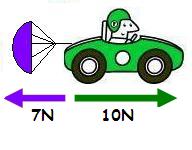
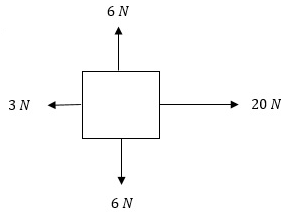
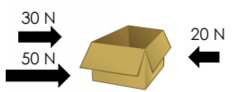
What is the NET FORCE of this diagram?
17 N, right
17 N, left
23 N, right
12 N, up


Calculate the net force acting upon the object.
10N, north
20N, south
10N, south
22.4N, north

What is the net force of the block?
8N, right
2N, right
8N, left
2N, left


Determine the net force and direction of motion:
16 N Right
16 N Left
0 N not moving
0 N left

Determine the net force and direction
20 N up
0 N no movement
20 N down
40 N down

Determine the net force and direction
15 N up
15 N down
0 N no movement
30 N up

Determine the missing force at C:
700 N
200 N
0 N
1100 N

Newton's _____ Law of motion states that every action has an equal and opposite reaction.
1st
2nd
3rd
4th

When a hammer exerts a force on the nail, the nail _________________________________________.
exerts a smaller amount of force back onto the hammer
exerts a larger amount of force back onto the hammer
exerts the same amount of force back onto the hammer
cries and cries and cries

Forces come in ___________ ___________ force pairs.
action, reaction
acting lessons
action, cut
chemical reaction

According to Newton’s Third Law, if someone jumps off a skateboard, the skateboard will roll backward because -
the mass of the skateboard is the same as the mass of the person jumping off.
the pull of gravity on the person is the same as on the skateboard, regardless of size.
the air resistance on the person is great and the friction on the skateboard is small.
for the force that sent the person forward, there is an equal force pushing back on the skateboard.

Which of Newton's Laws of Motion does this Newton's cradle demonstrate?
Newton's 1st Law of Motion (interia)
Newton's 2nd Law of Motion (F=m * a)
Newton's 3rd Law of Motion (action-reaction)

List the three (3) possibilities that an object might demonstrate when subjected to an unbalanced force:
(You must choose 3 answers)
Speed Up
Leave Our Atmosphere
Slow Down
Levitate In The Air
Change Direction

What unit is Force measured in?
Nanograms
Newtons
Kilograms
meters per second

What is the formula for the 2nd law of motion?
a = lw
F = mama
F = ma
F = llama


According to __________, the acceleration of an object is equal to the net force acting on the object divided by the object's mass.
Newton's Second Law
Newton's Third Law
Newton's First Law
Marvin the Martian's Earthlings Can't Dance Law

