
 Worksheets
Yr 8 Biology Revision
Total questions: 98
Worksheet time: 3hrs 16mins
Which do BOTH prokaryotes and eukaryotes contain?
nucleus
mitochondria
ribosomes
cell wall
Bacteria is an example of a(n)
prokaryotic cell.
eukaryotic cell.
What is the basic unit of life that can carry out all the functions of a living thing?
cell
atom
molecule
protein
What type of organisms does the cell theory apply to
bacteria
multicellular organisms
plants and animals
all of the above
Choose all parts of cell theory (more than 1 correct answer)
All eukaryotic cells were once prokaryotic
All cells come from preexisting cells
All living things are made of cells.
Cells are the most basic unit of life.
All cells contain a nucleus

Students use a microscope to look for structures present in four different cells. The students placed an X for each structure that was viewed for each cell on the table shown. Which cell that was viewed is most likely a prokaryote?
Cell W
Cell X
Cell Y
Cell Z
Prokaryotic cells don't have:
Membrane bound organelles.
Ribosomes
Genetic material (DNA or RNA).
All of the above
Prokaryotic
These are small, single cells with a simple internal structure
Eukaryotic
These are larger and more complex with specialized membranous compartments
Unicellular
All Prokaryotes are and Some Eukaryotes can be ..
Multicellular
Only Eukaryotes are...
Bacteria
Prokaryotes include
How would you write micrometers with symbols
mm
μm
microm
none of the above
True or false: Bacteria and plant cells both have a cell wall
True
False
What is the name of the structure which holds the cell and its contents together?
Cell Wall
Centriole
Cell Membrane
Vacuole
The gel-like fluid that fills a cell is called what?
Centriole
Vacuole
Cytoplasm
Plasma
True or false: Both plant and animal cells have a vacuole.
False
True
Bacteria have...
Free-floating DNA
DNA in a nucleus
No DNA
DNA similar to humans
The organelle responsible for plant photosynthesis.
Ribosomes
Chloroplast
Lysosome
Mitochondria
The function of the cell wall is...
Transport nutrients into the cell
Stop water from getting out of the cell
To provide structure and support
Make the cell look good
What is DNA for?
DNA moves the cell around
DNA maintains the shape of the cell
DNA stores the information on how the cell should grow and reproduce
DNA prevents the bacterial cell from drying out
We measure cells in what units?
centimetres
nanometres
millimetres
microns/micrometres
The circular image we can see our specimens on through a light microscope is called what?
Stage
Field of view
Microscope
Light
Which of the following is smallest?
Millimetres
Micrometres
Centimetres
Nanometres
On a microscope, the ........ moves up and down.
Ocular Lens (eye piece)
Objectives
Base
Stage

Which of these lists shows the organisation of living things in the correct order?
Tissue, organ system, organ, cell
Cell, tissue, organ system, organ
Tissue, cell, organ, organ system
Cell, tissue, organ, organ system

What is the name of part 1?
Arm
Eye piece
Objective lens
Stage

What is the name of part 7?
Eye piece
Arm
Stage
Objective lens
On a microscope, if an eyepiece has a magnification of 10 and the objective lens has a magnification of 20, what is the total magnification?
2
30
200
10

When you made the microscope slide with the onion, what did you use to stain the onion
Iodine
Water
Copper sulphate
Ethanol
Convert 35 mm to micrometres
(a)
Convert 8 micrometers to mm
(a)


Chloroplasts are green because they
Reflect Green, Red and Blue light
Absorb Green, Red and Blue light
Reflect Green light, but Absorb Red and Blue light
Absorb Green light, but Reflect Red and Blue light
Both mitochondria and chloroplasts ____
contain their own unique ribosomes that are different than the cells
contain their own unique DNA that are different than the cells
are specialized organelles that capture and release energy
are found in both in plants and animals
Powerhouse of the cell, organelle that is the site of ATP ( energy production ) and cellular respiration in plants and animals.
Nucleus
Ribosomes
Mitochondria
Vacuoles
Increase the surface area available for ATP synthesis
cristae
matrix
inner membrane
outer membrane
The inner membrane of mitochondria is usually , highly convoluted forming a series of infoldings known as
thylakoids
cristae
grana
lamella

The openings that are found in the leaves of plants are called:
Stomata
Chlorophyll
Xylem
Chloroplast
Which of the following equations represents the overall chemical reaction for photosynthesis?
6O2+ 6H2O → C6H12O6+ 6O2
C6H12O6 + 6H2O→ 6O2+ 6O2
6CO2+ 6H2O→ C6H12O6+ 6O2
6O2 + 6H2O→ C6H12O6 + 6CO2
The rate of photosynthesis can be influenced by...
Temperature
Carbon dioxide levels
Light intensity
Oxygen concentration
Temperatures that are too high can slow photosynthesis because
stomata stay open
enzymes are ruined
there is not enough CO2
there is too much water
How many membrane coverings does mitochondria have?
0
2
1
none of the above
What does ATP have that ADP does not have?
Ribose Sugar
Adenine
3 Phosphate Chain
2 Phosphate Chain
There are two types of Cellular Respiration:
Aerobic Respiration (In the Presence of Oxygen)
Aerobic Respiration (Without Oxygen)
Anaerobic Respiration (In the Presence of Oxygen)
Anaerobic Respiration (Without Oxygen)
If prokaryotic unicellular living things do not have a mitochondria, where does Cellular Respiration take place?
Cytoplasm
Nucleus
Ribosome
Endoplasmic Reticulum
Aerobic
Presence of Oxygen
Anaerobic
Absence of Oxygen
Glycolysis
Cytoplasm
Krebs Cycle
Mitochondria
Electron Transport Chain
Inner Membrane of Mitochondria
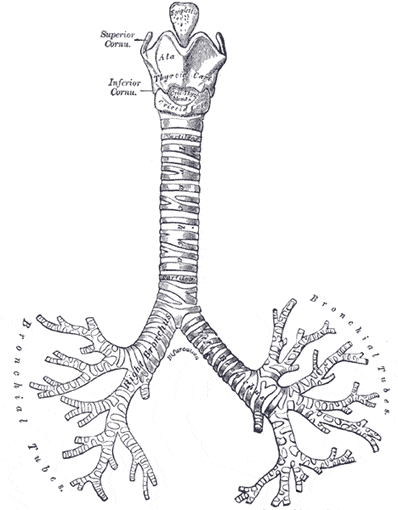
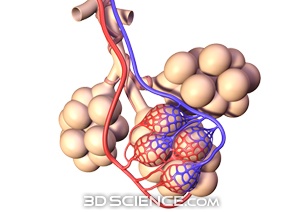
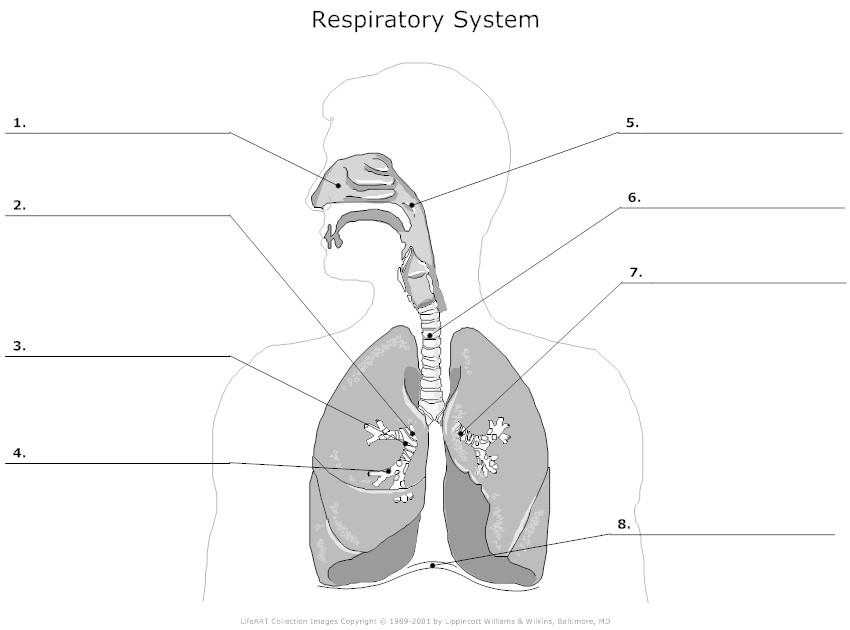
Which is an adaptation to increase rates of gas exchange in the lung?
Small surface area
Dry surface
High vascularization
Muscular alveoli
Where does Oxygen go after it enters the lungs?
it moves to the mouth through exhalation
it stays in the lungs
it moves to the bloodstream through diffusion
it moves to the body cells through diffusion
How does the body remove carbon dioxide from the cells?
The body cells converts carbon dioxide into carbon monoxide
The body cells don't expel the waste, they store them for future use
The body cells expel the carbon dioxide through the use of the nucleus
The carbon dioide diffuses out of the body cells and into the bloodstream due to differences in the concentration gradient
How do the particles move in diffusion?
From a region of low concentration to a region of high concentration
From a region of high concentration to a region of low concentration
From a region of low concentration to a region of low concentration
From a region of high concentration to a region of high concentration
How does the diffusion gradient constantly fluctuate between the bloodstream and alveoli within the lungs?
The flow of the bloodstream carries away the platelets
The flow of the bloodstream carries away the oxygen
The concentration is stable within the bloodstream and alveoli
The gradient is automatically kept constant via the brain
Carbohydrates are broken down into:
Proteins
Lipids
Fats
Glucose

Which letter on the diagram shows an area where the concentration of oxygen would always be high?
A
B
C
D
Which letter on the diagram shows an area where the concentration of oxygen would always be lower?
A
B
C
D
Which of the following things assists the gases O2 and CO2 to diffuse quickly to where they need to go?
Inhaled air is always coming in (with lots of O2)
The blood in the capillaries is always moving through
The alveoli and the capillaries have very thin walls
The red blood cells are very good at carrying oxygen around the body
Which of the following help with mechanical digestion
Saliva
Chewing
Stomach Acid
Muscular squeezing
Which organ churns food and uses acid and enzymes to break down food?
stomach
esophagus
mouth
epiglottis
What connects the mouth to the stomach
epiglottis
pylorus
esophagus
tongue

The teeth and tongue of the oral cavity break foodstuff down physically. This is an example of
mechanical digestion
chemical digestion
absorption
peristalsis
Which organ stores and releases bile?
liver
gallbladder
pancreas
Which organ makes bile?
liver
gallbladder
pancreas
What is the process of wave-like muscle contractions that moves food through the digestive tract?
Pericardium
Peristalsis
Pepsin
Pericoronitis

What are these structures call that are found on the lining of the small intestine?
Gallbladder
Villi
Sphincter
Duodenum
What is the term given to a ball-like mixture of food and saliva that forms in the mouth?
Peristalsis
Mucus
Epiglottis
Bolus

Take a look at this skull. What did this animal more than likely eat?
meat
plants
both plants and animals

Classify this skull as a herbivore, carnivore, or omnivore.
herbivore
carnivore
omnivore

Molars on an animal is used for
whistling.
grinding.
laughing.

Canines on a predator are used for
opening up a can lid.
having a great smile.
digging in the ground.
tearing into the prey's meat.
Deoxygenated blood flows from body parts to ______ of the heart.
Left atrium
Right atrium
Left ventricle
Right ventricle
Small blood vessels that diffuse oxygen, carbon dioxide, and nutrients.
heart
arteries
veins
capillaries
What is the main artery called?
heart
ventricle
aorta
atrium
From which chamber of the heart does blood leave to go to the lungs?
lower ventricle
upper ventricle
left ventricle
right ventricle
Which type of blood vessel carries blood away from the heart?
arteries
ventricles
aorta
veins
The upper chambers of your heart are called ______
atrium
ventricle
vesticle
artery
A _____ is a blood vessel that carries blood to the heart
blood vessel
artery
vein
capillary


The pulmonary artery is the artery that carries the blood to your heart from your lungs.
True
False


What is the vein that carries blood in the heart?
aorta
vena cava
left atrium
right atrium

