
 Worksheets
Magnetism
Total questions: 71
Worksheet time: 36mins
Which of the following is the correct explanation of the electrical motor operation?
Electric motor uses electricity
The operation is based on the principle of electromagnetism
The motor converts electric energy into mechanical energy
All of the above
What do you call an energy-converting system that transforms electrical energy into mechanical movement?
Electric motor
Electric field
Electric generator
Electric plasma
The two poles on a magnet are...
positive and negative
north and south
east and west
up and down
The arrows drawn on magnetic field lines always point...
north to south
south to north
The direction of a magnetic field can be shown using iron filings.
True
False
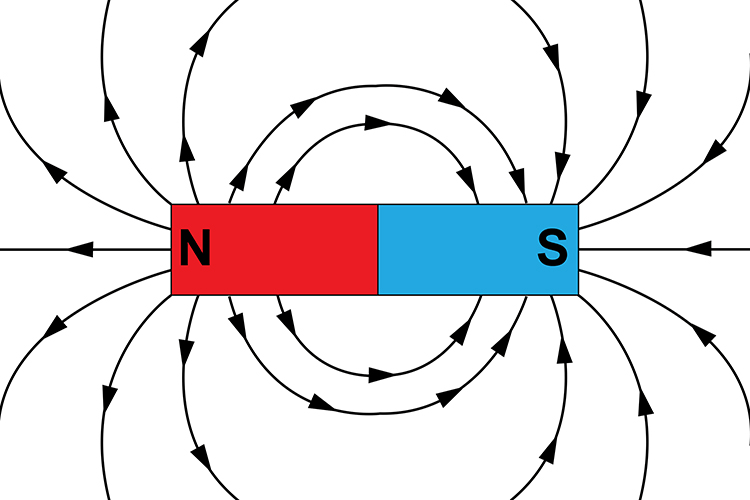
Where is the magnetic field the strongest around a bar magnet?
far away from the magnet
at the side of the magnet
at the poles
above the magnet

When running a current through a wire, what do the blue lines represent?
The wire spinning
A magnetic field that was created
Electrons leaving
Electricity
What would happen is a north pole of a magnet came close to a north pole of another magnet?
they would be attracted to each other
they would be repelled from each other

The area around a magnet is called the .....
attraction zone
work area
magnetic field
hot zone

Why does the compass needle move at different locations?
Because the needle is attracted to the magnetic field produced by the magnet
Because north is up
Because it is being attracted to the Magnetic North Pole
Because north is down

These magnetic domains are:
strongly magnetized
slightly magnetized
unmagnetized

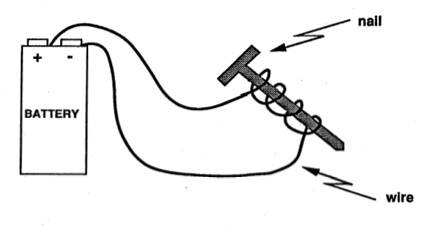
To make this electromagnet stronger you could:
use less wire
have fewer wire coils around the nail
have more wire coils around the nail
use a plastic core


What conclusion can you draw from this graph?
As current increases, magnetic strength decreases.
As current increases, magnetic strength increases.
As current decreases, magnetic strength increases.
There is no relationship between current and magnetic strength.
A device that converts mechanical energy into electrical energy
A. electric generator
B. electric motor
C. electromagnetic induction
D. electric meter

Using the right-hand-slap rule, A represents
The current
The magnetic field
The direction of the force
Using the right-hand-slap rule, B represents
The current
The magnetic field
The direction of the force
Using the right-hand-slap rule, C represents
The current
The magnetic field
The direction of the force

Using the right hand grip rule, A represents the direction of the
current
magnetic field
Using the right hand grip rule, B represents the direction of the
current
magnetic field

Using the right hand grip rule, if the current is flowing towards you then the magnetic fields will flow from...
A to D to C to B and around
A to B to C to D and around
A to C to D to B and around
A to C to B to D and around
Using the right hand grip rule, if the current is flowing away from you then the magnetic fields will flow from...
A to D to C to B and around
A to B to C to D and around
A to C to D to B and around
A to C to B to D and around

In the solenoid pictured, the north pole would be on the
Left side
Right side
In the solenoid pictured, the south pole would be on the
Left side
Right side
Using the right hand slap rule, if the force is coming towards you and the current is travelling upwards then the
magnetic fields are going to the left
magnetic fields are going to the rightt
magnetic fields are going upwards
magnetic fields are going downwards
Using the right hand slap rule, if the force is coming towards you and the current is travelling downwards then the
magnetic fields are going to the left
magnetic fields are going to the rightt
magnetic fields are going upwards
magnetic fields are going downwards
If you brought an unknown pole of a magnet near a North magnetic pole and they repel what is the unknown pole?
North
South
Neutral
not enough information
Using the right hand slap rule, if the force is coming towards you and the magnetic fields are going to the left then the
current is going upwards
current is going downwards
current is going to the left
current is going to the right
Using the right hand slap rule, if the force is going away from you and the magnetic fields are going to the left then the
current is going upwards
current is going downwards
current is going to the left
current is going to the right
Using the right hand slap rule, if the magnetic fields are going to the left and the current is going downwards then the
force is going towards you
force is going away from you
force is going to the left
force is going to the right
Using the right hand slap rule, if the magnetic fields are going to the right and the current is going downwards then the
force is going towards you
force is going away from you
force is going to the left
force is going to the right
Electric current is measured in ____________.
Newtons (N)
Amperes (A)
Hertz (Hz)
Volts (V)
Increasing the number of coils in an electromagnet will _________ the power of the magnet.
decrease
increase
not affect
What three minerals are attracted to a magnet?
Gold, copper, cobalt
Cobalt, aluminum, silver
Iron, copper, aluminum
Iron, nickel, cobalt
What happens if you cut a magnet in half?
Nothing
The magnets repel
There will be two magnets
Which of the following is used to measure very small currents?
galvanometers
ammeters
voltmeters
electric motors
Which of the following is used to measure large currents?
galvanometers
ammeters
voltmeters
electric motors
Which of the following is used to measure voltage?
galvanometers
ammeters
voltmeters
batman
A faster moving charged particle would experience a larger magnetic force than a slower moving charged particle.
True
False
A 2.0 m long wire carrying 10 A of current moves through an 6.0 T magnetic field. What is the magnetic force acting on the wire?
10 N
120 N
0.5 N
2 N
A 2 C charge moving at 15 m/s enters into a magnetic field of strength 5 T. What is the maximum force experienced by this charge?
150 N
150 N into the page
360 N
360 N out of the page
A 5 C charge moving at 6 m/s toward the bottom of the page encounters a 12 T magnetic field pointed toward the right of the page. What is the magnetic force acting on the charge?
150 N
150 N into the page
360 N
360 N out of the page
Magnets are made of tiny sections of magnetic fields that are aligned to produce a larger magnetic field. These are called _____.
magnetic domains
magnetic fields
magnetic sections
electromagnets
A _____ is a device that has a magnetic needle that spins freely. It is used for navigation because its needle usually points north.
calculator
compass
GPS
map
What is Earth Magnetic Field?
is a part of the earth
Is a magnetic field that emanates from Earth's core and encircles the Earth.
i don´t now
it is a magnetic field that causes damage to the planet earth
What is the importance of the Earth magnetic field?
protects us from the damage that the solar wind can cause
protects us from pollution
protects us from lasers
protects us from the damage that the moon can cause
A soft iron bar is inserted inside a current-carrying solenoid. The magnetic field inside the solenoid:
Will decrease
Will increase
Will become zero
Will remain the same
Who was the first to observe the magnetic effect of electric current?
Faraday
Oersted
Volta
Ampere
What is magnetic field?
“The region surrounding a magnet, in which the force of the electrons can be detected ,
“The region surrounding a magnet, in which the power of the magnet can be detected ,
“The region surrounding a magnet, in which the force of the electricity can be detected ,
“The region surrounding a magnet, in which the force of the magnet can be detected ,
The direction of magnetic field developed around a current -carrying conductor can be easily found by the use of
right hand thumb rule
left hand thumb rule
Fleming's left hand rule
Fleming's right hand rule

In the Earth, the magnetic North pole coincides with the....
South geographical pole.
North geographical pole.
The Earth's crust
The Earth's molten iron core
The Earth's mantel
The Sun

What is the difference between a soft magnet and a hard magnet?
A soft magnet is magnetized easily and loses magnetization easily, while a hard magnet is difficult to magnetize but retains its magnetization well.
A soft magnet is a type of electromagnet, while a hard magnet is a type of permanent magnet.
A soft magnet is used for temporary magnetic applications, while a hard magnet is used for permanent magnetic applications.
A soft magnet has a low magnetic field, while a hard magnet has a high magnetic field.
Which of the following materials is an example of a soft magnet?
Samarium-cobalt
Iron
Neodymium
Nickel
Which of the following materials is an example of a hard magnet?
Ferrite
Nickel
Iron
Steel

