Wayground logo

Free Printable Worksheets

Font size

S
M
L
XL
Worksheets

APES Review 1-7

Total questions: 64

Worksheet time: 39mins

Name
Class
Date
1.

Define Carrying Capacity:

a)

The maximum number of species that can be supported in a given environment.

b)

The increase in a number of species over time.

c)

The quality of being mindful of our usage of natural resources, thereby supporting long-term ecological balance.

d)

An environmental event or obstacle that tends to stop or slow down the population size/growth.

2.

Which of the following is a limiting factor: (Check all that apply)

a)

Hair growth

b)

Land availability

c)

height

d)

diseases

3.
These types of power plants are primarily responsible for acid deposition (including acid rain)
a)
natural gas
b)
petroleum
c)
coal
d)
nuclear
4.
Which is NOT an example of biomass?
a)
wood
b)
crop leftovers (the part of the plant that isn't consumed)
c)
manure and/or trash
d)
petroleum
5.
The world gets MOST of their energy through all of the following sources EXCEPT
a)
natural gas
b)
coal
c)
hydroelectric
d)
oil
6.
Nuclear energy generates ________ waste instead of _____________.
a)
radioactive, air pollutants
b)
air pollutants, ash
c)
CO2, uranium ore
d)
radioactive, uranium ore
7.
what is the earliest stage of coal? (this has the least amount of energy and is the youngest)
a)
peat
b)
lignite
c)
bituminous
d)
anthracite
8.
which of these FOSSIL FUELS burns the cleanest?
a)
coal
b)
natural gas
c)
motor oil
d)
petroleum
9.
Most of the developing countries in the world depend on _______ for their main source of energy.
a)
renewable sources
b)
nuclear
c)
biomass (including wood, manure, etc)
d)
coal
10.
Most of the energy that we use on Earth can be traced back to 
a)
coal
b)
the sun
c)
geothermal heat from the earth
d)
natural gas
11.
If a 100 W incandescent bulb uses 400 kJ of energy per hour. How much would a CFL use that is 3 times as efficient IN 30 MINUTES?
a)
66 kJ
b)
133 kJ
c)
200 kJ
d)
1200 kJ
12.
Which region would have the greatest potential for solar technology?
a)
10 degrees north latitude
b)
40 degrees south latitude
c)
35 degrees north latitude
d)
50 degrees south latitude
13.
The major downside to hydraulic fracturing (fracking) is that
a)
the empty spaces left behind can result in earthquakes or buildings collapsing
b)
the equipment that is used is very cheap and often falls apart after a single use
c)
the fracking chemicals could get into aquifers and groundwater
d)
all of these 
14.

What is crop rotation?

a)

Planting different types of crops in alternating patterns

b)

The rotation of crops in a field from one period of time to the next

c)

The transformation of slopes into different steps

d)

Rows planted in a field to slow down the wind

15.

What type of farming is this?

a)

Intercropping

b)

Contour Farming

c)

Terracing

d)

Crop Rotation

16.

What is irrigation?

a)

Flooding plants to the point of suffocation

b)

Synthetically manufactured mineral supplements

c)

Excessive grazing of fields

d)

Artificial provision of water to support agriculture

17.

When roots become saturated with water due to over-irrigation, it causes death in plant roots. This is called:

a)

salinization

b)

desertification

c)

agroforestry

d)

waterlogging

18.

When irrigation water evaporates, salts are left behind on the soil surface and can cause plant death or lead to

a)

soil salinization

b)

desertification

c)

waterlogging

d)

monocropping

19.

This method of irrigation is conducted by creating small parallel channels along the field length in the direction of predominant slope.

(a)  

20.

An economics problem in which every individual has an incentive to consume a resource, but at the expense of every other individual.

(a)  

21.

A method of extracting minerals near the surface of the Earth

(a)  

22.

What is overfishing?

a)

The removal of a bad fish from an environment?

b)

The removal of a dead fish from a body of water.

c)

The over-breeding of fish.

d)

The removal of a fish species from a body of water at rate faster than the species can repopulate.

23.

Which of the following is NOT a benefit of aquaculture?

a)

Reduces risk of fishery collapse

b)

Requires small amount of water, space and fuel

c)

Doesn't take up a vast amount of land space

d)

Fish produce low concentration of waste

24.

Biomes are mainly determined by _____ and ____.

a)

temperature

b)

weather

c)

precipitation

d)

soil

e)

rocks

25.

What do you notice about this climate graph?

a)

temperature is warm year round

b)

temperature is cold year round

c)

dry summers

d)

most rain in the winter

26.

What are some characteristics of rainforests?

a)

lots of trees

b)

high year round temperature

c)

high amount of rainfall

d)

grasslands

e)

low year round temperature

27.

What are some characteristics of tundra?

a)

permafrost

b)

very cold, low average temperatures

c)

lots of trees

d)

small amount of plants

e)

high amount of rainfall

28.

What are some characteristics of a taiga/boreal forest?

a)

coniferous trees

b)

very cold

c)

very hot

29.

What are some characteristics of a tropical grassland/savanna?

a)

warm temperatures

b)

seasonal rainfall

c)

lots of trees

d)

grassland

e)

low average temperature

30.
Which of the following causes Earth's tectonic plates to move?
a)
Energy from the Sun
b)
Magnetic Pole Reversal
c)
Convection currents in the mantle
d)
Faults in Mountain Ranges
31.
What type of event will occur at this boundary?
a)
Earthquake
b)
Volcano Eruption
c)
Tornado
d)
Mountain Building
32.
What type of plate boundary is this?
a)
Plate
b)
Divergent
c)
Convergent
d)
Transform
33.
A divergent boundary occurs when plates ....
a)
Pull apart
b)
Come together
c)
Slide past each other
d)
subducting
34.
What geologic feature/event would you most likely to find at a divergent boundary between two pieces of oceanic crust?
a)
Rift Valley
b)
Mid-Ocean Ridge
c)
Island Arc
d)
Flat land
35.
What geologic feature/event would you most likely to find at a convergent boundary between two pieces of continental crust?
a)
Volcano
b)
Mountain
c)
Rift
d)
Island Arc
36.

When water evaporates, residues of ______ and other minerals that will not evaporate are left behind, making water ______ .

a)

salt; denser

b)

chalk; lighter

c)

silt; warmer

d)

carbon; cooler

37.

The El Niño-Southern Oscillation is a fluctuation in tropical ocean temperatures off the Pacific coast of South America. The warm phase is called ______.

a)

La Niña.

b)

El Caballero

c)

El Niño

d)

La Dama

38.

This Image represents...

a)

Downwelling

b)

Upwelling

c)

Thermohaline circulation

d)

Rip Current

39.
The Coriolis Effect is caused by
a)
Earth rotating around the sun
b)
Earth rotating on its axis
c)
The tides
d)
Gravity
40.

A Density Independent Limiting Factor is a limiting factor of a population that can affect population growth no matter what the population density. What is a density independent limiting factor that can affect the human population growth of North Carolina?

a)

disease

b)

hurricanes

c)

food supply

d)

water supply

41.
What is the carrying capacity of the following graph?
a)
1000
b)
8000
c)
800
d)
600
42.
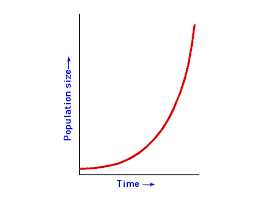
What type of growth is shown in the diagram?
a)
exponential growth
b)
logistic growth 
c)
predator-prey cycle
d)
boom-bust curve
43.

Which of the following is a density-dependent limiting factor?

a)

human activities

b)

unusual weather

c)

competition

d)

natural disaster

44.
If the number of births in a population is the same as the number of deaths in a population, what will happen to the growth of the population?
a)
It will increase.
b)
It will decrease.
c)
It will stay the same.
d)
It will fluctuate.
45.
If the number of births is greater than the number of deaths in a population, what will happen to the growth of the population?
a)
It will increase.
b)
It will decrease.
c)
It will stay the same.
d)
It will fluctuate.
46.

Stage 5 may be a new stage of the demographic transition, raising issues for some populations.

a)

True

b)

False-4

c)

False-3

47.

Stage 1 of the demographic transition has high birth and death rates,

a)

which lead to fast population growth

b)

which lead to slow population growth

c)

which lead to no population growth

48.

In stage 3 of the demographic transition, birth rate starts to fall,

a)

so population growth starts to slow

b)

so population growth starts to speed up

49.

In some areas, birth rates fell when children were forced to go to school.

a)

True

b)

False

50.

Most developed nations are in which stage of the demographic transition?

a)

stage 1

b)

stage 2

c)

stage 3

d)

stage 4

51.

A stage 5 population can be dangerous, as

a)

there is a large aging population.

b)

there is a large young population.

c)

the population has reached its carrying capacity.

52.
Emissions created through human activities are considered
a)
anthropogenic
b)
biogenic
53.
Ozone and acid rain are both pollutants formed through reactions in the atmosphere. This makes them
a)
primary air pollutants
b)
secondary air pollutants 
c)
atmospheric transport
d)
atmospheric deposition
54.
This colorless, odorless gas can be deadly if breathed in. It is produced by incomplete combustion (not enough oxygen).
a)
SO2
b)
CO
c)
NO
d)
NO2
55.
The general term for air pollution that reduces visibility, especially in cities. 
a)
atmospheric transport
b)
pollution 
c)
smog
d)
wet scrubber
56.

Produced by burning fossil fuels

a)

Carbon Dioxide

b)

Sulfur Dioxide

c)

Nitrogen Dioxide

d)

Phytochemical Oxidant

57.
The principal component of smog
Source: Chemical reaction of  VOCs and NOx
Health effects: breathing problems, reduced lung capacity, asthma, eye irritation, reduced resistance to disease
Environmental effects: can damage plants
a)
Pb
b)
CO
c)
SO2
d)
O3
58.

what is a primary pollutant?

a)

it is not directly emitted, but forms when pollutants react in the atmosphere.

b)

a pollutant that is emitted from a source.

59.
What causes acid rain?
a)
High concentrations of sulfuric or nitric acid from pollution
b)
Fertilizer use
c)
Pesticide use
d)
CFCs
60.
Acid rain can damage
a)
Drinking water sources
b)
Aquatic life
c)
Architecture/buildings
d)
All options are correct
61.
Which of the following are greenhouse gases?
a)
Carbon dioxide
b)
Methane
c)
Water vapor
d)
All answers are correct
62.
Dust, ash and pollen are examples of this air pollutant
a)
Lead
b)
Ground-level ozone
c)
Particulate matter
d)
Nitrogen oxides
63.

Which of the following are examples of VOC's ? select 3

a)

paint and paint thinners

b)

gasoline

c)

water vapor

d)

formaldehyde

e)

smog

64.

Which devices trap suspended particles in air by spraying water and other liquids?

a)

wet scrubbers

b)

catalytic converters

c)

cyclones

d)

baghouse filters

e)

pumps